 The good folks at NOVA Next were good enough to publish my article on a new social psychology experiment. Stereotype threat is when someone fears they are at risk of confirming a negative stereotype about their group. It helps explain why women and ethnic minority students underperform on standardized exams that begin by asking for your sex and ethnicity. The researchers I spoke to found that stereotype threat's effect can be reversed under certain conditions, though.
Tuesday, October 6, 2015
On NOVA Next: Stereotype Threat and Biased Testing
The good folks at NOVA Next were good enough to publish my article on a new social psychology experiment. Stereotype threat is when someone fears they are at risk of confirming a negative stereotype about their group. It helps explain why women and ethnic minority students underperform on standardized exams that begin by asking for your sex and ethnicity. The researchers I spoke to found that stereotype threat's effect can be reversed under certain conditions, though.

Thursday, October 1, 2015
Reporting on Brain Implants for Depression
 |
| from WIkimedia Commons, user Andreashorn. |
Friday, September 11, 2015
You Can't Build a Better Tuna
 |
| RoboTuna |
Though over twenty years old, RoboTuna looks
like a freshly caught fish partway through filleting.
Its fabric skin is pulled back to
reveal slender plastic ribs and motor-guts near its head, but the layer of
synthetic scales between ribs and skin still clings to its back half. A wire threads
through each belt of long, thin scales, creating a series of overlapping scale-belts
down its body. Six joints down its spine give it the potential to ripple like a
tuna hurtling after prey. RoboTuna is ready to swim as smoothly as a real fish.
Friday, August 28, 2015
Drones for Watching Beavers and Whales?
Are
drones capable of non-evil purposes? Actually, are they even capable of a use
that doesn’t make them look creepy and intrusive? (I feel that drone engineers
need to do more to make drones that don’t instantly remind me of the Viper
probe droid that the Imperial Fleet sent to spy on the Rebel base on planet
Hoth.)
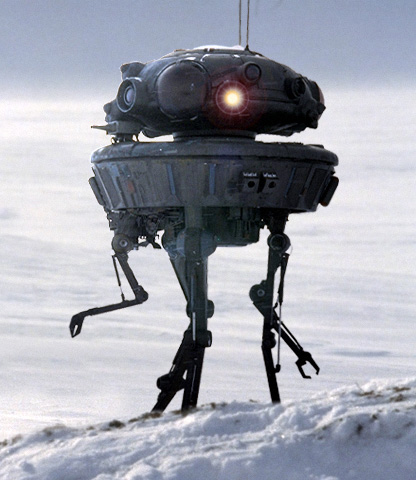
There
is a surprising application for robotic aircraft that gives me a teaspoonful of
hope. In a
paper in the Journal of Unmanned
Vehicle Systems (a journal whose title will always sound creepy to me)
four researchers describe how they used a drone to survey the impacts of a
pair of reintroduced beavers on ecosystem structure.
 |
| Photo by Per Harald Olsen |
Conservationists
in the United Kingdom are engaged in a major project of reintroducing the
beaver to their country. Overhunting forced the species to local extinction as
early as the 16th century. By damming streams and creating ponds and wetlands,
beavers make a huge contribution to local diversity. Amphibians, fish,
arthropods, plants and more all depend on the habitat created by beavers.
This
study observed a pair of beavers brought to a first-order stream in southwestern
England. The drone, a hexacopter equipped with a camera, was able to provide
good images of beaver activity such as gnawed trees and dams under construction.
And with software, the researchers converted these photos to computer models
capable of telling us about hydrology, topography, vegetation structure, and
other interesting landscape variables.
Unfortunately,
the researchers only studied this site after the beavers had done their work,
so they weren’t able to make comparisons to how the site was before the beaver
engineers got to work.
Nonetheless,
what the study suggests will be possible soon is very promising. The drone
method is not just trendy. It’s cheaper than piloted aircraft, and, since it is
low-altitude, it provides higher resolution data. It’s less labor intensive and
faster than doing surveys on foot. You also avoid disturbing sensitive
wetlands, which can be harmed by trace amounts of chemicals or pathogens found
on researchers. The wildlife themselves are less bothered by a quiet hexacopter
than a human or a piloted helicopter. And though the study didn’t mention it, a
programmable aircraft is more rigorous than a human observer. Human estimations
of vegetation parameters is notoriously prone to error.
Lastly,
the drones don’t have a social schedule or a preference for warm or cold
weather, and can be kept to inhumane and demanding survey schedules that even a
seasoned field biologist would reject.
Another
study in the same issue showed perhaps even more exciting benefits to drone
surveys of whales. The surveyors launched the hexacopter from small craft at
sea, where piloted aircraft would have been expensive and unfeasible. Since the
whale pod showed no behavioral changes, the paper concluded that the drone did
not bother them. From a height of 35 meters, the drone’s images showed enough
detail for the biologists to identify each whale by its markings. And, because
the drones can be kept to a constant altitude, biologists can use their photos
of whales to calculate precise sizes and track growth rates for each whale.
Monday, August 24, 2015
Egrets at Columbia Bottoms
This morning,
my mom and I drove to Columbia Bottom Conservation Area for the my last birding trip in the St. Louis region for a while. Just north of the city, stacks of shipping containers and freight warehouses transition in just a few miles to the broad floodplains of the confluence of the Mississippi and Missouri rivers. I had never been to the park before, and was impressed with the shorebird, wading bird, and duck diversity that the broad wet meadows and mudflats support.

After spotting a few Killdeer and Lesser Yellowlegs foraging in a roadside puddle, we were impressed with a flock of over 200 Great Egrets packed in the tall grasses of a marsh.
Neither of us had seen so many egrets in one place before. We set up a scope to get a closer look and see if any Snowy Egrets were tucked in among the others. (They would have black bills rather than orange.) We didn't see any Snowies, but there were at least two Great Blue Herons strutting around the edges of the flock. You can get a fairly high resolution picture by pressing a camera phone up to a spotting scope, though this picture isn't the best example.

We spooked a few Egrets as we drove by.
 Looking to the other side of the road, we saw a large lake lined with a seemingly endless flock of egrets, at least twice as large as the ones nearer to us. You can see them in the distance of this photo as a line of white on the far side of the lake.
We also found a flock of 150+ ducks beside a smaller group of egrets. In their duller non-breeding plumage, they gave us some trouble in identification, but seeing the band of white on the underside of their wings, dark eyestripe, and blotch of white behind the beak (the last two aren't so easy to see in this picture) allowed us to identify them as Blue-winged Teals.

We followed the road until it took us to the Missisippi River. An Army Corps of Engineers pumping station had a large scale for reading the flood level. Strange to think that those heights are plausible; the bank in this photo is already 15 feet above the water level.
Over the last two centuries, engineering projects in general have sought to contain rivers and eliminate floodplains so that they can be settled for homes and farming. The path of the Missouri through the plains used to change drastically year to year as snowmelt and spring rains sprung the river from its banks, reshaping its embankments each season. Millions of amphibians spawned in the huge wetlands created in the thaws, and amphibian predators like the egrets followed in the summer. At Columbia Bottom, the Army Corps of Engineers and the Missouri Department of Conservation have collaborated to restore and protect over 4000 acres of floodplain, allowing us to see a sizable glimpse of an ecosystem type that once stretched for hundreds of miles.
Sunday, August 23, 2015
Selfishness and Sushi
Yesterday
morning a downpour started, so I stepped out to the covered porch and read
about sushi. I had Trevor Corson’s book, The
Zen of Fish, which uses an American woman’s entry to the California Sushi Academy to explore the history and current state of sushi culture.

“In
the mid-1990s, Reiko Yuyama, a Japanese publishing executive, stopped by a
famous sushi bar for a meal. She was alone. Most of the other customers were
men. The chef chatted amiably with the other customers but ignored Yuyama. She
managed to order several pieces of sushi, but after only her fourth piece a cup
of green tea appeared in front of her. Since green tea is often served at the
end of the meal, she took this as a request that she leave. She stayed for an
hour, continuing to order. When she asked for the bill, it was obviously for
more than she’d been served.
“Spurred
by this incident, Yuyama visited many of the best sushi bars in Tokyo and
around Japan, always alone, and described her experiences in a book called One Woman Sushi. Traditional sushi bars
are like exclusive clubs, Yuyama found—difficult for single women and the
uninitiated to enter, especially since there are no menus.
“The
other women Yuyama encountered in the sushi bars were almost always accompanied
by men, and the men used the opportunity to impress their dates with
ostentatious displays of sushi knowledge. …. When Yuyama ordered sushi herself,
the other women glared at her. Yuyama concluded that traditional sushi bars are
the last place in Japan where men still feel completely superior to women.”
This
came as a surprise to me. Stepping into a fairly Westernized sushi shop in
Missouri, I had no idea the role that gender played in this kind of cuisine. I suspected
that California rolls weren’t traditionally enjoyed in Japan. Corson confirmed
this, but also described how Japanese tourists in America sometimes order the
greasier American sushi dishes they can’t get back home. Cultural legacies,
adaptations, and power struggles all acted themselves out in the apparently
undramatic space of a sushi bar. Reading Corson, as with his previous book, The Secret Life of Lobsters, is a trail
of unexpected revelations about apparently commonplace items. So it is too with
other nonfiction writers—David Foster Wallace’s essay “Consider the Lobster”
and John McPhee’s book Oranges come
to mind.
Is
it selfish to write about sushi? About fine food in general, when people are
starving, no less? Thoughts like this bring me to Doctor Zhivago—the scene in which the narrator, a Bolshevik
commissar, comes to warn his brother Yuri, the poet-doctor protagonist, that
his apolitical lyric poetry was putting “a noose round his neck,” in the eyes
of the revolutionary authorities. Yuri asks his brother, “Do you think it’s ‘personal, petit-bourgeois
and self-indulgent?’” The narrator says “I lied” on the voice-over as his past self
nods to Yuri. But fine feelings aside, people were and are starving.
The
short answer: yes, it’s selfish—in the same sense that it’s selfish to discuss
the shortcomings of Western medicine when people go without basic services
elsewhere. However we angle it, we are all trapped in a web of privilege and
injustice.
However,
what allows us to see this web, and therefore, do something about it? For me,
it’s books.
The
goal of great fiction is not only to give someone an in-depth knowledge of
Russian aristocratic drawing-room conventions, the conditions of a Harlem tenement
in the Depression, or the legal details of inheritance in southern England, but
instead to develop a reader’s ability to think critically about the human motives
that created all of these social structures. No, we don’t improve the world at
large a whit by knowing who the Thane of Cawdor was, but we might by being able
to spot someone like him, willing to murder to become the next King of
Scotland.
In
The Zen of Fish, Corson follows two
chefs, Zoran and Tetsu, from the restaurant Hama Hermosa, in their morning trip
to Los Angeles’s biggest fish market, International Marine Products.
“As
they walked through a loading door in the warehouse, they felt the chill of the
huge refrigerated space. The smell of the ocean assaulted their nostrils. Their
shoes squished over a film of frigid water on the plastic floor. Under a high
ceiling, long tables were covered with plastic bins and Styrofoam boxes full of
ice. Zoran nodded to Tetsu and the two men split up. … Shouts in Spanish and
Japanese filled the room. … Zoran eyed the bins. There were sardines, squid,
and barracuda from the waters of California. There were butterfish, tilefish,
skate, and live Maine lobster from the East Coast. There were amberjack,
grouper, and trevally from Australia and New Zealand. From Japan there were
Pacific saury, blue snapper, red gurnard, largehead hairtail, chicken grunt,
and many other fish that didn’t even have English names.”
 |
| Some nigiri and sushi rolls I had recently. |
It’s
fair to question the motives of a writer who’s writing about something they
love—Trevor Corson and his sushi, John McPhee and his rocks—because such a
project can be deeply rewarding work. (As well as exhausting.) But it’s not
fair to question them and then keep eating sushi unreflectively.
Maybe
if we thought deeply enough about our own food we would notice those who don’t
have any for longer than a few seconds. Maybe if we considered the energy
expended in transporting fresh fish from New Zealand to the U.S., we would
think more critically about the possibility of feeding distant nations stricken
by famine. At the least, maybe we would appreciate people who make our sushi
more completely, with a greater understanding of the training and effort it
takes to make something worth eating.
Friday, August 21, 2015
Of Swallow Wings and SUV Windshields
I often
think of high-rise buildings, subways, and dams when I think about
characteristic human changes to the landscape. But in terms of acreage,
high-input agricultural zones have been a more widespread and comprehensive
land use change in the past two centuries. This land use type includes not just
the actual cornfields but also the houses, grain elevators, country highways,
and small towns that support the farming. The cumulative effect has been to
almost wipe out grasslands worldwide, replacing them with an ecosystem with
many different pressures and opportunities than the previous one.
These
changes have measurable impacts on wildlife that are often surprising. Wild
populations do not merely shuffle out of the way when humans come to settle. It
is always a collision. Some are killed in droves like the American buffalo. Others
slowly or steadily decline over many years, like grassland songbirds. And a few
special species are able to adapt and thrive in the new ecosystem.
 |
| Photo by Don DeBold |
Brown
and Brown compared the roadkilled birds to a sample of birds which died
accidentally while the researchers used mist-netting to capture individuals for
study. They saw that the roadkilled birds almost all had longer wings than the
rest of the population. Over the 30-year study, fewer and fewer birds ended up
on the highway shoulder, and the general population’s wings got shorter.
To
understand why short wings help you dodge a Hummer, we have to consider flight
physics. Longer wings lead to efficient flight and shallow, graceful takeoffs
by decreasing the amount of bird mass carried by each square inch of wing. But
shorter, stubbier wings allow for greater maneuverability and more vertical
takeoffs. These sharply angled takeoffs, the researchers believe, are what
allowed the short-winged swallows to launch away from the road surface as a car
approaches more successfully than their long-winged relatives.
While
the outcome has a strange beauty, the process was plainly brutal. The selection
pressure was millions of unforgiving windshields. Roadway traffic kills 80
million birds a year in the U.S. alone. If you look at Brown and Brown’s figures, you’ll see that
even in a moderate year, they and their students collected tens of thousands of
cliff swallow corpses. And these were the cliff swallow casualties only in
their Nebraska study area. Not that the butcher’s bill here is so different
from that resulting from other kinds of selective pressures. Evolution works
through death—new forms arise because less successful individuals die.
Yet
even though we can read the cliff swallow’s story as a success of natural
selection, what stands out to me is how few species have been able to adapt
this well. In the same region, birds such as Henslow’s Sparrow, the Upland
Sandpiper, and the Greater Prairie Chicken have faced severe declines due to
the loss and fragmentation of even marginally suitable habitat. For these
birds, evolution would not be a matter of changing wing length but changing
their entire lifestyle, something that is probably impossible within timescales
meaningful to humans. Are the opportunities that one country highway creates
for Cliff Swallows balanced by the splintering of the remaining lands for
declining and endangered species?
--
Citation
Brown,
C.R., and M.B. Brown. 2013. Where has all the road kill gone? Current Biology
23:233-234.
Subscribe to:
Posts (Atom)