Showing posts with label Notebooks. Show all posts

Friday, September 11, 2015

You Can't Build a Better Tuna

RoboTuna
Here's the first short essay I wrote for the Science Writing program at MIT. As a warm-up exercise, we were tasked with observing an object at a local museum and writing 500-800 words on it.


Though over twenty years old, RoboTuna looks like a freshly caught fish partway through filleting.

Its fabric skin is pulled back to reveal slender plastic ribs and motor-guts near its head, but the layer of synthetic scales between ribs and skin still clings to its back half. A wire threads through each belt of long, thin scales, creating a series of overlapping scale-belts down its body. Six joints down its spine give it the potential to ripple like a tuna hurtling after prey. RoboTuna is ready to swim as smoothly as a real fish.

Friday, August 28, 2015

Drones for Watching Beavers and Whales?

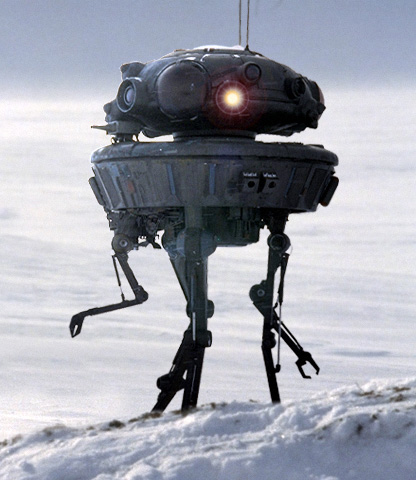
Are drones capable of non-evil purposes? Actually, are they even capable of a use that doesn’t make them look creepy and intrusive? (I feel that drone engineers need to do more to make drones that don’t instantly remind me of the Viper probe droid that the Imperial Fleet sent to spy on the Rebel base on planet Hoth.)

There is a surprising application for robotic aircraft that gives me a teaspoonful of hope. In a paper in the Journal of Unmanned Vehicle Systems (a journal whose title will always sound creepy to me) four researchers describe how they used a drone to survey the impacts of a pair of reintroduced beavers on ecosystem structure.

Photo by Per Harald Olsen
Conservationists in the United Kingdom are engaged in a major project of reintroducing the beaver to their country. Overhunting forced the species to local extinction as early as the 16th century. By damming streams and creating ponds and wetlands, beavers make a huge contribution to local diversity. Amphibians, fish, arthropods, plants and more all depend on the habitat created by beavers.

This study observed a pair of beavers brought to a first-order stream in southwestern England. The drone, a hexacopter equipped with a camera, was able to provide good images of beaver activity such as gnawed trees and dams under construction. And with software, the researchers converted these photos to computer models capable of telling us about hydrology, topography, vegetation structure, and other interesting landscape variables.

Unfortunately, the researchers only studied this site after the beavers had done their work, so they weren’t able to make comparisons to how the site was before the beaver engineers got to work.

Nonetheless, what the study suggests will be possible soon is very promising. The drone method is not just trendy. It’s cheaper than piloted aircraft, and, since it is low-altitude, it provides higher resolution data. It’s less labor intensive and faster than doing surveys on foot. You also avoid disturbing sensitive wetlands, which can be harmed by trace amounts of chemicals or pathogens found on researchers. The wildlife themselves are less bothered by a quiet hexacopter than a human or a piloted helicopter. And though the study didn’t mention it, a programmable aircraft is more rigorous than a human observer. Human estimations of vegetation parameters is notoriously prone to error.

Lastly, the drones don’t have a social schedule or a preference for warm or cold weather, and can be kept to inhumane and demanding survey schedules that even a seasoned field biologist would reject.

Another study in the same issue showed perhaps even more exciting benefits to drone surveys of whales. The surveyors launched the hexacopter from small craft at sea, where piloted aircraft would have been expensive and unfeasible. Since the whale pod showed no behavioral changes, the paper concluded that the drone did not bother them. From a height of 35 meters, the drone’s images showed enough detail for the biologists to identify each whale by its markings. And, because the drones can be kept to a constant altitude, biologists can use their photos of whales to calculate precise sizes and track growth rates for each whale.

I would be sad if the advent of drone ecology would mean the disappearance of human-led field surveys. We probably don’t have to worry about that any time soon. The main thing is to celebrate that we have found a socially and environmentally beneficial use for at least a few of those freaky airborne robots.

Friday, August 21, 2015

Of Swallow Wings and SUV Windshields

I often think of high-rise buildings, subways, and dams when I think about characteristic human changes to the landscape. But in terms of acreage, high-input agricultural zones have been a more widespread and comprehensive land use change in the past two centuries. This land use type includes not just the actual cornfields but also the houses, grain elevators, country highways, and small towns that support the farming. The cumulative effect has been to almost wipe out grasslands worldwide, replacing them with an ecosystem with many different pressures and opportunities than the previous one.

These changes have measurable impacts on wildlife that are often surprising. Wild populations do not merely shuffle out of the way when humans come to settle. It is always a collision. Some are killed in droves like the American buffalo. Others slowly or steadily decline over many years, like grassland songbirds. And a few special species are able to adapt and thrive in the new ecosystem.

Photo by Don DeBold
Cliff Swallows are small, handsome flycatching birds with a blue back and wings, a white belly and a red throat. They create colonies of nests on vertical surfaces made from mud they carry in their beaks. In Nebraska, biologists have been studying the habits of Cliff Swallows for over 30 years. There, the birds are not nesting on natural cliffs but the constructed ones under highway overpasses and roadway culverts. Birds with shorter wings are better able to avoid passing cars, and short wings are now the norm in these cliff swallow populations, according to Charles Brown and Mary Bomberger Brown of U. Nebraska-Lincoln and U. Tulsa. They described their findings in a paper, “Where has all the road kill gone?” published in Current Biology in 2013.

Brown and Brown compared the roadkilled birds to a sample of birds which died accidentally while the researchers used mist-netting to capture individuals for study. They saw that the roadkilled birds almost all had longer wings than the rest of the population. Over the 30-year study, fewer and fewer birds ended up on the highway shoulder, and the general population’s wings got shorter.

To understand why short wings help you dodge a Hummer, we have to consider flight physics. Longer wings lead to efficient flight and shallow, graceful takeoffs by decreasing the amount of bird mass carried by each square inch of wing. But shorter, stubbier wings allow for greater maneuverability and more vertical takeoffs. These sharply angled takeoffs, the researchers believe, are what allowed the short-winged swallows to launch away from the road surface as a car approaches more successfully than their long-winged relatives.

While the outcome has a strange beauty, the process was plainly brutal. The selection pressure was millions of unforgiving windshields. Roadway traffic kills 80 million birds a year in the U.S. alone. If you look at Brown and Brown’s figures, you’ll see that even in a moderate year, they and their students collected tens of thousands of cliff swallow corpses. And these were the cliff swallow casualties only in their Nebraska study area. Not that the butcher’s bill here is so different from that resulting from other kinds of selective pressures. Evolution works through death—new forms arise because less successful individuals die.

Yet even though we can read the cliff swallow’s story as a success of natural selection, what stands out to me is how few species have been able to adapt this well. In the same region, birds such as Henslow’s Sparrow, the Upland Sandpiper, and the Greater Prairie Chicken have faced severe declines due to the loss and fragmentation of even marginally suitable habitat. For these birds, evolution would not be a matter of changing wing length but changing their entire lifestyle, something that is probably impossible within timescales meaningful to humans. Are the opportunities that one country highway creates for Cliff Swallows balanced by the splintering of the remaining lands for declining and endangered species?

--
Citation


Brown, C.R., and M.B. Brown. 2013. Where has all the road kill gone? Current Biology 23:233-234.

Monday, August 17, 2015

M is for Memoir

            I have said some rude things about memoirs. In a creative nonfiction workshop at Truman State, I said that while I had respect for memoirists and had no doubt of their works’ literary quality, I simply had no appetite for the genre myself. I couldn’t understand, I questioned my professor and classmates (many of them ardent memoir fans and autobiographers themselves) one why it was that people described the value of a good memoir in terms of the volume of Kleenex used (usually something around a box-worth.) At that time, I had little tolerance for other students’ belief that confession was the supreme form of communication, instead putting my faith in a kind of literary stoicism. There was place for feeling in writing, but it was better put to use in understanding other people’s experiences or in researching a challenging but beloved subject.

            And I was led to my first book-length memoir, Helen MacDonald’s H is for Hawk, on somewhat false pretenses, or at least ignorance. A science writing professor recommended the title to me, and even once I understood it was not merely a dispassionate book about falconry but the story of how a woman copes with her father’s loss, I thought that I would at least meet this story through the comfortable distance of fiction, not of memoir.

            However, once I realized in the first chapter what I was reading, I had been entranced by MacDonald’s narrative voice so completely that genre seemed beside the point. She begins with a trip to the Brecklands (meaning ‘the broken lands’) as an escape from her scholarly work in Cambridge. She comes upon a pond:

 “The pond was a bomb crater, one of a line dropped by a German bomber over Lakenheath in the war. It was a watery anomaly, a pond in dunes, surrounded by thick tussocks of sand sedge many, many miles from the sea. It was odd. But then, it’s very odd here, and walking the forest you come across all sorts of things you don’t expect. Great tracts of reindeer moss, for example: tiny stars and florets and inklings of an ancient flora growing on exhausted land. Crisp underfoot in summer, the stuff is like a patch of the arctic fallen into the world in the wrong place.”

            MacDonald is adept at seeing how human actions and feral forces interact to create wild landscapes. Her hawk is at once domesticated and wild, the most difficult of raptors to train. She also excels in picking apart our romantic and ultimately false-hearted attempts to preserve or recreate ‘pure nature,’ showing how our beliefs about what is authentic and what is not are changeable and often misguided, unhelpful to human or creature. Instead, she favors whatever actions allow natural beauty to persist, whether it be found on the moors or in suburban Britain.

            In addition to exploring her natural landscape, the landscape of grief for her father, and the landscape within the mind of her goshawk, Mabel, MacDonald also takes a compassionate but unsparing look at the English writer T.H. White, perhaps the only other author to write a memoir centered around goshawk training, The Goshawk. White’s struggles with his own demons guide MacDonald away from self-loathing, and tutor her in how to be a more humane hawk-keeper.

            The language of falconry is enticingly archaic, with inputs from medieval English, French, and Turkish.  A goshawk-keeper is an austringer. A hawk struggling against its jesses, hungry for rabbits, is said to be in yarak. While she walks about the south of Britain, wild-eyed goshawk on leather-gloved arm, as if a figure out of its medieval or at least its Georgian past, MacDonald casts a shrewd eye on lazy neo-nationalism that would label her more essentially English than a recently arrived family from Algeria making their way in London or Manchester. After talking companionably with an older couple about some nearby deer, one of the few successful conversations with strangers she has managed in months, MacDonald is horrified to hear the man say, “Isn’t it a relief that there’re things still like that, a real bit of Old England still left, despite all these immigrants coming in?”

As a University of Cambridge historian with a Scottish name—a culture which at different times has carried the respect of landed gentry and the indignity of backwoods rebels in the eyes of their English neighbors—MacDonald recognizes the fluidity of identity and the dangers of labelling a skin tone, animal-training hobby or an ancestry as more pure than the rest. Indeed, goshawks were extirpated from England in the 19th century and now exist there only as immigrants from the mainland, where they hunt hares that were similarly introduced. So were the deer.

*           *            *

            My problem with memoirs, I realized as I read H is for Hawk, had to do not with the genre but with my expectations for what a book should do for me. Should it only educate, titillate, and make me chuckle? Or was I willing, as I once was when much younger before I knew I had the choice in the matter, to invite a book into the more private circle of close confidants who share their most difficult experiences, as well as their greatest joys? And not through the angled mirror of fiction, the transparent guise of “I have this friend who did this and that,” but in a simple and direct storytelling tone of catching up with a friend after a long absence, eliminating as many illusions and artifices as possible?

            Even when I did not like memoirs, the notion that autobiography is self-serving cut no ice with me. How much more would we all strive for moral clarity and good service to others, if we knew that we would at some point call ourselves to account in a novel-sized analysis of our greatest choices? How much have we gained, in a mere documentary sense, from the countless diarists of past ages? And in this case, how much damned good nature writing would we lose if we refused to listen to the personal narrative within which it exists, which created it?

            I am grateful for MacDonald for introducing me to the surprising and beautiful world of goshawk training and the craggy English landscape. But most of all, I am grateful that I can believe, at least in some sense, that I have gained a friend through her work—that I have communicated forthrightly with another person and have expanded my circle of confidence with her book.

Friday, April 24, 2015

The Novelist's Eye View of Conservation and Climate Change: An Exchange


A Downy Woodpecker [photo by Marisa Gearin]
After we read Jonathan Franzen’s essay “Climate Capture” for biology senior seminar, I demanded that Jim Santel, my good friend and committed Franzenian, read it, too. He suggested we have a little scholarly discussion about the piece, and what it means care about wildlife in our fragmented age. Currently senior writer at the Robert F. Kennedy Center, Jim is an absurdly successful essayist and fiction writer whose work has appeared in The Wall Street Journal, The American Scholar, The Believer and the LA Review of Books. He blogs at Traction. He foolishly allowed me the last word here.

Jim,

Science is about skepticism, and that’s what makes it so valuable, beautiful, and hard. It fits well into an essay when things appear as tidy opposites—when just a small cost increase would buy special glass to reduce bird window-strike mortality, but the bad men don’t buy it to save costs. But I work with an ornithologist studying window-strikes. He’s skeptical about the techniques currently marketed to reduce such bird deaths, and hopes to experiment with them to find out if any truly work. It might turn out that the one act we think would restore balance to Middle Earth might not save a single hobbit.

In “Carbon Capture,” a recent piece in the New Yorker, novelist Jonathan Franzen offers a corrective to our “Puritan” focus on climate change to the detriment of more immediately impactful conservation efforts. His opening gambit is convincing: when the Vikings built their new glass-walled football stadium, the Minneapolis Star Tribune’s Jim Williams argued that it was worthless to worry about the thousands of birds projected to die from striking the glass walls when “the real threat to birds was climate change.” Williams seemed to be drawing from a contemporary report from the National Audubon Society stating that climate change was the “greatest threat” to American birds, even though the apocalyptic date for this threat was 2080. Arguments like this allowed the sponsors to decline increasing the cost of the project by one tenth of one percent to install specially patterned glass that could have helped prevent bird deaths.

As a polemic, Franzen’s essay is successful in getting his readers out of the rut of worrying about climate change and forgetting about the issues close at hand. It’s not that we shouldn’t worry about climate change—it’s that not driving to get groceries doesn’t get you five minutes less time in climate change purgatory. You should focus on “helping something you love, something right in front of you, [where] you can see the results”—for the sake of our own inner peace, and for the birds.

But first, a word of reproach. In criticizing the Audubon’s climate change PR tactics, Franzen puts scare quotes around “citizen science data,” as well as “report,” and scare quotes seem to be implied around ‘scientists’ in the phrase “its own scientists.” While it is true that a report from a nonprofit is different from peer-reviewed literature, Franzen would do well to remember that those individuals are actual scientists, and that online citizen birdwatcher data—often collected by people with more experience than he—has made possible continental and global population monitoring.

Being someone “who cares about birds more than the next man” does not qualify one to make sweeping generalizations about bird biology and responses to climate change. Ornithologists with PhD’s are not exempt from this—the only difference is that there’s more pressure on an ornithologist to cite her sources and provide convincing evidence than there is for a science journalist. Franzen’s claim, early in the essay, that “North America’s avifauna may well become more diverse,” is the sort of marginally acceptable evidence used in a polemic. The range expansions from climate change we have seen are not good ones, not ones that increase biodiversity: mosquitoes moving up mountains and armadillos tearing up the southern United States. Franzen conveniently overlooks the utter havoc that would likely result if tropical species expanded their ranges into temperate North American ecosystems, and the possibility of next-to-irreversible loss or alteration of northern habitats that are dependent on particular climactic conditions.

A dose of humility, in other words, would be refreshing.

If it matters, I agree with Franzen that some models based on range-shifts have overestimated the impacts of climate change on bird populations. But I would only go so far as the cautious correctives written by those with the data: Dawson and colleagues in 2011, or Millar and Herdman in 2004, for example. Vertebrate responses to climate change was the topic of a literature review I wrote for a class last spring. I cited 17 sources in that paper, and still sometimes think of how my teacher, a seasoned ornithologist and evolutionary biologist, recommended I should have included more studies, more systems. I do wonder how many peer-reviewed articles Franzen read for his essay, and how many he thought was enough.

But after his arrogance plays out, Franzen stays and listens to longtime conservationist Daniel Janzen later in the piece. This tropical ecologist acts as a sort of doppelgänger for Franzen—instead of devoting his life to fiction like Franzen, Janzen and his wife Winnie Hallwachs have spent “nearly half [their] lives” creating the Area Conservation de Guanacaste (ACG) in Costa Rica, a massive reserve that includes much of the tropical dry forest remaining in the world. (Aside: Franzen makes the comment that “the forest in Santa Rosa seemed desperately dry to me,” aware that he is visiting a dry forest in the dry season. He next concludes all cows in Scotland are brown.) Listening to Janzen’s stories about the many struggles of ACG—“the story of Oliver North’s airstrip for the contras … the story of Janzen’s discovery that dry-forest moth species spend part of their life cycle in humid forest, and how this led him and Hallwachs to expand the scope of their already ambitious project … the story of how Janzen and Hallwachs learned to do business with multiple landowners simultaneously”—leads Franzen to his most admirable idea: that conservation work “is novelistic.” It is about narrative, and “no narrative is simple.”

My time in the company of ecologists could be reduced to this elegantly simple idea. The traditional scientific manuscript format is also known as a “narrative report”—it tells a complex story. Here’s what we thought at first, here’s where we are now, and here’s all the weird shit that happened in between. And the usually unspoken reality is that ecologists fall in love with their subject, and that this and only this can sustain a worthwhile career. It is this close association between fiction writing and conservation that allows me to continue on a trajectory towards becoming a full-time biologist rather than a full-time writer, and I thank Franzen for his flawed but beautiful reminder of what it is I think I’m doing with my life.

But if I see him, the first thing I’ll say is that you don’t “census” birds, you survey them. (You can never detect every individual.) It matters.

*          *          *


Conor,

You have the virtue of being both scientist and writer; I can lay claim only to the latter title. Still, as someone who has spent more time thinking about Franzen than the next man (har har), I was intrigued by his argument that our fixation on the “eschatology” of climate change has come at the expense of more traditional conservation efforts—that, in environmental terms, we’ve allowed anxiety about the future to license indifference to the present.

The essay bears many Franzonian hallmarks: a certain arrogance, which you have deftly identified; a seductive either/or argument that suffers under scrutiny; a rueful faith in mankind’s ability to somehow stumble through the end times; and a tendency toward contrarianism.

Along with his significant novelistic success, these are the things that drive people nuts about Franzen. As an unabashed fan, I admit to wishing he would avoid the clumsy scare-quoting that you identify. From what I can tell, Franzen is a pretty knowledgeable birdwatcher, and he was also a devoted high school science student. You’re right: he ought to know better than to denigrate researchers whom he should probably consider allies. (A separate bad science question: Franzen quotes Don Alberto, a leader of an indigenous Colombian community, as saying that the sun feels hotter to him in recent years. Without question, Franzen accepts Don Alberto’s testimony as a sign of a warming planet. That’s not really how climate change works, is it?)

I think the weakest part of the essay is the either/or argument; a professor responding to Franzen’s essay in the April 20th New Yorker called Franzen’s opposition between conservation and climate change a “false choice.” Your post gets at the same point, and it confirmed some of the doubts that arose in my mind as I read the essay. Is there really demonstrable evidence that climate change has diverted resources that would have once gone to what Franzen conceives of as “pure” conservation activities? Is there really a division between the two?

The nut of Franzen’s argument is that such a cleavage does exist: that climate change is a “done deal,” and that, in the absence of the kind of intergovernmental efforts that are required to make a real dent in climate trends (sorry, Prius drivers), we ought to do more to mitigate its immediate efforts. As Franzen puts it, “We can dam every river and blight every landscape with biofuel agriculture, solar farms, and wind turbines, to buy some extra years of moderated warming. Or we can settle for a shorter life of higher quality, protecting the areas where wild animals and plants are hanging on, at the cost of slightly hastening the human catastrophe.”

This dichotomy in turn rests on an argument about human nature, an argument that I found compelling. Basically, it goes like this: we now know that climate change is so large a problem that only massive governmental action can make a difference. This knowledge, coupled with the abstract quality of climate change that Franzen rightly identifies, makes us somewhat fatalistic about the prospects of reversing the effects of global warming: Governments aren’t likely to act, so what can I meaningfully do about rising tides and melting glaciers? The answer, of course, is nothing—and the cruel joke is that my indifference is precisely what makes my government less likely to act (and the American government is the key player here; without meaningful action by the United States on carbon emissions, the international community isn’t likely to do much). As Franzen writes, summarizing Dale Jamieson’s book “Reason in a Dark Time,” “…America’s inaction on climate change is the result of democracy. A good democracy, after all, acts in the interests of its citizens, and it’s precisely the citizens of the major carbon-emitting democracies who benefit from cheap gasoline and global trade, while the main costs of our polluting are borne by those who have no vote: poorer countries, future generations, other species. The Amercan electorate, in other words, is rationally self-interested.” 

This is a cruel spiral in which to be trapped, and if my own experience is any indication, Franzen is right about the despair that this helplessness can engender. In high school, when I’d been reading Elizabeth Kolbert’s landmark New Yorker essays about the impending catastrophe of climate change, I believed that if we all just recycled and drove hybrids, everything would be all right. Today, I understand the utter futility of that position. (“The problem here,” Franzen says, “is that it makes no difference to the climate whether any individual…drives to work or rides a bike.”) I still recycle, but without the hope that used to accompany dropping my completed New Yorkers into the blue bin.

I don’t think I’m alone in feeling powerless against climate change, and this is what makes Franzen’s argument so hypnotic. I agree with you that the high point of the essay—the point where Franzen, as one of our leading novelists, has something truly unique to contribute to the discussion around environmental decline—is Franzen’s discussion of the relative narrative characteristics of conservation and contra-climate change efforts. This is the kind of language that my English major self finds too often lacking in our scientific discourse (and, for what it’s worth, it’s the kind of language that you are uniquely equipped to bring to our scientific discourse, my multi-disciplinary friend).

Climate change, Franzen argues, is a “story [that] can be told in fewer than a hundred and forty characters: We’re taking carbon that used to be sequestered and putting it in the atmosphere, and unless we stop we’re fucked.”

This is the story I’ve succumbed to since high school. It’s both harder and easier to tell oneself this story, at once depressingly hopeless and perversely liberating. “Climate change is everyone’s fault—in other words, no one’s,” Franzen says.

But I wonder if Franzen is too quick to wave the flag of surrender. Of the three letters that the New Yorker printed in the April 20th essay in response to the essay, one from Jane Alexander, an Audobon Board Member, caught my attention in particular. Alexander contends that “Climate change is not, as Franzen writes, an abstract idea. Each of us experiences global warming as a local, and visceral, phenomenon—as drought, typhoons, snow, melting ice, or rising tides.”

This story—the story of climate change as indeed my problem—is the story that is lost as soon as we get too sanguine about climate change as a fait accompli. By rehearsing this story—and, it should be noted, by only interviewing people in South America—Franzen inadvertently reinforces this story. The alternate tale—that no, I’m not off the hook, and that yes, climate change is touching my life in immediate, painful ways (in, for instance, the ways it affects the birds that nest in my back yard)—has yet to be told successfully, Al Gore’s efforts notwithstanding. But that doesn’t mean we should stop trying to tell it.

*          *          *


Jim,

You’re right to point out that scientific prose often lacks in storytelling quality. But in most cases, this is intentional—scientists’ skepticism makes them very cautious about adopting a narrative to explain the data. Only with extensive testing and independent confirmation do they begin to believe in their own stories. Certainly without having hunches, no one would try anything new. But unlike you and me (I don’t feel like I’ve earned my science stripes quite yet), these people ruthlessly poke holes in their own ideas for the sake of trying to get at realities outside themselves. These realities can be boring, bizarre, or otherwise counter-intuitive. Often, telling a story too early, even a good one, can lead to a wrong conclusion.

The task of a science communicator writing for a broad audience, I suppose, is to tell a story about what we know so far, or how we’ve gotten where we are, without trampling over the uncertainty that remains. And while narrative can be crucial, I think the currency of science communication is metaphor—that bridge between what readers know and what they are about to imagine. As a poet and a science journalist, I’m intensely interested in this bridge.

And I think you have a great point about the essay that still needs to be written about climate change in our backyards. I wonder if you’d agree with me that the reasons for this lack have to do with our imperial economics. Like debilitating manual labor, we’ve outsourced the current effects of climate change to developing nations and impoverished regions: the tropics, Siberia, the lower 9th ward of New Orleans. Its most immediate effects (increased storm frequencies, higher average temperatures, and sea level rises) are not felt in the temperate climate of Franzen’s backyard, but are felt in real ways on the margins—in latitudinal extremes and the tropics. So even though science doesn’t work that way, perhaps Don Alberto does know more about climate change on an experience level than you or I.

Sunday, December 14, 2014

A Brief History of the Die-in

As a student of historical nonviolent movements, the protests in Saint Louis have an academic as well as a personal connection for me. In particular, I am interested in the language of protest. It can differ greatly by location and time period. In many places, a particular color has a deeply woven cultural meaning of resistance—yellow in the Phillipines, green in Iran, orange in Ukraine. In other movements, a particular kind of demonstration has become the signature of the movement—the boycotts and marches in the Civil Rights movement, the salt tax protests in the Indian independence movement, and the occupation of Tahrir Square in Cairo’s Arab Spring. However, these different forms of language have a similar goal: by wearing a certain color or taking a particular action in a highly public manner, nonviolent protesters aim to demonstrate their rejection of an unjust system, and the system’s inability to stop them from doing so without resorting to violence.

So far, the signature action of the Ferguson protest movement, other than the ‘hands up’ gesture, has been the die-in. As organizations have begun to struggle for control of the leadership of the current movement, I think it is important to bear witness to the Saint Louis roots of this particular demonstration. It is also a fascinating case-study in the spread of nonviolent tactics and the results of activism.

A little over a week before the grand jury decision announcement, Saint Louis-based activist groups were continuing their months-long campaign of protest. Though cable news attention had waned once the minority of criminally violent demonstrators had moved on, nonviolent protests continued unabated from August to November, with a peak of activity on the weekend of Oct. 11-12, dubbed “Ferguson October.”

According to the St. Louis American, on the afternoon of Sunday, Nov. 16, two groups of protesters, including members of Tribe X and Missourians Organizing for Reform (MORE) marched in University City, meeting in front of the Tivoli Theater on the Delmar Loop. After several minutes of chanting, some of them mimed holding a gun and shooting the others, who fell to the ground. Others traced chalk outlines around the ‘bodies.’ Laying in the street for 4.5 minutes, they mimicked the 4.5 hours that Michael Brown’s body lay on Canfield Ave. after he was shot. By blocking traffic and speaking over a megaphone to pedestrians, the protesters interrupted daily life and the normal flow of commerce in a business district. Delmar Blvd. is also culturally significant, as it represents the current line of segregation between white and black neighborhoods in St. Louis, according to the BBC (also see this write-up by the St. Louis Beacon). The Loop, therefore, is a liminal space in which this segregation can be challenged.

Video by the St. Louis American.

That evening, just hours after the protesters had dispersed, the New York Times put a photo of the die-in on the website’s front page.


Suddenly, the die-in was on track to spread virally. The Monday edition of the Times also featured this photo. However, it is important to consider that the activists strategically manipulated to get national coverage of this action. While the cable cameras had retreated, newspaper reporters from the Times, the Washington Post, and the L.A. Times remained. By beginning with a march, they made sure the reporters knew where they were headed. They chose a highly photogenic action that looks good on a front page and is easily replicated by other groups. Though these choices, the organizers created conditions that nearly ensured national attention.

Since then, the die-in has spread nationwide. Most recently, medical students around the country held campus die-ins while wearing their white coats.  They often target highly-trafficked spots such as malls, large roads and interstates, and public squares.

A St. Louis Post-Dispatch reporter, Nick Pistor, recently claimed on Twitter that the die-in “has officially become a pop culture thing.” I think there is an important distinction between “widespread” and “pop culture.” Pop culture is never dangerous. Demonstrators, especially people of color, take very real risks participating in die-ins, ranging from verbal abuse, to arrest for unlawful assembly, to violent police response. The Saint Louis activists created a word in the language of the current movement that, wherever spoken, continues to challenge racism and promote solidarity among groups throughout the country.

Thursday, October 3, 2013

Index Columns: Truman and Conservation

Last Thursday, I wrote about problems with Bear Creek, the stream that runs through Truman's campus, which the EPA considers an impaired stream. Today, my column considers the benefits of creating a wildlife watching license, as other states have done, that would allow birdwatchers to pay into conservation, which is traditionally supported by hunters and fishers alone. Again, apologies for the lack of paragraph indentation or spacing on the Index website ... Also, the website's teaser for my column describes me as an "enthusiastic" birdwatcher. I don't remember providing such an adjective.

Sunday, August 11, 2013

The Text, the Book, and the iPad

For your consideration: a thoughtful, concise editorial notebook from Verlyn Klinkenborg of the Times trying to parse through the nature of reading books on e-readers, and what may be lost. It's something we have all thought about, but I think it bears further discussion. Like him, I'm divided on the issue, more so than I have been in the past. In my polemic high school journalist days, I would have said that taking away a physical book and replacing it with electronic text is excising one brick from the temple of literacy, and other such wounded, sorrowful expressions.  However, could e-readers make books more affordable? Could they help us share beloved passages more quickly? Could they reduce our use of trees? Could they help create a more democratic, competitive market for writers? Some of the answers are clearer than others.

Yet for my own part, physical books have acted not just as monuments to the achievement of reading a book, but as a concrete way of organizing the landscapes, characters, and stories of a particular reading experience. As Klinkenborg says, the book's physicality is a "constant reminder," peculiarly alive, mysteriously like the presence of a friend. Not to mention that I have great appreciation for the art of typography and layout, the particular makeup--even, if we were to be rather Victorian for a moment, the physiognomy--of a book that make it memorable and contribute to the book's personality along with the author's words. The decision of the layout editors and jacket designers are meaningful, and comparable to the director's arrangement of artwork in a museum or the approach to a piece of music chosen by an orchestra conductor.

If you showed me a page of semi-recycled paper with Garamond typeface and chapter names with dagger-like serifs, I would know without having to read the words that I was looking at a Harry Potter paperback. If I saw a tall glossy page with Caslon body text and wacky Art-Deco headlines, I would know I was seeing a page from the New Yorker. At least in our current culture of literacy, a connection of touch as well as thought that binds the reader to the text. For a dose of literary piety, look up copies of the galleys and proofs passed between Elizabeth Bishop and the New Yorker to see the amount of work that goes into the typesetting even for a single poem. (I don't provide a link partly because I can't find one, and partly because I want you to engage the blessed difficulty of books and libraries.)

Seeing the Book of Kells this summer in Dublin was a powerful new point in my understanding of books. The library of Trinity College only displays one spread each from the two folios of the Book of Kells, but any page is a calligraphy performance and a display of the miniaturist art of illumination. In addition, the monks that copied the Gospels into these books would sometimes, when visited by a thought, write down a small poem about their lives in the margin, further personalizing the book and creating some of our first examples of written vernacular poetry. Within this highly energized culture of printing from our past, single letters became stained-glass windows.

I have not been awed by or befriended texts I have read online. Indeed, I have struggled to maintain even a mere civil acquaintanceship. Reading Henry James' novella Daisy Miller and Edith Wharton's not-so-short-stories online dried my eyes out and gave me headaches. I was inclined to blame the authors for this suffering, to damn them for their massive paragraphs and lack of pagination, even though the printed copies the authors intended would have solved those problems. I do not have an iPad or e-reader, but I have seen how their darkened screens and attractive typefaces make the experience easier on the eyes. Yet there is no invitation to dog-ear, to bend the spine to favorite passages, to jot colloquies with the author or characters into the margins, to make the book irretrievably yours as a printed book offers. Still and all, maybe we will see the day when the craft of electronic printing matures enough to rival the craft of printed texts.

Monday, January 28, 2013

The Know-Nothing Consumer


One day I was having lunch at my usual dining hall at Truman. Whipping a glass for milk out of the glass-tray (with a small, habitual, careless flourish that is sure to destroy a glass or glasses someday) I approached the milk dispenser. There are little labels for “Skim,” “Chocolate,” and “2%,” and also little labels that say “Full” and “Empty.” To my satisfaction, I noted that the 2%, my milk product of choice, was labeled “Full.” I confidently pushed up the lever, but found that only a dribble of milk descended from the spout. “What the devil are they about, labeling this ‘Full’?” I demanded (silently. Suspecting dining hall workers of malice is unfortunately an occasional pastime of Truman students.) “It is clearly not full, not by any measure.” I began to walk away, but then some neurons in my brain made a sudden and astounding connection: the “Full” and “Empty” labels were two-sided—they say “Full” on one side and “Empty” on the other. And yet the insight went even deeper: I realized that it is not the cafeteria workers but the students who are expected to flip the labels when a milk dispenser runs out, because, of course, they are the only ones who would know that.

This experience, in which I was a necessary (and defective) component of an economic activity, ended up being quite eye-opening. I began thinking about other things I did not understand. I could think of quite a few. You see, like most people my age, I live in an economy in which I as a consumer am not expected to know anything. I don’t need to know how to fix a car because we belong to AAA. The auto shop people can decode those mysterious orange lighted symbols mean on my dashboard. (Is that really what an engine looks like?) I don’t have to count out bills for most transactions because I use a check card. Think about that one for a moment: I don’t have to count. I don’t have to know the roads of St. Louis, Kirksville, or any other city, because I can look on Google Maps or borrow a GPS from my parents. The development of my cooking skills has been ponderous at best, due to fast food, freezer food and college dining halls. I don’t have to know how to fix my computer—either the ITS department or my dad can figure it out. And I didn’t have to pay attention to the labels on the milk dispenser—until at last they betrayed me. The architecture of our economy is designed to coddle young consummate morons such as myself, whose ignorant money leakages are enormously profitable.

Our parents had to know less than their parents, and we know essentially nothing. Examples of the helplessness of our generation in basic life activities abound. Tonight, while studying in a dorm, I printed off a guide for my genetics lab tomorrow morning. I galloped down the stairs to the lobby printer, confident that I would find the guide waiting for me there. It was not. The desk worker suggested to check if I had printed to the right printer. “Have I really done that again?” I asked myself. “Surely I checked before I impulsively clicked print.” I had not. In fact, when I brought up the print screen again, the selected printer was located in the library, a 5-minute walk away.

I set out for the library. When I got there, I found the first-floor printer belching out a six-page document every 15 seconds. All print jobs have a cover sheet with our serial username. The cover sheets showed that these were all coming from the same person. One of my friends was stacking the documents on the printer, anxiously waiting for her own papers to show up. Then I realized that I had not checked which library printer I had printed to, and that it was probably the second floor printer. I went upstairs and found my papers. Delighted, I returned to the first floor. The printer was still vomiting papers as if it had a sort of pulpy stomach flu. There were now a few nervous people standing around the printer. I offered to go explain what was happening to the students in the ITS office upstairs, one of those islands of experts to which we are continually having to hop so we can have our problems solved. But suddenly the printer started printing out other people’s papers. My friend left without ever getting her paper.

I’m willing to bet that the student who printed out a septillion of copies thought that he or she was only printing one. But the darn thing wasn’t coming out at the dorm lobby printer in front of which he or she was standing, so the ‘Print’ button got irritably clicked a few more times. And then a few more times.

It all just makes me wonder: first it was misunderstanding the milk system in the servery. But what will it be next time? I operate all sorts of complex and even dangerous machinery—a coffee maker, a car, a razor, a computer. What if next time I can’t just cross the room to the other milk dispenser? What if next time I’m faced with the certain disaster of having to rely on my own abilities? But that, of course, will never happen.

Saturday, August 18, 2012

Why Do You Talk So Much, Robert Frost?


I wonder about the trees.
Why do we wish to bear
Forever the noise of these
More than another noise
Thousand Hills State Park, Kirksville, MO
So close to our dwelling place?...
They are that that talks of going
But never gets away;
And that talks no less for knowing,
As it grows wiser and older,
That now it means to stay…
I shall set forth for somewhere,
I shall make the reckless choice
Some day when they are in voice
And tossing so as to scare
The white clouds over them on.
I shall have less to say,
But I shall be gone.”
—Robert Frost, “The Sound of the Trees”

The above poem is the bookend to the collection originally published as Mountain Interval, now known by its more marketable, recognizable title The Road Not Taken. In it, Robert Frost ruminates on beginnings and endings (“there are no such things./ There are only middles”) the challenge to have both a past and a future, the mixed results of technological advances (telephone poles, forsooth!) and the mysteries of nature, of things that both grow and stay the same.

Another crop of young people are becoming freshmen at college now. As with last year’s crop, which I belonged to, there is not so much a wide spread to how these people respond to this event so much as enormous disparity between them. To those who speak of extreme excitement, of straining at the limits of patience, of the certain excellence of the coming months: I raise my glass in respect and appreciation, but I really don’t understand how you feel this way. Not that I see anything wrong about that reaction. But to those who react with more uncertain sentiments, with enormously long Facebook statuses lavish with thanks for what they have been given with perhaps a dubious word or two at the end about the promise of the future: to you, a heartfelt and hearty “cheers.”

I sympathize who can see with some clarity what they are leaving behind and who cannot see at all what they are going to are faced with feelings they may have never felt before. With their minds they understand what is necessary and good about going away to school; with their hearts they ask what the sense is in leaving something good for something else, and grapple with the stunning amount of unknowing that confronts them. If their feelings are anything like mine were, of course, this is only a single thread in the Gordian’s knot of things they think, feel, and wish right now. They are making the sounds of Frost’s trees, of Frost himself, the songs of staying and going that rise and fall and never resolve.

I merely hope that they do not split this knot artificially, like me and others—that they do not respond to a question by cutting it apart, but give themselves enough time to unwind each strand. In that time of uncertainty last year, I demanded a quiet hope to act as an immovable fact.

But seeing things like those long thankful Facebook statuses is undeniably a good sign. They know that they ultimately don’t know how to respond to the enormous questions that now beat at their doors. But this causes them to speak and to write, and for that I am thankful.

One thing I’ve found is that there is no truly helpful advice for college, and a lot that's just annoying ("Plastics!"); the only accurate thing you can say is that there are no answers to those questions, and won’t be for a while. But unknowing need not be fatal, nor any of the answers that may yet grow in its fertile soil. And this growing takes more time than we are normally willing to allow.

But those are only the words of another tree talking of staying and going. And words are always offered in abundance to people about to leave for college, from aunts and uncles, teachers, friends—so I do not pretend to be adding much of anything. We are always motivated to say things to what they perceive to be younger versions of ourselves, the things we think we needed to hear then, even if we are speaking the answers to questions that belong to us and not to them.

No matter who hears, though, we must keep talking. It's more for ourselves than for anyone else, but occasionally you hear something that, while not really an answer, clarifies the challenge you face. There have been a couple old, gnarled trees, like Frost, that have been helpful to me in this way. Another is the German poet Rainer Maria Rilke, who wrote to someone in which he recognized his younger self:

“You are so young, so before all beginning, and I want to beg you, as much as I can, dear sir, to be patient toward all that is unsolved in your heart and to try to love the questions themselves like locked rooms and like books that are written in a very foreign tongue. Do not now seek the answers, which cannot be given you because you would not be able to live them. And the point is, to live everything. Live the questions now. Perhaps you will then gradually, without noticing it, live along some distant day into the answer.”
—from Letters to a Young Poet

Anton Chekhov also deeply valued unanswered questions, above all answers we may try to throw at them:

“You are right to demand that an author take conscious stock of what he is doing, but you are confusing two concepts: answering the questions and formulating them correctly. Only the latter is required of an author.”
—from a letter to Alexei Suvorin

For people who deal with change like I do, no one can really tell you anything that will be what you are looking for. But you can, at least, keep talking, and listening to yourself talk, which is called writing.

“Why do you talk so much,
Robert Frost? One day
I drove up to Ripton to ask,

I stayed the whole day
And never got the chance
to put the question.”
—Galway Kinnell, “For Robert Frost”