Showing posts with label The Natural World. Show all posts

Friday, September 11, 2015

You Can't Build a Better Tuna

RoboTuna
Here's the first short essay I wrote for the Science Writing program at MIT. As a warm-up exercise, we were tasked with observing an object at a local museum and writing 500-800 words on it.


Though over twenty years old, RoboTuna looks like a freshly caught fish partway through filleting.

Its fabric skin is pulled back to reveal slender plastic ribs and motor-guts near its head, but the layer of synthetic scales between ribs and skin still clings to its back half. A wire threads through each belt of long, thin scales, creating a series of overlapping scale-belts down its body. Six joints down its spine give it the potential to ripple like a tuna hurtling after prey. RoboTuna is ready to swim as smoothly as a real fish.

Monday, August 24, 2015

Egrets at Columbia Bottoms

This morning, my mom and I drove to Columbia Bottom Conservation Area for the my last birding trip in the St. Louis region for a while. Just north of the city, stacks of shipping containers and freight warehouses transition in just a few miles to the broad floodplains of the confluence of the Mississippi and Missouri rivers.  I had never been to the park before, and was impressed with the shorebird, wading bird, and duck diversity that the broad wet meadows and mudflats support. 

After spotting  a few Killdeer and Lesser Yellowlegs foraging in a roadside puddle, we were impressed with a flock of over 200 Great Egrets packed in the tall grasses of a marsh.

Neither of us had seen so many egrets in one place before. We set up a scope to get a closer look and see if any Snowy Egrets were tucked in among the others. (They would have black bills rather than orange.) We didn't see any Snowies, but there were at least two Great Blue Herons strutting around the edges of the flock. You can get a fairly high resolution picture by pressing a camera phone up to a spotting scope, though this picture isn't the best example.

We spooked a few Egrets as we drove by. 


Looking to the other side of the road, we saw a large lake lined with a seemingly endless flock of egrets, at least twice as large as the ones nearer to us. You can see them in the distance of this photo as a line of white on the far side of the lake.

We also found a flock of 150+ ducks beside a smaller group of egrets. In their duller non-breeding plumage, they gave us some trouble in identification, but seeing the band of white on the underside of their wings, dark eyestripe, and blotch of white behind the beak (the last two aren't so easy to see in this picture) allowed us to identify them as Blue-winged Teals

We followed the road until it took us to the Missisippi River. An Army Corps of Engineers pumping station had a large scale for reading the flood level. Strange to think that those heights are plausible; the bank in this photo is already 15 feet above the water level. 

Over the last two centuries, engineering projects in general have sought to contain rivers and eliminate floodplains so that they can be settled for homes and farming. The path of the Missouri through the plains used to change drastically year to year as snowmelt and spring rains sprung the river from its banks, reshaping its embankments each season. Millions of amphibians spawned in the huge wetlands created in the thaws, and amphibian predators like the egrets followed in the summer. At Columbia Bottom, the Army Corps of Engineers and the Missouri Department of Conservation have collaborated to restore and protect over 4000 acres of floodplain, allowing us to see a sizable glimpse of an ecosystem type that once stretched for hundreds of miles. 

Sunday, August 23, 2015

Selfishness and Sushi

Yesterday morning a downpour started, so I stepped out to the covered porch and read about sushi. I had Trevor Corson’s book, The Zen of Fish, which uses an American woman’s entry to the California Sushi Academy to explore the history and current state of sushi culture.

“In the mid-1990s, Reiko Yuyama, a Japanese publishing executive, stopped by a famous sushi bar for a meal. She was alone. Most of the other customers were men. The chef chatted amiably with the other customers but ignored Yuyama. She managed to order several pieces of sushi, but after only her fourth piece a cup of green tea appeared in front of her. Since green tea is often served at the end of the meal, she took this as a request that she leave. She stayed for an hour, continuing to order. When she asked for the bill, it was obviously for more than she’d been served.

“Spurred by this incident, Yuyama visited many of the best sushi bars in Tokyo and around Japan, always alone, and described her experiences in a book called One Woman Sushi. Traditional sushi bars are like exclusive clubs, Yuyama found—difficult for single women and the uninitiated to enter, especially since there are no menus.

“The other women Yuyama encountered in the sushi bars were almost always accompanied by men, and the men used the opportunity to impress their dates with ostentatious displays of sushi knowledge. …. When Yuyama ordered sushi herself, the other women glared at her. Yuyama concluded that traditional sushi bars are the last place in Japan where men still feel completely superior to women.”

This came as a surprise to me. Stepping into a fairly Westernized sushi shop in Missouri, I had no idea the role that gender played in this kind of cuisine. I suspected that California rolls weren’t traditionally enjoyed in Japan. Corson confirmed this, but also described how Japanese tourists in America sometimes order the greasier American sushi dishes they can’t get back home. Cultural legacies, adaptations, and power struggles all acted themselves out in the apparently undramatic space of a sushi bar. Reading Corson, as with his previous book, The Secret Life of Lobsters, is a trail of unexpected revelations about apparently commonplace items. So it is too with other nonfiction writers—David Foster Wallace’s essay “Consider the Lobster” and John McPhee’s book Oranges come to mind.

Is it selfish to write about sushi? About fine food in general, when people are starving, no less? Thoughts like this bring me to Doctor Zhivago—the scene in which the narrator, a Bolshevik commissar, comes to warn his brother Yuri, the poet-doctor protagonist, that his apolitical lyric poetry was putting “a noose round his neck,” in the eyes of the revolutionary authorities. Yuri asks his brother, “Do you think it’s ‘personal, petit-bourgeois and self-indulgent?’” The narrator says “I lied” on the voice-over as his past self nods to Yuri. But fine feelings aside, people were and are starving.

The short answer: yes, it’s selfish—in the same sense that it’s selfish to discuss the shortcomings of Western medicine when people go without basic services elsewhere. However we angle it, we are all trapped in a web of privilege and injustice.

However, what allows us to see this web, and therefore, do something about it? For me, it’s books.

The goal of great fiction is not only to give someone an in-depth knowledge of Russian aristocratic drawing-room conventions, the conditions of a Harlem tenement in the Depression, or the legal details of inheritance in southern England, but instead to develop a reader’s ability to think critically about the human motives that created all of these social structures. No, we don’t improve the world at large a whit by knowing who the Thane of Cawdor was, but we might by being able to spot someone like him, willing to murder to become the next King of Scotland.

In The Zen of Fish, Corson follows two chefs, Zoran and Tetsu, from the restaurant Hama Hermosa, in their morning trip to Los Angeles’s biggest fish market, International Marine Products.

“As they walked through a loading door in the warehouse, they felt the chill of the huge refrigerated space. The smell of the ocean assaulted their nostrils. Their shoes squished over a film of frigid water on the plastic floor. Under a high ceiling, long tables were covered with plastic bins and Styrofoam boxes full of ice. Zoran nodded to Tetsu and the two men split up. … Shouts in Spanish and Japanese filled the room. … Zoran eyed the bins. There were sardines, squid, and barracuda from the waters of California. There were butterfish, tilefish, skate, and live Maine lobster from the East Coast. There were amberjack, grouper, and trevally from Australia and New Zealand. From Japan there were Pacific saury, blue snapper, red gurnard, largehead hairtail, chicken grunt, and many other fish that didn’t even have English names.”

Some nigiri and sushi rolls I had recently.
Connected to a piece of nigiri on a plate in California, despite centuries of innovation, is still a deep knowledge of the sea—where fish come from, their diet, their ecology, how these things shape their taste. Studying that plate, tugging on its connections, Carson finds not just into a consideration of sushi culture but an entire world of human labor, knowledge, ambition, and sense of fun that sustains it.

It’s fair to question the motives of a writer who’s writing about something they love—Trevor Corson and his sushi, John McPhee and his rocks—because such a project can be deeply rewarding work. (As well as exhausting.) But it’s not fair to question them and then keep eating sushi unreflectively.


Maybe if we thought deeply enough about our own food we would notice those who don’t have any for longer than a few seconds. Maybe if we considered the energy expended in transporting fresh fish from New Zealand to the U.S., we would think more critically about the possibility of feeding distant nations stricken by famine. At the least, maybe we would appreciate people who make our sushi more completely, with a greater understanding of the training and effort it takes to make something worth eating.

Friday, August 21, 2015

Of Swallow Wings and SUV Windshields

I often think of high-rise buildings, subways, and dams when I think about characteristic human changes to the landscape. But in terms of acreage, high-input agricultural zones have been a more widespread and comprehensive land use change in the past two centuries. This land use type includes not just the actual cornfields but also the houses, grain elevators, country highways, and small towns that support the farming. The cumulative effect has been to almost wipe out grasslands worldwide, replacing them with an ecosystem with many different pressures and opportunities than the previous one.

These changes have measurable impacts on wildlife that are often surprising. Wild populations do not merely shuffle out of the way when humans come to settle. It is always a collision. Some are killed in droves like the American buffalo. Others slowly or steadily decline over many years, like grassland songbirds. And a few special species are able to adapt and thrive in the new ecosystem.

Photo by Don DeBold
Cliff Swallows are small, handsome flycatching birds with a blue back and wings, a white belly and a red throat. They create colonies of nests on vertical surfaces made from mud they carry in their beaks. In Nebraska, biologists have been studying the habits of Cliff Swallows for over 30 years. There, the birds are not nesting on natural cliffs but the constructed ones under highway overpasses and roadway culverts. Birds with shorter wings are better able to avoid passing cars, and short wings are now the norm in these cliff swallow populations, according to Charles Brown and Mary Bomberger Brown of U. Nebraska-Lincoln and U. Tulsa. They described their findings in a paper, “Where has all the road kill gone?” published in Current Biology in 2013.

Brown and Brown compared the roadkilled birds to a sample of birds which died accidentally while the researchers used mist-netting to capture individuals for study. They saw that the roadkilled birds almost all had longer wings than the rest of the population. Over the 30-year study, fewer and fewer birds ended up on the highway shoulder, and the general population’s wings got shorter.

To understand why short wings help you dodge a Hummer, we have to consider flight physics. Longer wings lead to efficient flight and shallow, graceful takeoffs by decreasing the amount of bird mass carried by each square inch of wing. But shorter, stubbier wings allow for greater maneuverability and more vertical takeoffs. These sharply angled takeoffs, the researchers believe, are what allowed the short-winged swallows to launch away from the road surface as a car approaches more successfully than their long-winged relatives.

While the outcome has a strange beauty, the process was plainly brutal. The selection pressure was millions of unforgiving windshields. Roadway traffic kills 80 million birds a year in the U.S. alone. If you look at Brown and Brown’s figures, you’ll see that even in a moderate year, they and their students collected tens of thousands of cliff swallow corpses. And these were the cliff swallow casualties only in their Nebraska study area. Not that the butcher’s bill here is so different from that resulting from other kinds of selective pressures. Evolution works through death—new forms arise because less successful individuals die.

Yet even though we can read the cliff swallow’s story as a success of natural selection, what stands out to me is how few species have been able to adapt this well. In the same region, birds such as Henslow’s Sparrow, the Upland Sandpiper, and the Greater Prairie Chicken have faced severe declines due to the loss and fragmentation of even marginally suitable habitat. For these birds, evolution would not be a matter of changing wing length but changing their entire lifestyle, something that is probably impossible within timescales meaningful to humans. Are the opportunities that one country highway creates for Cliff Swallows balanced by the splintering of the remaining lands for declining and endangered species?

--
Citation


Brown, C.R., and M.B. Brown. 2013. Where has all the road kill gone? Current Biology 23:233-234.

Thursday, August 20, 2015

How Small Jaws Got Bigger in Prairie Cornfields

Image from Doudna and Danielson (2015).
It can be hard to grasp how much humans have reshaped the landscape—particularly in agricultural regions like the Midwest. I struggle to picture prairie where corn and oak-lined subdivisions now stand. One window into these changes is to look at how our farms have widened some of the smallest of mammal mouths.


The arrival of massive corn and soybean fields forced prairie deer mice to shift their diets, according to a study by John Doudna and Brent Danielson of Iowa State published in the journal PLOS ONE this June. The researchers compared museum collections of deer mice skulls from before major agriculture to mice they trapped during 2012 and 2013 from the same regions. Instead of tiny wildflower seeds, deer mice started eating the many-times larger corn and soybean seeds left behind in Midwestern fields. The selective pressure of the new food sources led to populations with larger, more robust jaws able to handle cracking corn. I hope to give this topic a fuller treatment soon. For now, check out the original study!

--
Citation
Doudna, J.W., and B.J. Danielson. 2015. Rapid morphological change in the masticatory structures of an important ecosystem service provider. PLOS ONE 10. doi:10.1371/journal.pone.0127218.

Monday, August 17, 2015

M is for Memoir

            I have said some rude things about memoirs. In a creative nonfiction workshop at Truman State, I said that while I had respect for memoirists and had no doubt of their works’ literary quality, I simply had no appetite for the genre myself. I couldn’t understand, I questioned my professor and classmates (many of them ardent memoir fans and autobiographers themselves) one why it was that people described the value of a good memoir in terms of the volume of Kleenex used (usually something around a box-worth.) At that time, I had little tolerance for other students’ belief that confession was the supreme form of communication, instead putting my faith in a kind of literary stoicism. There was place for feeling in writing, but it was better put to use in understanding other people’s experiences or in researching a challenging but beloved subject.

            And I was led to my first book-length memoir, Helen MacDonald’s H is for Hawk, on somewhat false pretenses, or at least ignorance. A science writing professor recommended the title to me, and even once I understood it was not merely a dispassionate book about falconry but the story of how a woman copes with her father’s loss, I thought that I would at least meet this story through the comfortable distance of fiction, not of memoir.

            However, once I realized in the first chapter what I was reading, I had been entranced by MacDonald’s narrative voice so completely that genre seemed beside the point. She begins with a trip to the Brecklands (meaning ‘the broken lands’) as an escape from her scholarly work in Cambridge. She comes upon a pond:

 “The pond was a bomb crater, one of a line dropped by a German bomber over Lakenheath in the war. It was a watery anomaly, a pond in dunes, surrounded by thick tussocks of sand sedge many, many miles from the sea. It was odd. But then, it’s very odd here, and walking the forest you come across all sorts of things you don’t expect. Great tracts of reindeer moss, for example: tiny stars and florets and inklings of an ancient flora growing on exhausted land. Crisp underfoot in summer, the stuff is like a patch of the arctic fallen into the world in the wrong place.”

            MacDonald is adept at seeing how human actions and feral forces interact to create wild landscapes. Her hawk is at once domesticated and wild, the most difficult of raptors to train. She also excels in picking apart our romantic and ultimately false-hearted attempts to preserve or recreate ‘pure nature,’ showing how our beliefs about what is authentic and what is not are changeable and often misguided, unhelpful to human or creature. Instead, she favors whatever actions allow natural beauty to persist, whether it be found on the moors or in suburban Britain.

            In addition to exploring her natural landscape, the landscape of grief for her father, and the landscape within the mind of her goshawk, Mabel, MacDonald also takes a compassionate but unsparing look at the English writer T.H. White, perhaps the only other author to write a memoir centered around goshawk training, The Goshawk. White’s struggles with his own demons guide MacDonald away from self-loathing, and tutor her in how to be a more humane hawk-keeper.

            The language of falconry is enticingly archaic, with inputs from medieval English, French, and Turkish.  A goshawk-keeper is an austringer. A hawk struggling against its jesses, hungry for rabbits, is said to be in yarak. While she walks about the south of Britain, wild-eyed goshawk on leather-gloved arm, as if a figure out of its medieval or at least its Georgian past, MacDonald casts a shrewd eye on lazy neo-nationalism that would label her more essentially English than a recently arrived family from Algeria making their way in London or Manchester. After talking companionably with an older couple about some nearby deer, one of the few successful conversations with strangers she has managed in months, MacDonald is horrified to hear the man say, “Isn’t it a relief that there’re things still like that, a real bit of Old England still left, despite all these immigrants coming in?”

As a University of Cambridge historian with a Scottish name—a culture which at different times has carried the respect of landed gentry and the indignity of backwoods rebels in the eyes of their English neighbors—MacDonald recognizes the fluidity of identity and the dangers of labelling a skin tone, animal-training hobby or an ancestry as more pure than the rest. Indeed, goshawks were extirpated from England in the 19th century and now exist there only as immigrants from the mainland, where they hunt hares that were similarly introduced. So were the deer.

*           *            *

            My problem with memoirs, I realized as I read H is for Hawk, had to do not with the genre but with my expectations for what a book should do for me. Should it only educate, titillate, and make me chuckle? Or was I willing, as I once was when much younger before I knew I had the choice in the matter, to invite a book into the more private circle of close confidants who share their most difficult experiences, as well as their greatest joys? And not through the angled mirror of fiction, the transparent guise of “I have this friend who did this and that,” but in a simple and direct storytelling tone of catching up with a friend after a long absence, eliminating as many illusions and artifices as possible?

            Even when I did not like memoirs, the notion that autobiography is self-serving cut no ice with me. How much more would we all strive for moral clarity and good service to others, if we knew that we would at some point call ourselves to account in a novel-sized analysis of our greatest choices? How much have we gained, in a mere documentary sense, from the countless diarists of past ages? And in this case, how much damned good nature writing would we lose if we refused to listen to the personal narrative within which it exists, which created it?

            I am grateful for MacDonald for introducing me to the surprising and beautiful world of goshawk training and the craggy English landscape. But most of all, I am grateful that I can believe, at least in some sense, that I have gained a friend through her work—that I have communicated forthrightly with another person and have expanded my circle of confidence with her book.

Friday, April 24, 2015

The Novelist's Eye View of Conservation and Climate Change: An Exchange


A Downy Woodpecker [photo by Marisa Gearin]
After we read Jonathan Franzen’s essay “Climate Capture” for biology senior seminar, I demanded that Jim Santel, my good friend and committed Franzenian, read it, too. He suggested we have a little scholarly discussion about the piece, and what it means care about wildlife in our fragmented age. Currently senior writer at the Robert F. Kennedy Center, Jim is an absurdly successful essayist and fiction writer whose work has appeared in The Wall Street Journal, The American Scholar, The Believer and the LA Review of Books. He blogs at Traction. He foolishly allowed me the last word here.

Jim,

Science is about skepticism, and that’s what makes it so valuable, beautiful, and hard. It fits well into an essay when things appear as tidy opposites—when just a small cost increase would buy special glass to reduce bird window-strike mortality, but the bad men don’t buy it to save costs. But I work with an ornithologist studying window-strikes. He’s skeptical about the techniques currently marketed to reduce such bird deaths, and hopes to experiment with them to find out if any truly work. It might turn out that the one act we think would restore balance to Middle Earth might not save a single hobbit.

In “Carbon Capture,” a recent piece in the New Yorker, novelist Jonathan Franzen offers a corrective to our “Puritan” focus on climate change to the detriment of more immediately impactful conservation efforts. His opening gambit is convincing: when the Vikings built their new glass-walled football stadium, the Minneapolis Star Tribune’s Jim Williams argued that it was worthless to worry about the thousands of birds projected to die from striking the glass walls when “the real threat to birds was climate change.” Williams seemed to be drawing from a contemporary report from the National Audubon Society stating that climate change was the “greatest threat” to American birds, even though the apocalyptic date for this threat was 2080. Arguments like this allowed the sponsors to decline increasing the cost of the project by one tenth of one percent to install specially patterned glass that could have helped prevent bird deaths.

As a polemic, Franzen’s essay is successful in getting his readers out of the rut of worrying about climate change and forgetting about the issues close at hand. It’s not that we shouldn’t worry about climate change—it’s that not driving to get groceries doesn’t get you five minutes less time in climate change purgatory. You should focus on “helping something you love, something right in front of you, [where] you can see the results”—for the sake of our own inner peace, and for the birds.

But first, a word of reproach. In criticizing the Audubon’s climate change PR tactics, Franzen puts scare quotes around “citizen science data,” as well as “report,” and scare quotes seem to be implied around ‘scientists’ in the phrase “its own scientists.” While it is true that a report from a nonprofit is different from peer-reviewed literature, Franzen would do well to remember that those individuals are actual scientists, and that online citizen birdwatcher data—often collected by people with more experience than he—has made possible continental and global population monitoring.

Being someone “who cares about birds more than the next man” does not qualify one to make sweeping generalizations about bird biology and responses to climate change. Ornithologists with PhD’s are not exempt from this—the only difference is that there’s more pressure on an ornithologist to cite her sources and provide convincing evidence than there is for a science journalist. Franzen’s claim, early in the essay, that “North America’s avifauna may well become more diverse,” is the sort of marginally acceptable evidence used in a polemic. The range expansions from climate change we have seen are not good ones, not ones that increase biodiversity: mosquitoes moving up mountains and armadillos tearing up the southern United States. Franzen conveniently overlooks the utter havoc that would likely result if tropical species expanded their ranges into temperate North American ecosystems, and the possibility of next-to-irreversible loss or alteration of northern habitats that are dependent on particular climactic conditions.

A dose of humility, in other words, would be refreshing.

If it matters, I agree with Franzen that some models based on range-shifts have overestimated the impacts of climate change on bird populations. But I would only go so far as the cautious correctives written by those with the data: Dawson and colleagues in 2011, or Millar and Herdman in 2004, for example. Vertebrate responses to climate change was the topic of a literature review I wrote for a class last spring. I cited 17 sources in that paper, and still sometimes think of how my teacher, a seasoned ornithologist and evolutionary biologist, recommended I should have included more studies, more systems. I do wonder how many peer-reviewed articles Franzen read for his essay, and how many he thought was enough.

But after his arrogance plays out, Franzen stays and listens to longtime conservationist Daniel Janzen later in the piece. This tropical ecologist acts as a sort of doppelgänger for Franzen—instead of devoting his life to fiction like Franzen, Janzen and his wife Winnie Hallwachs have spent “nearly half [their] lives” creating the Area Conservation de Guanacaste (ACG) in Costa Rica, a massive reserve that includes much of the tropical dry forest remaining in the world. (Aside: Franzen makes the comment that “the forest in Santa Rosa seemed desperately dry to me,” aware that he is visiting a dry forest in the dry season. He next concludes all cows in Scotland are brown.) Listening to Janzen’s stories about the many struggles of ACG—“the story of Oliver North’s airstrip for the contras … the story of Janzen’s discovery that dry-forest moth species spend part of their life cycle in humid forest, and how this led him and Hallwachs to expand the scope of their already ambitious project … the story of how Janzen and Hallwachs learned to do business with multiple landowners simultaneously”—leads Franzen to his most admirable idea: that conservation work “is novelistic.” It is about narrative, and “no narrative is simple.”

My time in the company of ecologists could be reduced to this elegantly simple idea. The traditional scientific manuscript format is also known as a “narrative report”—it tells a complex story. Here’s what we thought at first, here’s where we are now, and here’s all the weird shit that happened in between. And the usually unspoken reality is that ecologists fall in love with their subject, and that this and only this can sustain a worthwhile career. It is this close association between fiction writing and conservation that allows me to continue on a trajectory towards becoming a full-time biologist rather than a full-time writer, and I thank Franzen for his flawed but beautiful reminder of what it is I think I’m doing with my life.

But if I see him, the first thing I’ll say is that you don’t “census” birds, you survey them. (You can never detect every individual.) It matters.

*          *          *


Conor,

You have the virtue of being both scientist and writer; I can lay claim only to the latter title. Still, as someone who has spent more time thinking about Franzen than the next man (har har), I was intrigued by his argument that our fixation on the “eschatology” of climate change has come at the expense of more traditional conservation efforts—that, in environmental terms, we’ve allowed anxiety about the future to license indifference to the present.

The essay bears many Franzonian hallmarks: a certain arrogance, which you have deftly identified; a seductive either/or argument that suffers under scrutiny; a rueful faith in mankind’s ability to somehow stumble through the end times; and a tendency toward contrarianism.

Along with his significant novelistic success, these are the things that drive people nuts about Franzen. As an unabashed fan, I admit to wishing he would avoid the clumsy scare-quoting that you identify. From what I can tell, Franzen is a pretty knowledgeable birdwatcher, and he was also a devoted high school science student. You’re right: he ought to know better than to denigrate researchers whom he should probably consider allies. (A separate bad science question: Franzen quotes Don Alberto, a leader of an indigenous Colombian community, as saying that the sun feels hotter to him in recent years. Without question, Franzen accepts Don Alberto’s testimony as a sign of a warming planet. That’s not really how climate change works, is it?)

I think the weakest part of the essay is the either/or argument; a professor responding to Franzen’s essay in the April 20th New Yorker called Franzen’s opposition between conservation and climate change a “false choice.” Your post gets at the same point, and it confirmed some of the doubts that arose in my mind as I read the essay. Is there really demonstrable evidence that climate change has diverted resources that would have once gone to what Franzen conceives of as “pure” conservation activities? Is there really a division between the two?

The nut of Franzen’s argument is that such a cleavage does exist: that climate change is a “done deal,” and that, in the absence of the kind of intergovernmental efforts that are required to make a real dent in climate trends (sorry, Prius drivers), we ought to do more to mitigate its immediate efforts. As Franzen puts it, “We can dam every river and blight every landscape with biofuel agriculture, solar farms, and wind turbines, to buy some extra years of moderated warming. Or we can settle for a shorter life of higher quality, protecting the areas where wild animals and plants are hanging on, at the cost of slightly hastening the human catastrophe.”

This dichotomy in turn rests on an argument about human nature, an argument that I found compelling. Basically, it goes like this: we now know that climate change is so large a problem that only massive governmental action can make a difference. This knowledge, coupled with the abstract quality of climate change that Franzen rightly identifies, makes us somewhat fatalistic about the prospects of reversing the effects of global warming: Governments aren’t likely to act, so what can I meaningfully do about rising tides and melting glaciers? The answer, of course, is nothing—and the cruel joke is that my indifference is precisely what makes my government less likely to act (and the American government is the key player here; without meaningful action by the United States on carbon emissions, the international community isn’t likely to do much). As Franzen writes, summarizing Dale Jamieson’s book “Reason in a Dark Time,” “…America’s inaction on climate change is the result of democracy. A good democracy, after all, acts in the interests of its citizens, and it’s precisely the citizens of the major carbon-emitting democracies who benefit from cheap gasoline and global trade, while the main costs of our polluting are borne by those who have no vote: poorer countries, future generations, other species. The Amercan electorate, in other words, is rationally self-interested.” 

This is a cruel spiral in which to be trapped, and if my own experience is any indication, Franzen is right about the despair that this helplessness can engender. In high school, when I’d been reading Elizabeth Kolbert’s landmark New Yorker essays about the impending catastrophe of climate change, I believed that if we all just recycled and drove hybrids, everything would be all right. Today, I understand the utter futility of that position. (“The problem here,” Franzen says, “is that it makes no difference to the climate whether any individual…drives to work or rides a bike.”) I still recycle, but without the hope that used to accompany dropping my completed New Yorkers into the blue bin.

I don’t think I’m alone in feeling powerless against climate change, and this is what makes Franzen’s argument so hypnotic. I agree with you that the high point of the essay—the point where Franzen, as one of our leading novelists, has something truly unique to contribute to the discussion around environmental decline—is Franzen’s discussion of the relative narrative characteristics of conservation and contra-climate change efforts. This is the kind of language that my English major self finds too often lacking in our scientific discourse (and, for what it’s worth, it’s the kind of language that you are uniquely equipped to bring to our scientific discourse, my multi-disciplinary friend).

Climate change, Franzen argues, is a “story [that] can be told in fewer than a hundred and forty characters: We’re taking carbon that used to be sequestered and putting it in the atmosphere, and unless we stop we’re fucked.”

This is the story I’ve succumbed to since high school. It’s both harder and easier to tell oneself this story, at once depressingly hopeless and perversely liberating. “Climate change is everyone’s fault—in other words, no one’s,” Franzen says.

But I wonder if Franzen is too quick to wave the flag of surrender. Of the three letters that the New Yorker printed in the April 20th essay in response to the essay, one from Jane Alexander, an Audobon Board Member, caught my attention in particular. Alexander contends that “Climate change is not, as Franzen writes, an abstract idea. Each of us experiences global warming as a local, and visceral, phenomenon—as drought, typhoons, snow, melting ice, or rising tides.”

This story—the story of climate change as indeed my problem—is the story that is lost as soon as we get too sanguine about climate change as a fait accompli. By rehearsing this story—and, it should be noted, by only interviewing people in South America—Franzen inadvertently reinforces this story. The alternate tale—that no, I’m not off the hook, and that yes, climate change is touching my life in immediate, painful ways (in, for instance, the ways it affects the birds that nest in my back yard)—has yet to be told successfully, Al Gore’s efforts notwithstanding. But that doesn’t mean we should stop trying to tell it.

*          *          *


Jim,

You’re right to point out that scientific prose often lacks in storytelling quality. But in most cases, this is intentional—scientists’ skepticism makes them very cautious about adopting a narrative to explain the data. Only with extensive testing and independent confirmation do they begin to believe in their own stories. Certainly without having hunches, no one would try anything new. But unlike you and me (I don’t feel like I’ve earned my science stripes quite yet), these people ruthlessly poke holes in their own ideas for the sake of trying to get at realities outside themselves. These realities can be boring, bizarre, or otherwise counter-intuitive. Often, telling a story too early, even a good one, can lead to a wrong conclusion.

The task of a science communicator writing for a broad audience, I suppose, is to tell a story about what we know so far, or how we’ve gotten where we are, without trampling over the uncertainty that remains. And while narrative can be crucial, I think the currency of science communication is metaphor—that bridge between what readers know and what they are about to imagine. As a poet and a science journalist, I’m intensely interested in this bridge.

And I think you have a great point about the essay that still needs to be written about climate change in our backyards. I wonder if you’d agree with me that the reasons for this lack have to do with our imperial economics. Like debilitating manual labor, we’ve outsourced the current effects of climate change to developing nations and impoverished regions: the tropics, Siberia, the lower 9th ward of New Orleans. Its most immediate effects (increased storm frequencies, higher average temperatures, and sea level rises) are not felt in the temperate climate of Franzen’s backyard, but are felt in real ways on the margins—in latitudinal extremes and the tropics. So even though science doesn’t work that way, perhaps Don Alberto does know more about climate change on an experience level than you or I.

Monday, December 1, 2014

Nine Haiku


For your diversion, or perhaps your distraction from evening work: Phizzog Review, led by our own Hart L'Ecuyer, was good enough to publish some haiku I wrote during a haiku frenzy in our writing workshop this spring. And they're alongside (well, below) a series of cicada haikus by Matthew Rohrer, a widely published writer. Check 'em out. 

Note - both sets of haiku are non-traditional: they don't all have 5-7-5 syllable structure. Mine do only when convenient. In this I am following Robert Hass's lead. He translated hundreds of classic haiku and sought dynamic recreations in English rather than literal replications.

Friday, November 7, 2014

Birds in Restored Campus Habitat

This fall, I have been conducting surveys at sites around Kirskville to study how birds use streamside vegetation (known as riparian zones) during fall migration. I designed the project because other students have led an effort to restore the native riparian vegetation to Truman's campus along a stream called Bear Creek. As preparation for eventual presentations of the project, I went out to get some pictures of late fall migrants foraging among the plants that have sprung up in the no-mow zone on either side of the creek on campus. 


A Red-winged Blackbird perching in a tree above the creek.

Zoomed out: so there was also an American Robin. That's less important, since the Red-winged Blackbird is primarily a wetland bird, while the Robin is more of a generalist. 


 These pictures are unfortunately a bit blurry, but they show a Red-winged Blackbird in the act of foraging on the seeds of Ambrosia trifida, otherwise known as Giant Ragweed (which I happen to be allergic to.)


A Dark-eyed Junco on a ragweed stem.  
  

A House Sparrow. Like the Robin, this is less convincing evidence of the quality of the restored habitat, since House Sparrows are urban birds, but it nonetheless shows a bird making use of the vegetation.

Two male blackbirds and a House Finch in the background.

Friday, October 31, 2014

Red Leaves, Yellow Cello Case

I don't think I could have posed a more autumnal scene on the Quad last evening. A cellist and a violist were playing pop songs and improvising around sunset.  

Tuesday, July 29, 2014

Orono Sketches, Part 2


Well, I don't like this one as much as the one I did at NUI-Galway, and I paid for the dusk setting in blood collected by the diligent campus mosquitoes, but I'm glad I got to give watercolor a shot here.  This is Stevens Hall at U. Maine-Orono.

Friday, July 11, 2014

Summer Leaves

Here's the link to my first post for the blog of the vernal pool research program at University of Maine-Orono, "Of Pools and People." They're also on Facebook. It's my first foray into writing about a branch of ecology which is still very new to me: biogeochemistry, the study of fundamental environmental processes. There's a couple formatting hiccups in it that will probably be rectified soon, but I figured I might as well just link to it now, trusting in your generosity not to condemn me too badly.

Saturday, May 17, 2014

First Days in Maine


I went into the field with the grad student I'm working with the morning after I arrived in Orono. This is Duck Pond, the first of the vernal pools we sampled from. This summer is about background research and preparing for future summers. We anchored light and temperature sensors to the pool floor and waded to put in depth sticks to track the depth of water over the season. We also attached Nalgene tubing such that we could take samples from different levels of the water column by drawing the water from shore. This is done to avoid disturbing the water and the sediment during sampling. Since the differences in nutrient concentrations are subtle, large primates wading in the pool would instantly change the chemistry of the water column. Eventually, we want to compare water samples taken at deep and shallow depths to see if there is stratification in the nutrient concentrations.


They may not look it, but these pools can get pretty deep. We use hip waders, which go up above the waist, and Duck Pond certainly reached to my hip. The next pool, Emerald Pond, was so deep it would have topped our waders, meaning that the grad student I'm working with had to quickly swim in clothes without waders to put in the depth sticks with the sampling tubing attached. (Waders become dangerous and awkward when full of water, as you might imagine.)

It is also relevant to mention that Duck Pond was 46 degrees F, and Emerald was 52 degrees. Not exactly ideal swimming conditions. For science!

Another view of Duck Pond. More about wading in hip waders: the water pressure flattens them against your legs, and the air in them gives them a buoyancy that makes your feet bounce upwards each time you step. The effect is a little like what I imagine moonwalking in a spacesuit would feel like.

The next field day is this coming Monday. Thursday and Friday were for paperwork, training, and preparing field equipment for Monday. I also had some time to wander around the University of Maine's campus after work. Here's the Library (foreground) and the Memorial Union.

Another view of the Memorial Union.

A house attached to the greenhouses. I've always liked the way universities sometimes re-purpose of old houses instead of tearing them down.

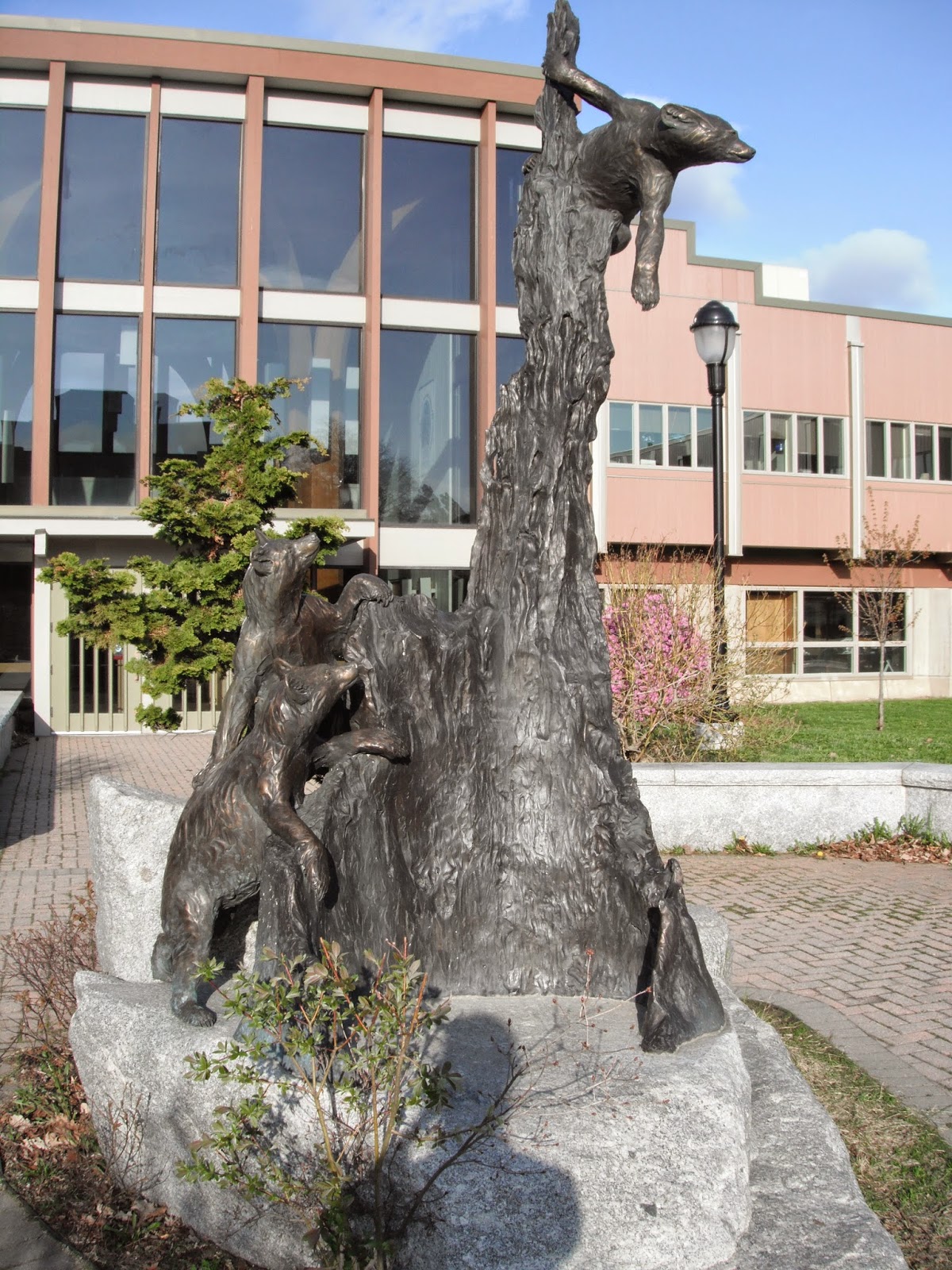
A statue in front of Nutting Hall, where our lab is, as well as the rest of the Department of Wildlife, Fisheries, and Conservation Biology. Note that the little juniper behind the bears is trimmed to look like a miniature pine.

The entry hall of Nutting Hall. Very rustic and all that. The thing on the left appears to be a sideways wooden tree that spins. Your guess as to its purpose is as good as mine.

I found a path to campus through a field and some woods managed by the university. Beehives!

Buoys monitoring the water currents of inland Maine. Currently reporting significant evaporation.

Translation-- "WARNING: KICK-ASS SCIENCE INSIDE"

 There's large areas of undeveloped and low-developed land in Maine, and the apartment complex where I live has some trails. I'm a big fan of the birch tree forests here. Reminds me of Mother Russia.

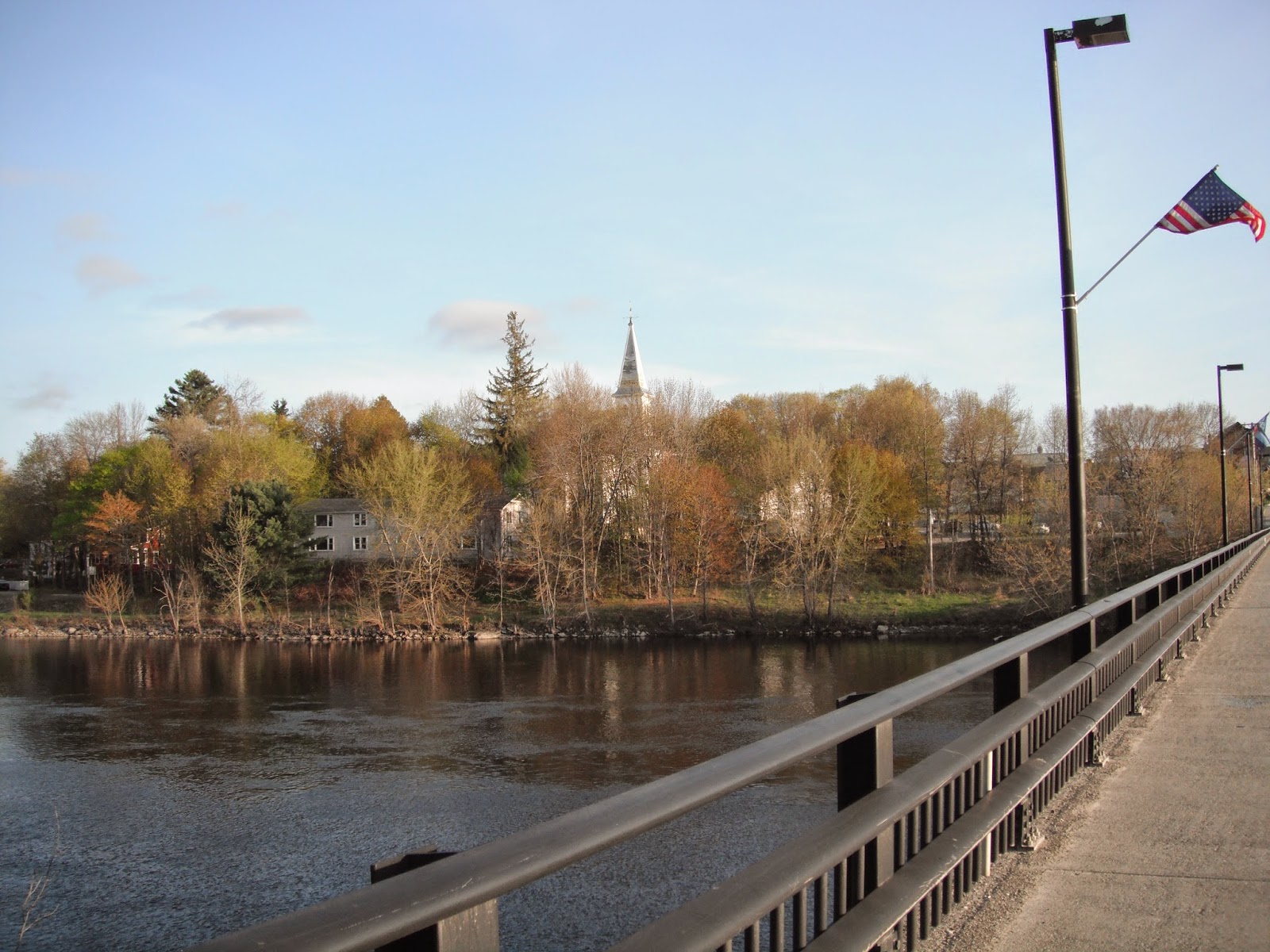
The Penobscot River, on the bridge to downtown Orono. The University of Maine is actually on a large island in the Penobscot. Well, if you are picky about what you call an island, maybe you wouldn't call it an island, but certainly there's a river on both sides of it.

The town of Orono. At last I have reached the region where the jigsaw puzzles with vague origins in "Small-town America" come from. 

Sunset over the Penobscot.

Rhododendrons (right?) on campus after rain-showers. Truman purple! Looks like it's going to rain until Thursday of next week, including during our field sampling on Monday, so y'all have some rainy pictures of spring-fed vernal pools to look forward to. Have a good weekend!