Showing posts with label Biology. Show all posts

Friday, August 28, 2015

Drones for Watching Beavers and Whales?

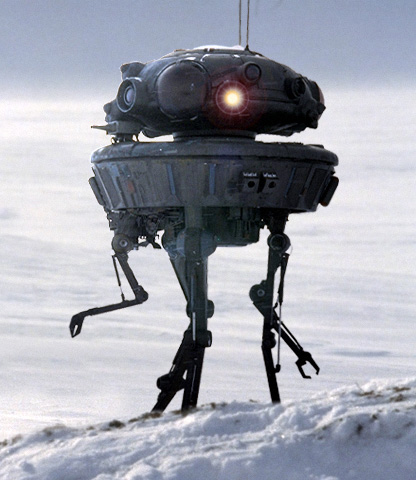
Are drones capable of non-evil purposes? Actually, are they even capable of a use that doesn’t make them look creepy and intrusive? (I feel that drone engineers need to do more to make drones that don’t instantly remind me of the Viper probe droid that the Imperial Fleet sent to spy on the Rebel base on planet Hoth.)

There is a surprising application for robotic aircraft that gives me a teaspoonful of hope. In a paper in the Journal of Unmanned Vehicle Systems (a journal whose title will always sound creepy to me) four researchers describe how they used a drone to survey the impacts of a pair of reintroduced beavers on ecosystem structure.

Photo by Per Harald Olsen
Conservationists in the United Kingdom are engaged in a major project of reintroducing the beaver to their country. Overhunting forced the species to local extinction as early as the 16th century. By damming streams and creating ponds and wetlands, beavers make a huge contribution to local diversity. Amphibians, fish, arthropods, plants and more all depend on the habitat created by beavers.

This study observed a pair of beavers brought to a first-order stream in southwestern England. The drone, a hexacopter equipped with a camera, was able to provide good images of beaver activity such as gnawed trees and dams under construction. And with software, the researchers converted these photos to computer models capable of telling us about hydrology, topography, vegetation structure, and other interesting landscape variables.

Unfortunately, the researchers only studied this site after the beavers had done their work, so they weren’t able to make comparisons to how the site was before the beaver engineers got to work.

Nonetheless, what the study suggests will be possible soon is very promising. The drone method is not just trendy. It’s cheaper than piloted aircraft, and, since it is low-altitude, it provides higher resolution data. It’s less labor intensive and faster than doing surveys on foot. You also avoid disturbing sensitive wetlands, which can be harmed by trace amounts of chemicals or pathogens found on researchers. The wildlife themselves are less bothered by a quiet hexacopter than a human or a piloted helicopter. And though the study didn’t mention it, a programmable aircraft is more rigorous than a human observer. Human estimations of vegetation parameters is notoriously prone to error.

Lastly, the drones don’t have a social schedule or a preference for warm or cold weather, and can be kept to inhumane and demanding survey schedules that even a seasoned field biologist would reject.

Another study in the same issue showed perhaps even more exciting benefits to drone surveys of whales. The surveyors launched the hexacopter from small craft at sea, where piloted aircraft would have been expensive and unfeasible. Since the whale pod showed no behavioral changes, the paper concluded that the drone did not bother them. From a height of 35 meters, the drone’s images showed enough detail for the biologists to identify each whale by its markings. And, because the drones can be kept to a constant altitude, biologists can use their photos of whales to calculate precise sizes and track growth rates for each whale.

I would be sad if the advent of drone ecology would mean the disappearance of human-led field surveys. We probably don’t have to worry about that any time soon. The main thing is to celebrate that we have found a socially and environmentally beneficial use for at least a few of those freaky airborne robots.

Tuesday, August 18, 2015

Fly in Your Burger?

"In a typical fast food meal of a hamburger, fries, and a milkshake, most of the components required an insect somewhere along the way; although the wheat in the bun is wind-pollinated, the other plants, from the cucumber for the pickle to the feed eaten by the cow, are insect-pollinated. Nicola Gallai from the University of Montpellier in France and her colleagues estimated the world economic value of pollination to be $153 billion, pointing out that this is nearly 10 percent of the value of agricultural production used for human food in 2005."


- Marlene Zuk,  Sex on Six Legs: On Life, Love, and Language from the Insect World

Just one more reason to think twice about that squeeze bottle of Bug-Blaster.

For me, science writers fall into two broad categories: those with scientific backgrounds and PhDs who have entered the realm of journalism, and those with hard-boiled reorting backgrounds who are exploring the realms of science. In practice, you hopefully won't be able to tell, from the text alone, what kind of writer wrote which successful popular science article or book. Dr. Zuk, an entomologist at the University of California-Riverside, falls into the first category. In preparation for my master's program, I'm trying to read a wide swath of authors and steal as many of their tricks as I can. Zuk spins off a new riff on the ever dependable method of putting economic value to overlooked wildlife: she shows us how many dollars worth of insects it took to produce your double cheeseburger with pickles and diced onions.

Friday, November 7, 2014

Birds in Restored Campus Habitat

This fall, I have been conducting surveys at sites around Kirskville to study how birds use streamside vegetation (known as riparian zones) during fall migration. I designed the project because other students have led an effort to restore the native riparian vegetation to Truman's campus along a stream called Bear Creek. As preparation for eventual presentations of the project, I went out to get some pictures of late fall migrants foraging among the plants that have sprung up in the no-mow zone on either side of the creek on campus. 


A Red-winged Blackbird perching in a tree above the creek.

Zoomed out: so there was also an American Robin. That's less important, since the Red-winged Blackbird is primarily a wetland bird, while the Robin is more of a generalist. 


 These pictures are unfortunately a bit blurry, but they show a Red-winged Blackbird in the act of foraging on the seeds of Ambrosia trifida, otherwise known as Giant Ragweed (which I happen to be allergic to.)


A Dark-eyed Junco on a ragweed stem.  
  

A House Sparrow. Like the Robin, this is less convincing evidence of the quality of the restored habitat, since House Sparrows are urban birds, but it nonetheless shows a bird making use of the vegetation.

Two male blackbirds and a House Finch in the background.

Friday, July 11, 2014

Summer Leaves

Here's the link to my first post for the blog of the vernal pool research program at University of Maine-Orono, "Of Pools and People." They're also on Facebook. It's my first foray into writing about a branch of ecology which is still very new to me: biogeochemistry, the study of fundamental environmental processes. There's a couple formatting hiccups in it that will probably be rectified soon, but I figured I might as well just link to it now, trusting in your generosity not to condemn me too badly.

Saturday, May 17, 2014

First Days in Maine


I went into the field with the grad student I'm working with the morning after I arrived in Orono. This is Duck Pond, the first of the vernal pools we sampled from. This summer is about background research and preparing for future summers. We anchored light and temperature sensors to the pool floor and waded to put in depth sticks to track the depth of water over the season. We also attached Nalgene tubing such that we could take samples from different levels of the water column by drawing the water from shore. This is done to avoid disturbing the water and the sediment during sampling. Since the differences in nutrient concentrations are subtle, large primates wading in the pool would instantly change the chemistry of the water column. Eventually, we want to compare water samples taken at deep and shallow depths to see if there is stratification in the nutrient concentrations.


They may not look it, but these pools can get pretty deep. We use hip waders, which go up above the waist, and Duck Pond certainly reached to my hip. The next pool, Emerald Pond, was so deep it would have topped our waders, meaning that the grad student I'm working with had to quickly swim in clothes without waders to put in the depth sticks with the sampling tubing attached. (Waders become dangerous and awkward when full of water, as you might imagine.)

It is also relevant to mention that Duck Pond was 46 degrees F, and Emerald was 52 degrees. Not exactly ideal swimming conditions. For science!

Another view of Duck Pond. More about wading in hip waders: the water pressure flattens them against your legs, and the air in them gives them a buoyancy that makes your feet bounce upwards each time you step. The effect is a little like what I imagine moonwalking in a spacesuit would feel like.

The next field day is this coming Monday. Thursday and Friday were for paperwork, training, and preparing field equipment for Monday. I also had some time to wander around the University of Maine's campus after work. Here's the Library (foreground) and the Memorial Union.

Another view of the Memorial Union.

A house attached to the greenhouses. I've always liked the way universities sometimes re-purpose of old houses instead of tearing them down.

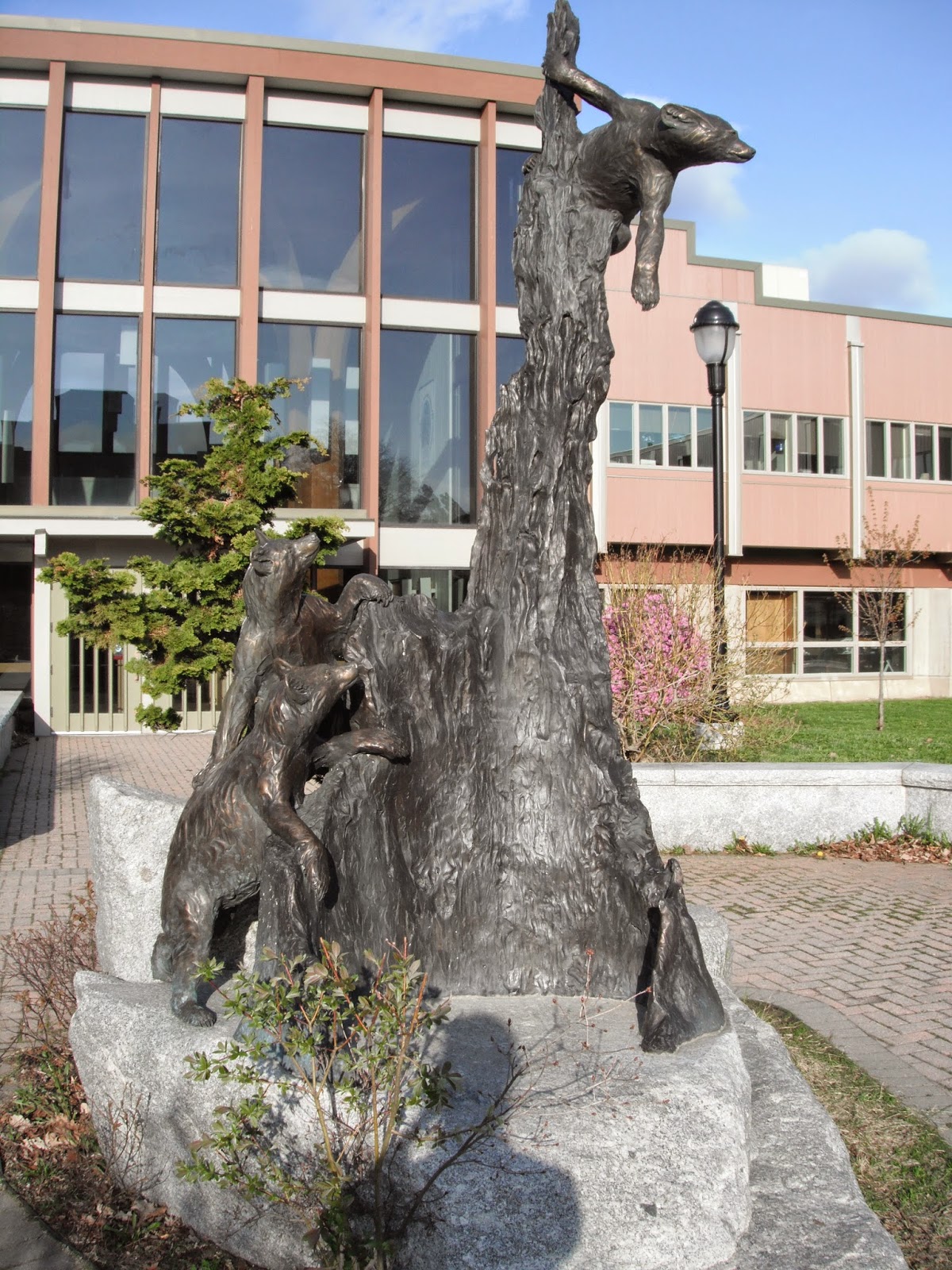
A statue in front of Nutting Hall, where our lab is, as well as the rest of the Department of Wildlife, Fisheries, and Conservation Biology. Note that the little juniper behind the bears is trimmed to look like a miniature pine.

The entry hall of Nutting Hall. Very rustic and all that. The thing on the left appears to be a sideways wooden tree that spins. Your guess as to its purpose is as good as mine.

I found a path to campus through a field and some woods managed by the university. Beehives!

Buoys monitoring the water currents of inland Maine. Currently reporting significant evaporation.

Translation-- "WARNING: KICK-ASS SCIENCE INSIDE"

 There's large areas of undeveloped and low-developed land in Maine, and the apartment complex where I live has some trails. I'm a big fan of the birch tree forests here. Reminds me of Mother Russia.

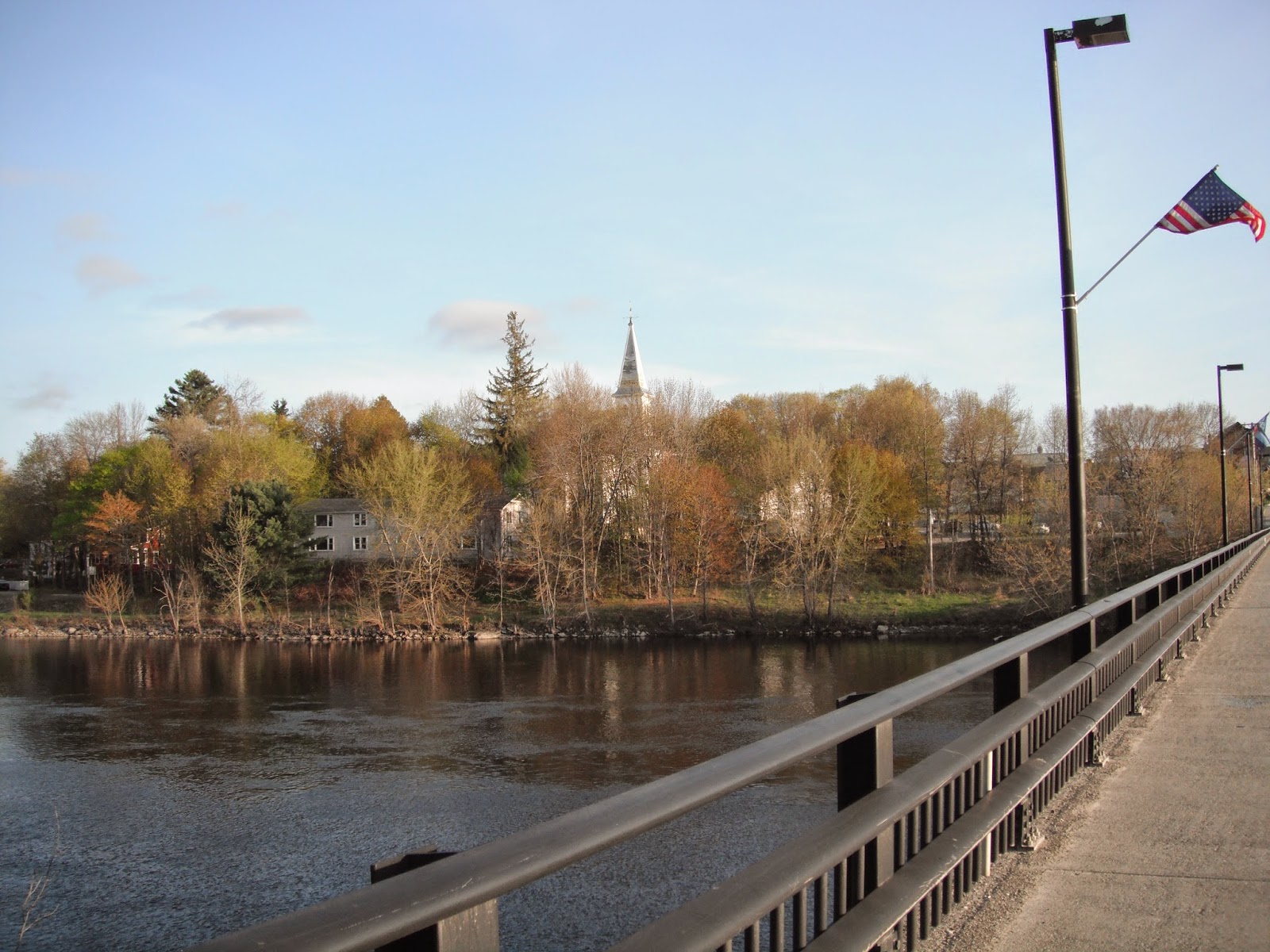
The Penobscot River, on the bridge to downtown Orono. The University of Maine is actually on a large island in the Penobscot. Well, if you are picky about what you call an island, maybe you wouldn't call it an island, but certainly there's a river on both sides of it.

The town of Orono. At last I have reached the region where the jigsaw puzzles with vague origins in "Small-town America" come from. 

Sunset over the Penobscot.

Rhododendrons (right?) on campus after rain-showers. Truman purple! Looks like it's going to rain until Thursday of next week, including during our field sampling on Monday, so y'all have some rainy pictures of spring-fed vernal pools to look forward to. Have a good weekend!


Tuesday, April 22, 2014

Off to Orono

This summer I am headed off to the University of Maine-Orono to work as a Research Assistant on a project studying ephemeral wetlands. The small bodies of water we will be studying are called vernal pools. They fill with snowmelt in spring and dry up at the end of the summer. In the time in between, they are important habitat for frogs and salamanders. The project is supported by a National Science Foundation grant for research on small-scale landscape features with an out-sized impact on the surrounding ecosystem.

The graduate student I am working with is focusing on biogeochemistry and the cycles of nutrients in the pools, including dissolved oxygen, nitrogen and phosphorus. Keeping an eye on these chemical concentrations can give us a better idea of the quality of the habitat and how it is being affected by runoff from nearby human activity. That's my slapdash explanation before actually having seen any of these pools. I'll know much more soon.

As the ice is melting right about now, I will have to head off to Maine quickly after exams end. I'll be back in Saint Louis in mid-August.

This is my first experience on a biology project with national funding, so I'm very excited to start. In Orono, I will also be an hour from Acadia National Park. It will be a different kind of summer than I'm used to, but it should be very rewarding! I hope to keep some updates here throughout the summer.

Thursday, January 30, 2014

Gray Wolves and Black Coffee


The New York Times printed this memorable
image of Ukrainian protesters in Kiev.
I try to vary my columns between trends in the news and personal experience. My first column of the year considered our future with Gray wolves, which are expanding their ranges south as reintroduced populations rebound. This morning's column is one in my unofficial series, Advocacy for Unlovely Causes. The cause this time was rising early in college, which may just get me stoned to death for cultural heresy. Oh well. Next week: making sense of Ukraine from 5,000 miles away.

Thursday, October 24, 2013

Biology Metaphors in Popular Culture

Inspired by Orwell's "Politics and the English Language," in today's column I examine some biological concepts such as "survival of the fittest" and see if the way they are used as metaphors in popular culture actually makes sense anymore.