Whenever I travel, my mind often
takes a faint recollection of a place I’ve been and turns it into a vivid
memory of a place or event only tenuously linked to reality. Various memories I
have of the city of Boston, in particular, I now understand to be heavily
fictionalized and built-upon subconsciously until a scene far grander than
reality replaces the vague imprint of the initial memory.
 |
| The Shostakovich Grand Hall. |
But this is not the case, I believe,
with what I call the “St. Petersburg Symphony.” During the 3-week
exchange program to St. Petersburg, Russia, that I took part in, my host family
took me to the Shostakovich Grand Hall to see (what I believe to have been) the
St. Petersburg Philharmonic perform. I’m forever indebted to my hosts' generosity. We nearly showed up late—I remember it definitely being my fault, but I forget
how exactly. I did not find a program to that night’s performance for that reason. I
had no idea what was being played, or by whom. These conditions created a very
interesting experience.
I remember indistinctly
enjoying the first two pieces played, not finding much particularly noteworthy
about them. But that third (or um, fourth, maybe) piece—no music I have ever heard
has stuck with me like that. I remember turning to my host student in awe
afterwards, as if to say, “Did you just hear what I heard?” She seemed largely
unmoved, though less bored than at the first two pieces. However, “stuck with
me” is perhaps not the best phrase to use, because what’s stuck with me is
sparsely detailed to say the least.
The dominant theme in this symphony or movement of a symphony (or maybe symphonic poem, I wouldn’t have known back then) was carried mainly by
the brass, and said something to me that night very specific and affirmative about the trials
of spirit that occur during times of extensive travel, and the spirit’s vital, brave response to the reluctance to begin a new journey. A theme
to adventure, but not light and boastful (like, say, the "Raider’s March" from Indiana Jones) nor yet so wrought with
struggle and home-yearning that it turns to melancholy (think of Vaughan
William's "Fantasia on a Theme"). This
theme (which sadly is now the faintest sort of memory to me) found the ever-shifting middle ground between struggle and hope, a portrait of a person, a country, or
a band of friends that has found a way to dance on the line between the fear
of loss and the potential of the unknown.
And there was an absolutely thrilling
drumbeat that accompanied the theme—dogged, persistent, reminding one of the
unrelenting beat of Ravel’s "Bolero", but with more energy. And unlike "Bolero," the drumbeat vanished and returned several times, though
it was sustained for such incredible lengths of time that the percussionist
responsible took his own very deserved bow and received eager applause at the end
of the piece.
And the symphony was, you know, pretty
long. Much longer than your typical "Maroon 5" song, I'd say. And that’s all I remember. There you have it: the "St. Petersburg Symphony." I have no idea who could have composed it,
other than that now after a classical music history course at Truman I am fairly sure it’s
post-Beethoven and probably even post-Romantic.
As we left the concert hall I
looked to the posters on the walls for a name to attach to the night’s
performance but couldn’t find anything. Hopping into my host family’s car, I had a sense that I should not bother trying
to hunt down the symphony: rather that trap it forever in an iPod, better to let it be mysterious and free, better to allow it to return when I need it most,
unexpected, calling me to adventure again.
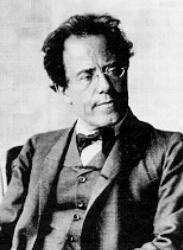 |
| Could it be Mahler? |
If it did return in this way, needless to say, I
would welcome it as triumphantly as the heir of Elendil was welcomed to the empty throne of
Gondor. But now I’m not just passively waiting for it to return: I’m hunting. There's a part of me that wishes to wait for an unasked-for return, but I also think that now is the time it is needed. I
haven’t hired a PI yet, but I have been searching near and far. I’ve burned
through many of Mahler’s symphonies, mainly because one of his more famous
portraits is somehow concordant with the sense I have of the mysterious
symphony. (His expression: somewhere between an ironic grimace and a quietly proud smile. Or is that just me capitalizing on the vagueness of early photography?) I’ve seized on the archives of the St. Petersburg Philharmonic’s
programs and have been checking every item they performed for June 2010.
Nothing like what I remember yet. Maybe it wasn’t the Philharmonic. Maybe I’m
looking up works with similar names but vastly different content. (If someone
thinks they have a lead on this, let me know!)
Maybe I’ll never find it. Maybe
it’s not even as beautiful as I remember. Maybe it was a dream. One thing’s for
certain, though: I’ll probably never let that memory rest, and eventually, it
may become a nucleus for something very different from what actually happened.
Does that make it less important?
