
Showing posts with label Kirksville. Show all posts
Showing posts with label Kirksville. Show all posts
Friday, October 31, 2014
Red Leaves, Yellow Cello Case

Tuesday, May 13, 2014
Pictures: End of Spring & Beginning of Summer
While waiting at a bus station in Portland, Maine to go North to Orono, Maine, I thought I would post some pictures from recent adventures and arrival in Maine.


Spring was late this year, and 39 degrees F in late April was the warmest temperature for our ornithology class's bird surveys at Big Creek Conservation Area, an oak-savannah restoration habitat near Kirksville.
Spring in St. Louis during Easter weekend.
Up early for a bird survey.
Bear Creek on Truman's campus, where I'm doing surveys of the bird community to study the effects of plantings along suburban stream edges.

Spring flowers on Truman's campus!
On Saturday morning after we were all free from our exams, some friends and I got up to see the sunrise at 1000 Hills State Park and eat muffins.
Barn Swallows on the shore.
We had been meaning to rent canoes here for a long time and finally found a morning to do it!
We paddled to a cove of the opposite shore and landed on a small shrubby island, which we believe to be the home of several endemic species of ticks (monographs currently in press.)
The opposite shore.
Finally, Maine: haven't seen much of it yet, but what I've seen so far has been promising. The grassy area in the middle of this picture from the plane is a salt marsh!
In an hour I'm taking a bus north to Bangor, and then it's a short drive to U-Maine's campus. Thanks for reading!
Thursday, October 31, 2013
Staring Down the Rat
 In this week's Index column, I take a look at two poems from the Seamus Heaney collections I picked up earlier this semester, and use them to try to come to terms with processes of change and decay around Kirksville. The column does not mention it, but the poems are from Death of a Naturalist.
Wednesday, May 8, 2013
In Just-spring

A brief history of northern Missouri weather this year, for those interested.
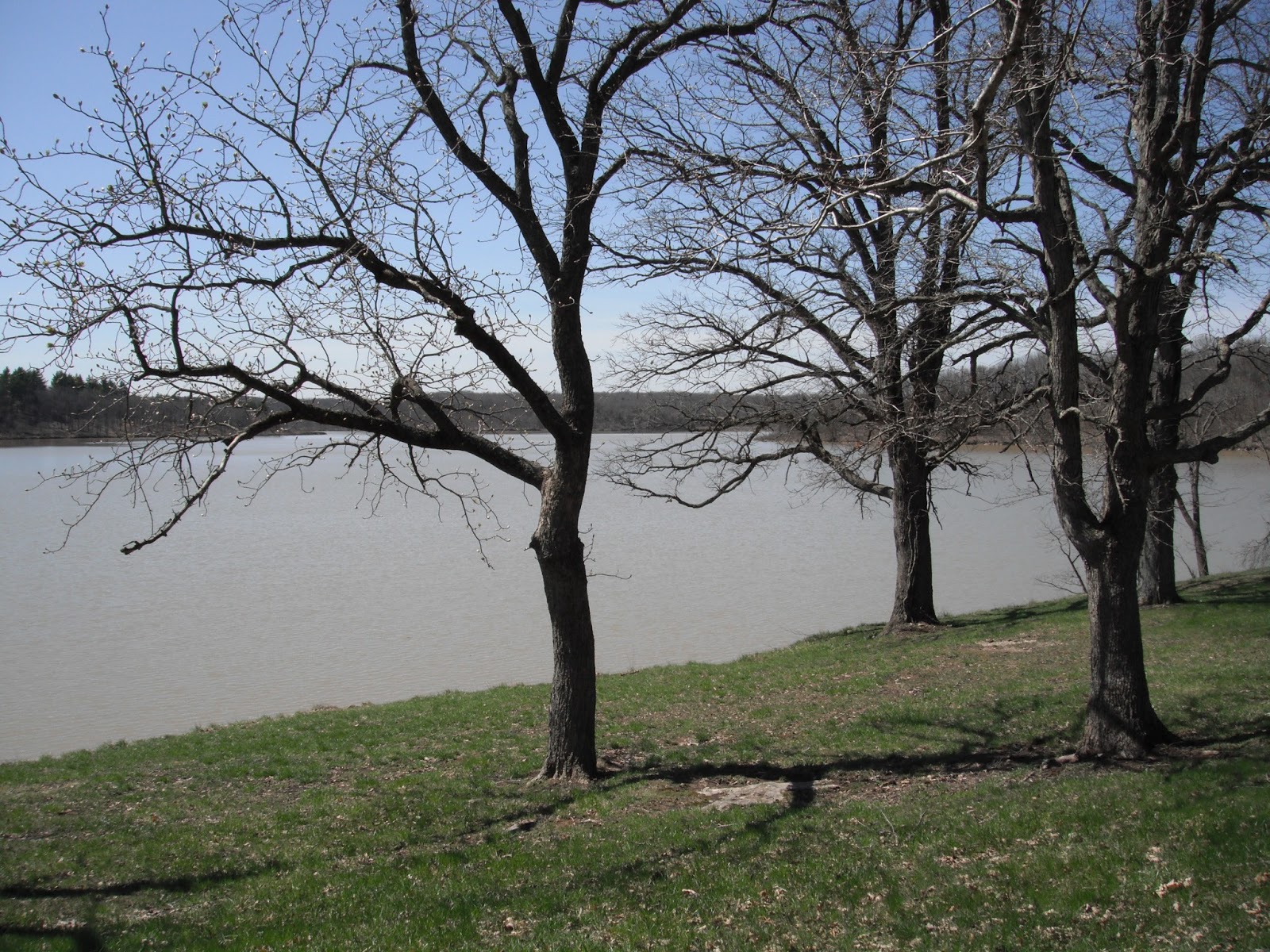 And then we went through that long period of a few days of warm weather and then back to winter; meanwhile, the trees cautiously kept their leaves back.
But then, very suddenly, "the world is mud-luscious" and "puddle-wonderful" (ee cummings).


 Welcome to the Shire. I'm a big fan of these blue flowers at left. Also the pink ones above. A kind of cherry tree, perhaps?
 (In my best David Attenborough voice) With the long-awaited departure of the migratory polar bears, the rabbit population of the southern prairie and its bordering forests at last rebounds--and bounds, and bounds.

I tend to take pictures of the same thing over and over again--you might remember seeing a similar view of the shelter in the Sunken Garden before. However, I'm not particularly apologetic about this habit--no, what I really want is a picture from the same view at the same time of day from every day of at least one year, but preferably seven.
Lately I've wondered what we are to make of transformations of this kind. As astonished as we are every time, spring happens every year. The popular short-sighted mistake is to see the turning of seasons as linear progress, conquering the preceding season--which would be about as silly as spinning around in a four-walled room and thinking that each time your sight passes a corner, the wall you're looking at is new and unique in the world. Then again, maybe not such a mistake. Doesn't each spring have a character of its own among all springs that have ever been? Do we remember enough of what is the same to really know what is different? And perhaps climate change is making our weather even more frantic and capricious, and perhaps there are more sinister implications for these seemingly more abrupt changes between the seasons. But even if it turned out to be scientifically irrelevant, I suppose I'd rather stay one of the foolish humans spinning in our enormous room of light, forgetful and amazed at the intricate green details each time around.
Sunday, December 2, 2012
A Day of Fog
This morning, banks of fog descended on Adair County. Many students found the fog creepy, suggestive of stranglers and dementors. I thought it looked kind of cool.


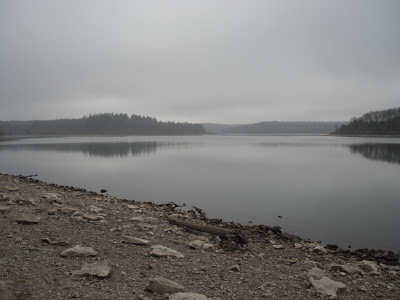


Thousand Hills State Park looked like it was in another country today.

A more northern, bracingly cold country with heather and fens and firths.


I was keeping an eye out for Nessie. No luck today, though.


The sun started to break through as the day went on, but the light was still strange, making the lake look like the coast of the North Sea.

And then, as if that wasn't enough of a treat, even heavier banks of fog rolled in tonight. My camera was not really up to the task.


The Quad, and some Christmas lights. That figure to the right is a statue of Baldwin, Truman's first president. Okay, so maybe the fog is a little creepy after all.
Friday, January 27, 2012
Something New

Yesterday in Kirksville, we awoke to fogs and temperatures above freezing--quite an anomaly, as the norm is currently sub-zero wind chills. The mists cleared as the day went on, and afternoon recalled the feeling of spring. The air was mild and humid, full of the earthy smell of the ground thawing. Finches and sparrows called from the bushes, and squirrels rose from their shelters to look for food.
It felt like a tiny Easter in this already long winter. Perhaps that's what I needed it to be, at least. The priests that I know are fond of reminding people that the most important holiday is actually not Christmas, but Easter. Yesterday, though, I thought how perhaps it's fitting that most of us still like Christmas better--or at least, look forward to it more. As a kid, I understood Easter to be a sort of watered-down Christmas. Presents in small plastic eggs instead of big square wrapped-up things. Even when I began to consciously consider the religious aspects of the two holidays, somehow God coming into the world was easier to grasp than dying to save it. I'm still not sure anyone living actually understands what that really means. Christmas is easy to understand. What came afterwards is more difficult to parse out. Year after year, never feeling much wiser, always looking out from the same eyes, maybe we get a sliver closer to the truth.
We're always trying to understand the future in terms of something that has already happened to us. We're always looking for the Temple to be rebuilt, not destroyed. For a warrior-savior that conquers that which we fear, not someone who helps us not have fear. For a new Jerusalem, not an entirely new kingdom. We've never been ready for something entirely new.
Here are some pictures I took when it snowed at Truman on the Friday before Martin Luther King Jr. Day--well before yesterday's thaw.
 |
| One of the shelters in the Sunken Garden |
 |
| The Sunken Garden and the bell tower |
 |
| Dobson Hall (my dorm) and some bikes that probably won't be used for a while |
Saturday, November 19, 2011
Patria: A Few Fields in Greece, or Perhaps Kirksville

Going to college at Truman means living in rural Kirksville, Missouri. This was something that was always in the “con” column when I was deciding where to go last year. I had wanted to live for a while one of America’s big cities, to feed off the energy of a vibrant downtown area, like many of my friends from high school.
Kirksville’s downtown area is anything but vibrant. I explored it one day early in the semester, as the summer weather continued long past its due. A square surrounds the county courthouse, an impressive building that figured in a minor Civil War skirmish. There are a few restaurants, an independently-owned movie theater, a grocer, and a number of antique stores, the largest of which has three floors, with a small used bookshop on the top floor. The bookstore was a priority for me. A good, comfortable bookstore has always been something that I—well, I hesitate to say ‘need,’ but that’s my inclination. Being surrounded by books, most of which I have never read or seen before, in a quiet place with just a few other customers, is an environment I find rejuvenating for some reason.
I found a small classics section—a single bookshelf. The selection was thin but definitely interesting. The Beautiful and the Damned, Pilgrim’s Progress, Ulysses, and many other mysterious books I’ve never read. One in particular caught my eye—an old but mostly unworn copy of My Antonia. It snagged my attention first because it is one of my best friends’ favorite books, but also because I thought the cover was dully designed, overly pastoral, and sentimental. Which wasn’t too different from what I then thought of Kirksville. I bought the book in the hope that it would help me reconcile myself to where I was.
I ended up immensely enjoying the book—its slow storytelling place, the richly developed characters, its careful, loving attention to the red prairie grass and the way the Nebraska sunsets turned farming machinery into mysteriously portentous silhouettes. I even grew to love the cover, an old painting of a wheat harvest, pastel-hued and irretrievably dated, but beautiful all the same.
One of the most important parts of the book for me was Jim’s realization, while reading Virgil, of what was meant by the line “Primus ego in patriam mecum … deducam Musas” (“for I shall be the first, if I live, to bring the Muse into my country.”) I thought this line sounded very high-minded, but the Jim’s professor explained
“that ‘patria’ here meant, not a nation or even a province, but the little rural neighborhood on the Mincio where the poet was born. This was not a boast, but a hope, at once bold and devoutly humble, that he might bring the Muse (but lately come to Italy from her cloudy Grecian mountains), not to the capital, the palatia Romana, but to his own little ‘country’; to his father’s fields, ‘sloping down to the river and to the old beech trees with broken tops.’”
Jim goes on to speculate about his professor’s “country” as well.
“We left the classroom quietly, conscious that we had been brushed by the wing of a great feeling, though perhaps I alone knew Cleric [the professor] intimately enough to guess what that feeling was … I was wondering whether that particular rocky strip of New England coast about which he had so often told me was Cleric’s patria.”
I found the idea of the patria very interesting. For Jim, patria is his adopted home of the Nebraska fields. More importantly, patria is Antonia and the other “hired girls” he grew up with—the group of brawny, ambitious immigrant women that took up traditionally masculine jobs to secure the futures of their families and themselves. Though looked down upon by the prim townsfolk, they ultimately became the most successful of anyone from the town or surrounding farms.
For me, patria was the thick woods and streams around my house, our camping-themed family room, the cupboard-sized newspaper office in my high school, my friends’ houses. Patria was my family and the friends I made in high school. And it still is those things and those people. But for the next several years my country will also be this dusty old northern Missouri town and its college. What and who will I find in this place?
Subscribe to:
Posts (Atom)