"All rivers are full of sky.
Waterfalls are in the mind.
We all come from slime.
Even alpacas."
-Dean Young, "Belief in Magic," Poetry magazine (July/August 2014)
Sunday, July 6, 2014

Saturday, July 5, 2014
Risking Delight
A Brief for the Defense
Sorrow everywhere. Slaughter
everywhere. If babies
are not starving someplace, they are
starving
somewhere else. With flies in their
nostrils.
But we enjoy our lives because that's
what God wants.
Otherwise the mornings before summer
dawn would not
be made so fine. The Bengal tiger would
not
be fashioned so miraculously well. The
poor women
at the fountain are laughing together
between
the suffering they have known and the
awfulness
in their future, smiling and laughing
while somebody
in the village is very sick. There is
laughter
every day in the terrible streets of
Calcutta,
and the women laugh in the cages of
Bombay.
If we deny our happiness, resist our
satisfaction,
we lessen the importance of their
deprivation.
We must risk delight. We can do without
pleasure,
but not delight. Not enjoyment. We must
have
the stubbornness to accept our gladness
in the ruthless
furnace of this world. To make injustice
the only
measure of our attention is to praise
the Devil.
If the locomotive of the Lord runs us
down,
we should give thanks that the end had
magnitude.
We must admit there will be music
despite everything.
We stand at the prow again of a small
ship
anchored late at night in the tiny port
looking over to the sleeping island:
the waterfront
is three shuttered cafés and one naked
light burning.
To hear the faint sound of oars in the
silence as a rowboat
comes slowly out and then goes back is
truly worth
all the years of sorrow that are to
come.
—Jack
Gilbert
This Fourth of July, my bike lock fell
off my handlebars sometime on a three-mile trip to the grocery store. This is
one of those things that instantly reminds me of the feebleness of my body without
wheels, and reawakens my dread of losing the ability to travel freely and
without the worry that my vehicle will be stolen. I checked every foot of trail
between my apartment and the grocery store, under a bright gray
headache-inducing sky and steady cold rain. I did not find it, and decided to
look for a bike lock at gas stations, the only other places open on this
holiday.
The first, nearer one did not have a
bike lock, nor did another convenience store. I had been in the rain for almost two hours at this point and was losing courage fast.
But like in an old story, an inner voice
told me—Just ride to the top of yon hill,
lad. Then ye may return home. This inner voice was apparently from northern
England.
And upon reaching the top of the hill,
I saw the sharp lights of a gas station, like Jane Eyre seeing the parson’s
house across the moor.
I arrived at the convenience store and
found an attendant leaning against the outside wall, smoking a cigarette.
“Hello,” I said.
“Hi,” she replied, clearly peeved at
being distracted on her smoke break.
“Do you sell gas—er, bike locks here?”
The speaking part of my brain was short of oxygen.
“No,” she said, looking back at her
phone.
“Okay.” I mounted my bike and turned
back to ride through some more oily puddles.
In a moment my story had changed from
one of classical Providence to something like Sergey Dovlatov’s tragi-farcical
sketches of late Soviet life.
At least I had already bought ibuprofen.
This morning, I had been planning to go
to Acadia National Park. However, I woke up to howling winds and driving rain.
I knew it would rain, but not this hard. I had already begun composing an essay
in my head about my trip. It would parallel Ishmael’s arrival in port during a
storm in the opening chapters of Moby
Dick. It would celebrate the sights of huge waves driven by (comfortably distant)
hurricane winds, and perhaps speculate about unseen whales in the Atlantic, the
horrors of modern whaling, and our changing relationship with Leviathan in the
days of climate change.
But I won’t be able to write that essay
yet, because I was not willing to go to Acadia on a day forecasted to have two
inches of rain. Apologies, Ishmael.
Instead, I went into town, bike-less,
in the pouring post-hurricane rain, ordered French toast and corned beef hash
at a diner, and listened to an audio recording of Patrick O’Brian’s H.M.S. Surprise. All the time hearing,
for some reason, David Bowie’s “Suffragette City” in my head. And I had a grand
time doing it, especially since I knew I was denying Fate the satisfaction of making
me miserable.
It made me think of something I had
thought of many times before—what matters is not external events but one’s
response to them—which is often a matter of rallying against them. To me, this
is a source of happiness: the knowledge that we are making an effort to live
well in the world. What draws me to Moby
Dick is ultimately not its setting but Ishmael’s narrative voice,
delighting in absurdity even in strange and terrible conditions. It's the same reason I admire Lizzy's voice in Pride and Prejudice, delighting in other absurdities, though in surroundings usually reckoned much more pleasant than the 'tween decks of the Pequod.
Compared to the suffering of many
people, the kind of problems I have would be relief. And yet I don’t advocate
being thankful for the kind of problems we have—an impossible if possibly noble
task. Nor yet do I advocate feeling guilty for one’s gifts, an unproductive and
merely Puritanical task. I suppose we have to risk delight, wherever we are, as
Jack Gilbert encourages us.
Reading in the afternoon of a day that
was no longer titled “The Day I Didn’t Go to Acadia” but instead a free day
whose meaning I was still uncovering, I arrived at this passage in Moby Dick: describing the Pequod for the first time, Ishmael tells us, “Long seasoned and weather-stained in the
typhoons and calms of all four oceans, her old hull’s complexion was darkened
like a French grenadier’s, who has alike fought in Egypt and Siberia.” The
wide-traveling experience suggested here instantly delighted me. It led me to
consider the degrees of separation between me and the (imaginary) French grenadier. First there were the original, and probably
none too enjoyable, experiences of shooting musket-balls at the British in
Egypt and the Russians in Siberia. (By the way, Napoleon's army was turned back near Moscow. Poetic license.) Then there was the distance of time, which
allowed the grenadier to pick out the meaningful parts of those experiences and
craft them into a story which he wore proudly on his weathered cheeks. Then
Herman Melville either saw such a person—or, more likely, read about one. One
day at the docks, in an imaginative moment, he connected this person with a
ship he admired. Finally, he wrote this thought down, and over a century later,
I read it.
And yet all those sequential frames are
instantly fused into a single windowpane by the magic of human communication—in
this case, by the written word and the power of story. Is telling and listening
to stories, however small, our most accessible way of risking happiness?
Sunday, June 15, 2014
Orono Sketches, Part 1

Here's the first of what I hope will be a (small) series of sketches of the town of Orono, Maine. This is the Orono Community Center, with a well-trafficked thrift shop on the second floor, senior center on the first floor, and a community garden beside it. Sitting on top of a grassy bluff above a stream, it seemed to have the air of an English country house (which may have something to do with my reading Pride and Prejudice at the moment.) Don't think I was being lazy: there really were only nine windows from where I was sitting. For all its fine angles, it is strangely lacking in the category of windows. I may go back and add color later.
Saturday, June 7, 2014
Penobscot County Busride

You might think it strange that I haven’t yet written about my work on the vernal pool research project here. (After all, at right is what one of our vernal pools looks like.) However, as lucky as I am to have gotten this opportunity for biology field work, it is nonetheless work, and I’m therefore more inclined to talk and write about what I do on my free time.
And experiences in Ireland, New York, Boston, St. Petersburg, St. Louis, Chicago and now Maine have convinced me that boarding a public bus or light rail train car is one of the most rewarding things you can do with a free day or even with a free forty minutes. So that is what I did with this Saturday: took the bus 20 minutes southwest to the city of Bangor. Perhaps from the outside buses might look like poorly lit mobile caves, but inside you find that the whole cabin is surrounded by wide windows, making you feel like you are on a large glass box. After paying less than a candy bar you are free to board. To an enthusiastic mind, the raised rear section of a bus recalls the quarterdeck of a sailing ship. You are then whirled off somewhere else without having to think about it, and are free to read or listen to music.
Or
perhaps even talk to someone. In Galway, Ireland, the bus drivers I saw often
had friends who would board for a stop or two just to cling on the front pole
and exchange witticisms with them. “Are you a Galway man, at all?” an elderly
man asked me on the train to Dublin, midway through his wife’s brief account of their family’s life history. She told him of course he isn’t,
don’t you see his ball-cap? (I hadn’t picked up a Galwegian accent: I just think he couldn't hear very well.) Sure, I have heard some tedious
speeches on the subways of large cities, but for the most part American
public transit spaces are often ones of comradely traveler’s small talk, or at least
a silence with a positive, and not a defensive, energy to it. Wal-Marts and lame polo shirts carry on their slow, steady arsenic poisoning of American
culture, but buses remain. Even in Maine, buses are multiethnic and often
multilingual. It is one of the few places left in this country where, while
waiting out a long cargo train crossing, a stranger is unafraid of asking another if they’d be brave enough to save up money, get on a train
and cross the country, and another stranger is unafraid to answer yeah, of course, why not?
The bus
from University of Maine-Orono’s campus to Bangor roughly follows the Penobscot
River downstream. Riders are treated to quick views of the river between houses
on the banks, and of small mountain ridges in the distance. This is a good time
to discuss how the people of New England are often spoiled utterly rotten. I
have heard whale watching called “cheesy,” when I believe many of the people I grew up
with in St. Louis will never see a whale. I have heard Mainers talk with great complacency
of the low property values here, how it is only good as retirement country—a
cold Florida. And yet the number of houses—of apartment complexes and trailer
lots—with rock-bottomed salmon rivers a hundred yards wide and more in their
backyards is, to my Midwestern eyes, incredible! Cheesy whale watching, forsooth.

 We
stopped at the central bus depot in Bangor, which was, as I had hoped, right in
the historic downtown. Bangor, whose name
comes from a city in Northern Ireland (though indirectly, through a city
founder’s favorite hymn), is the third-largest city in Maine. The city plan is
haphazard and gangling, not unlike the asymmetric street grids of medieval
cities in Europe. It grew quickly as a port for the loggers of Maine in the 1800s,
shipping Maine lumber to build New York and Boston. At one time it was an
economically crucial city. But in more recent years, the usual outer ring of
box stores and strip malls has expanded to serve a broad rural population that
includes New Brunswick, Canada. As a result, the center has declined—antique
stores are not good evidence for commercial bustle. Yet it still retains some
of its vigor. I was deeply pleased to see tall brick buildings, old
white-steepled churches, and a café devoted entirely to bagels. On a Thursday
when I drove through on the way to a vernal pool, downtown had all the dense
traffic a city-dweller could wish for.
We
stopped at the central bus depot in Bangor, which was, as I had hoped, right in
the historic downtown. Bangor, whose name
comes from a city in Northern Ireland (though indirectly, through a city
founder’s favorite hymn), is the third-largest city in Maine. The city plan is
haphazard and gangling, not unlike the asymmetric street grids of medieval
cities in Europe. It grew quickly as a port for the loggers of Maine in the 1800s,
shipping Maine lumber to build New York and Boston. At one time it was an
economically crucial city. But in more recent years, the usual outer ring of
box stores and strip malls has expanded to serve a broad rural population that
includes New Brunswick, Canada. As a result, the center has declined—antique
stores are not good evidence for commercial bustle. Yet it still retains some
of its vigor. I was deeply pleased to see tall brick buildings, old
white-steepled churches, and a café devoted entirely to bagels. On a Thursday
when I drove through on the way to a vernal pool, downtown had all the dense
traffic a city-dweller could wish for. I stopped
in a café with an Italian name and bought a muffin and a double-shotted cappuccino.
The barista took the order from the cashier with every appearance of great
personal dislike for me, vanished behind the corvette-red espresso machine, and
reappeared to hand over what instantly seemed to me the best cappuccino I had
ever tasted, as coffee is apt to do. I sat outside, nominally reading a Jane
Austen novel, but in fact watching large bright clouds passing over the sunlit brick buildings.
I stopped
in a café with an Italian name and bought a muffin and a double-shotted cappuccino.
The barista took the order from the cashier with every appearance of great
personal dislike for me, vanished behind the corvette-red espresso machine, and
reappeared to hand over what instantly seemed to me the best cappuccino I had
ever tasted, as coffee is apt to do. I sat outside, nominally reading a Jane
Austen novel, but in fact watching large bright clouds passing over the sunlit brick buildings..jpg) My
wandering about town, up and down the canal, up and down Main Street, satisfied
an appetite I have for urban landscapes that has not been fed by the small but
adorable town of Orono. Having heard that some undergrads at U. Maine see Bangor,
dear little Bangor, as “sketchy,” I was reminded of my hypothesis that
somewhere along the line, many white suburban children learn the lesson that
there is something inherently dangerous and untrustworthy to places where buildings
are close together—even, God forbid, touching along their sides—unless the buildings happen to be in Europe. I don’t know
how exactly I escaped this lesson, but I am grateful that I did. Their
are few cities I've visited that I don't have affection for. I have a passion
for roof gardens (at right) and the tiny, over-planted front lawns of Boston
(usually no larger than a kitchen) that is disproportionate to their size.
My
wandering about town, up and down the canal, up and down Main Street, satisfied
an appetite I have for urban landscapes that has not been fed by the small but
adorable town of Orono. Having heard that some undergrads at U. Maine see Bangor,
dear little Bangor, as “sketchy,” I was reminded of my hypothesis that
somewhere along the line, many white suburban children learn the lesson that
there is something inherently dangerous and untrustworthy to places where buildings
are close together—even, God forbid, touching along their sides—unless the buildings happen to be in Europe. I don’t know
how exactly I escaped this lesson, but I am grateful that I did. Their
are few cities I've visited that I don't have affection for. I have a passion
for roof gardens (at right) and the tiny, over-planted front lawns of Boston
(usually no larger than a kitchen) that is disproportionate to their size. |
| The bagel shop on the left is closed on Saturdays--what nonsense! |
 |
| The pub. |
 With
only half an hour to go before catching the bus, I headed towards the long boardwalk
along the Penobscot. There was a food truck with an entire brick pizza oven stuffed
inside, an ice cream truck, and many picnicking families. While the Kenduskeag
Stream through the center of Bangor is somewhat dirty (every city worth its
salt has filthy rivers—the Liffey, the Chicago, the Hudson) the Penobscot
beside Bangor is broad and blue, with a very tall bridge, high enough for ships
to pass under, some way downstream. With a very limited knowledge of Maine
geography, I wondered—was it possible to ride a bike to the ocean from here? I
was about to take a picture of the bridge when a voice startled me from behind.
My first reaction was defensive: a panhandler, I thought? Money for the bus?
No, it turned out, he was asking if I wanted to be in the picture. First I automatically
said no, that’s alright, but he offered again and I accepted. It didn’t end up
being a particularly good picture of me, but the mere fact of his offering made
me strangely happy as I walked back towards the bus depot. Travel makes us
sensitive to the ordinary kindnesses of strangers.
With
only half an hour to go before catching the bus, I headed towards the long boardwalk
along the Penobscot. There was a food truck with an entire brick pizza oven stuffed
inside, an ice cream truck, and many picnicking families. While the Kenduskeag
Stream through the center of Bangor is somewhat dirty (every city worth its
salt has filthy rivers—the Liffey, the Chicago, the Hudson) the Penobscot
beside Bangor is broad and blue, with a very tall bridge, high enough for ships
to pass under, some way downstream. With a very limited knowledge of Maine
geography, I wondered—was it possible to ride a bike to the ocean from here? I
was about to take a picture of the bridge when a voice startled me from behind.
My first reaction was defensive: a panhandler, I thought? Money for the bus?
No, it turned out, he was asking if I wanted to be in the picture. First I automatically
said no, that’s alright, but he offered again and I accepted. It didn’t end up
being a particularly good picture of me, but the mere fact of his offering made
me strangely happy as I walked back towards the bus depot. Travel makes us
sensitive to the ordinary kindnesses of strangers.
Saturday, May 17, 2014
First Days in Maine

I went into the field with the grad student I'm working with the morning after I arrived in Orono. This is Duck Pond, the first of the vernal pools we sampled from. This summer is about background research and preparing for future summers. We anchored light and temperature sensors to the pool floor and waded to put in depth sticks to track the depth of water over the season. We also attached Nalgene tubing such that we could take samples from different levels of the water column by drawing the water from shore. This is done to avoid disturbing the water and the sediment during sampling. Since the differences in nutrient concentrations are subtle, large primates wading in the pool would instantly change the chemistry of the water column. Eventually, we want to compare water samples taken at deep and shallow depths to see if there is stratification in the nutrient concentrations.

They may not look it, but these pools can get pretty deep. We use hip waders, which go up above the waist, and Duck Pond certainly reached to my hip. The next pool, Emerald Pond, was so deep it would have topped our waders, meaning that the grad student I'm working with had to quickly swim in clothes without waders to put in the depth sticks with the sampling tubing attached. (Waders become dangerous and awkward when full of water, as you might imagine.)
It is also relevant to mention that Duck Pond was 46 degrees F, and Emerald was 52 degrees. Not exactly ideal swimming conditions. For science!

Another view of Duck Pond. More about wading in hip waders: the water pressure flattens them against your legs, and the air in them gives them a buoyancy that makes your feet bounce upwards each time you step. The effect is a little like what I imagine moonwalking in a spacesuit would feel like.

The next field day is this coming Monday. Thursday and Friday were for paperwork, training, and preparing field equipment for Monday. I also had some time to wander around the University of Maine's campus after work. Here's the Library (foreground) and the Memorial Union.

Another view of the Memorial Union.

A house attached to the greenhouses. I've always liked the way universities sometimes re-purpose of old houses instead of tearing them down.
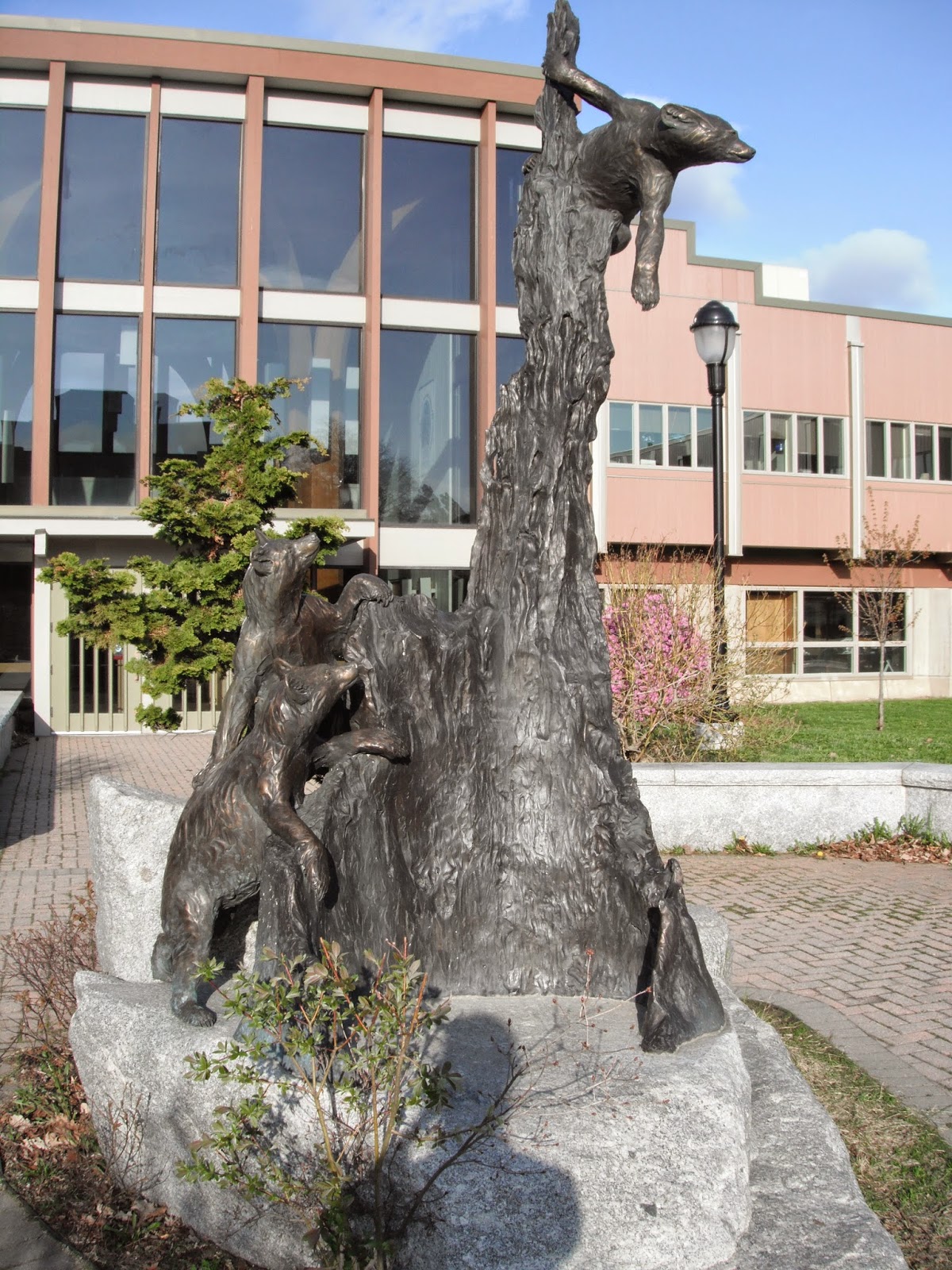
A statue in front of Nutting Hall, where our lab is, as well as the rest of the Department of Wildlife, Fisheries, and Conservation Biology. Note that the little juniper behind the bears is trimmed to look like a miniature pine.

The entry hall of Nutting Hall. Very rustic and all that. The thing on the left appears to be a sideways wooden tree that spins. Your guess as to its purpose is as good as mine.

I found a path to campus through a field and some woods managed by the university. Beehives!

Buoys monitoring the water currents of inland Maine. Currently reporting significant evaporation.

Translation-- "WARNING: KICK-ASS SCIENCE INSIDE"

There's large areas of undeveloped and low-developed land in Maine, and the apartment complex where I live has some trails. I'm a big fan of the birch tree forests here. Reminds me of Mother Russia.

The Penobscot River, on the bridge to downtown Orono. The University of Maine is actually on a large island in the Penobscot. Well, if you are picky about what you call an island, maybe you wouldn't call it an island, but certainly there's a river on both sides of it.
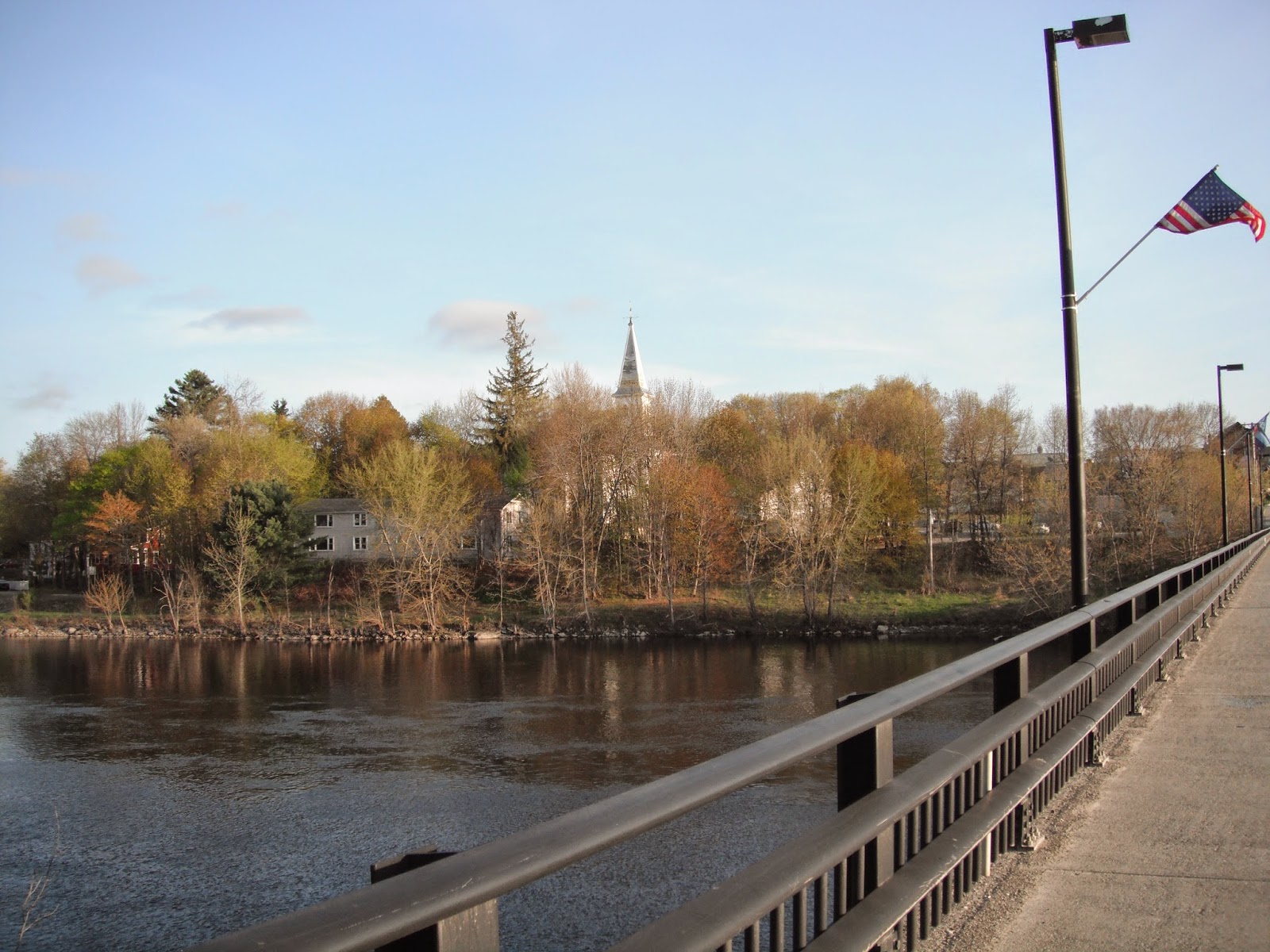
The town of Orono. At last I have reached the region where the jigsaw puzzles with vague origins in "Small-town America" come from.

Sunset over the Penobscot.

Rhododendrons (right?) on campus after rain-showers. Truman purple! Looks like it's going to rain until Thursday of next week, including during our field sampling on Monday, so y'all have some rainy pictures of spring-fed vernal pools to look forward to. Have a good weekend!
Tuesday, May 13, 2014
Pictures: End of Spring & Beginning of Summer
While waiting at a bus station in Portland, Maine to go North to Orono, Maine, I thought I would post some pictures from recent adventures and arrival in Maine.


Spring was late this year, and 39 degrees F in late April was the warmest temperature for our ornithology class's bird surveys at Big Creek Conservation Area, an oak-savannah restoration habitat near Kirksville.
Spring in St. Louis during Easter weekend.
Up early for a bird survey.
Bear Creek on Truman's campus, where I'm doing surveys of the bird community to study the effects of plantings along suburban stream edges.

Spring flowers on Truman's campus!
On Saturday morning after we were all free from our exams, some friends and I got up to see the sunrise at 1000 Hills State Park and eat muffins.
Barn Swallows on the shore.
We had been meaning to rent canoes here for a long time and finally found a morning to do it!
We paddled to a cove of the opposite shore and landed on a small shrubby island, which we believe to be the home of several endemic species of ticks (monographs currently in press.)
The opposite shore.
Finally, Maine: haven't seen much of it yet, but what I've seen so far has been promising. The grassy area in the middle of this picture from the plane is a salt marsh!
In an hour I'm taking a bus north to Bangor, and then it's a short drive to U-Maine's campus. Thanks for reading!
Saturday, May 3, 2014
The Pony Express
 In poetry workshop this semester, our professor told us that the only difference between us and published poets is the "pony express." In other words, the difference is that published writers send their stuff out. It's fitting, then, that the journal in which two poems I wrote for this workshop will appear is named after the saddlebags used by Pony Express mail-carriers: the Mochila Review. (Our teacher encouraged us to submit to this journal, published by Missouri Western, without being aware of the coincidence. Kismet!) Here's the link to the PDF. My poems are on pages 35 and 61. Shout-out to two of my classmates, Lydia Frank (pp. 52 and 78) and Paula Vaught (pp. 25 and 79) , who also are in print in this issue. Here's to the pony express!
We also published the 2014 issue of Windfall, TSU's undergraduate literary magazine, this past Thursday. Let me know if you want a copy (free but limited supply) and I'll try to put one aside for you.
Subscribe to:
Posts (Atom)