Here's the first of what I hope will be a (small) series of sketches of the town of Orono, Maine. This is the Orono Community Center, with a well-trafficked thrift shop on the second floor, senior center on the first floor, and a community garden beside it. Sitting on top of a grassy bluff above a stream, it seemed to have the air of an English country house (which may have something to do with my reading Pride and Prejudice at the moment.) Don't think I was being lazy: there really were only nine windows from where I was sitting. For all its fine angles, it is strangely lacking in the category of windows. I may go back and add color later.
Sunday, June 15, 2014
Saturday, June 7, 2014
Penobscot County Busride
You might think it strange that I haven’t yet written about my work on the vernal pool research project here. (After all, at right is what one of our vernal pools looks like.) However, as lucky as I am to have gotten this opportunity for biology field work, it is nonetheless work, and I’m therefore more inclined to talk and write about what I do on my free time.
And experiences in Ireland, New York, Boston, St. Petersburg, St. Louis, Chicago and now Maine have convinced me that boarding a public bus or light rail train car is one of the most rewarding things you can do with a free day or even with a free forty minutes. So that is what I did with this Saturday: took the bus 20 minutes southwest to the city of Bangor. Perhaps from the outside buses might look like poorly lit mobile caves, but inside you find that the whole cabin is surrounded by wide windows, making you feel like you are on a large glass box. After paying less than a candy bar you are free to board. To an enthusiastic mind, the raised rear section of a bus recalls the quarterdeck of a sailing ship. You are then whirled off somewhere else without having to think about it, and are free to read or listen to music.
Or
perhaps even talk to someone. In Galway, Ireland, the bus drivers I saw often
had friends who would board for a stop or two just to cling on the front pole
and exchange witticisms with them. “Are you a Galway man, at all?” an elderly
man asked me on the train to Dublin, midway through his wife’s brief account of their family’s life history. She told him of course he isn’t,
don’t you see his ball-cap? (I hadn’t picked up a Galwegian accent: I just think he couldn't hear very well.) Sure, I have heard some tedious
speeches on the subways of large cities, but for the most part American
public transit spaces are often ones of comradely traveler’s small talk, or at least
a silence with a positive, and not a defensive, energy to it. Wal-Marts and lame polo shirts carry on their slow, steady arsenic poisoning of American
culture, but buses remain. Even in Maine, buses are multiethnic and often
multilingual. It is one of the few places left in this country where, while
waiting out a long cargo train crossing, a stranger is unafraid of asking another if they’d be brave enough to save up money, get on a train
and cross the country, and another stranger is unafraid to answer yeah, of course, why not?
The bus
from University of Maine-Orono’s campus to Bangor roughly follows the Penobscot
River downstream. Riders are treated to quick views of the river between houses
on the banks, and of small mountain ridges in the distance. This is a good time
to discuss how the people of New England are often spoiled utterly rotten. I
have heard whale watching called “cheesy,” when I believe many of the people I grew up
with in St. Louis will never see a whale. I have heard Mainers talk with great complacency
of the low property values here, how it is only good as retirement country—a
cold Florida. And yet the number of houses—of apartment complexes and trailer
lots—with rock-bottomed salmon rivers a hundred yards wide and more in their
backyards is, to my Midwestern eyes, incredible! Cheesy whale watching, forsooth.
My
wandering about town, up and down the canal, up and down Main Street, satisfied
an appetite I have for urban landscapes that has not been fed by the small but
adorable town of Orono. Having heard that some undergrads at U. Maine see Bangor,
dear little Bangor, as “sketchy,” I was reminded of my hypothesis that
somewhere along the line, many white suburban children learn the lesson that
there is something inherently dangerous and untrustworthy to places where buildings
are close together—even, God forbid, touching along their sides—unless the buildings happen to be in Europe. I don’t know
how exactly I escaped this lesson, but I am grateful that I did. Their
are few cities I've visited that I don't have affection for. I have a passion
for roof gardens (at right) and the tiny, over-planted front lawns of Boston
(usually no larger than a kitchen) that is disproportionate to their size.| The bagel shop on the left is closed on Saturdays--what nonsense! |
| The pub. |
Saturday, May 17, 2014
First Days in Maine
I went into the field with the grad student I'm working with the morning after I arrived in Orono. This is Duck Pond, the first of the vernal pools we sampled from. This summer is about background research and preparing for future summers. We anchored light and temperature sensors to the pool floor and waded to put in depth sticks to track the depth of water over the season. We also attached Nalgene tubing such that we could take samples from different levels of the water column by drawing the water from shore. This is done to avoid disturbing the water and the sediment during sampling. Since the differences in nutrient concentrations are subtle, large primates wading in the pool would instantly change the chemistry of the water column. Eventually, we want to compare water samples taken at deep and shallow depths to see if there is stratification in the nutrient concentrations.
They may not look it, but these pools can get pretty deep. We use hip waders, which go up above the waist, and Duck Pond certainly reached to my hip. The next pool, Emerald Pond, was so deep it would have topped our waders, meaning that the grad student I'm working with had to quickly swim in clothes without waders to put in the depth sticks with the sampling tubing attached. (Waders become dangerous and awkward when full of water, as you might imagine.)
It is also relevant to mention that Duck Pond was 46 degrees F, and Emerald was 52 degrees. Not exactly ideal swimming conditions. For science!
Another view of Duck Pond. More about wading in hip waders: the water pressure flattens them against your legs, and the air in them gives them a buoyancy that makes your feet bounce upwards each time you step. The effect is a little like what I imagine moonwalking in a spacesuit would feel like.
The next field day is this coming Monday. Thursday and Friday were for paperwork, training, and preparing field equipment for Monday. I also had some time to wander around the University of Maine's campus after work. Here's the Library (foreground) and the Memorial Union.
Another view of the Memorial Union.
A house attached to the greenhouses. I've always liked the way universities sometimes re-purpose of old houses instead of tearing them down.
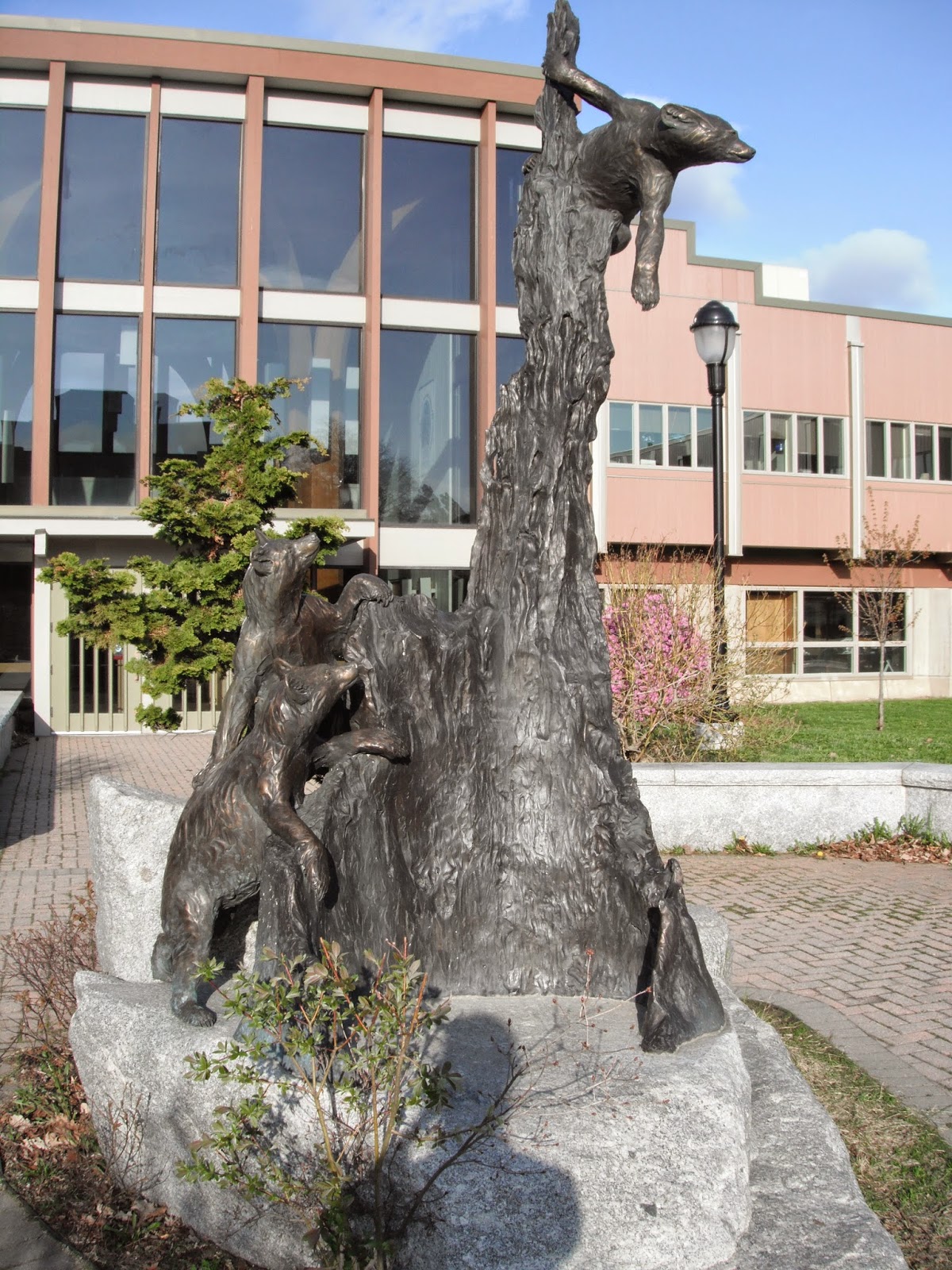
A statue in front of Nutting Hall, where our lab is, as well as the rest of the Department of Wildlife, Fisheries, and Conservation Biology. Note that the little juniper behind the bears is trimmed to look like a miniature pine.
The entry hall of Nutting Hall. Very rustic and all that. The thing on the left appears to be a sideways wooden tree that spins. Your guess as to its purpose is as good as mine.
I found a path to campus through a field and some woods managed by the university. Beehives!
Buoys monitoring the water currents of inland Maine. Currently reporting significant evaporation.
Translation-- "WARNING: KICK-ASS SCIENCE INSIDE"
There's large areas of undeveloped and low-developed land in Maine, and the apartment complex where I live has some trails. I'm a big fan of the birch tree forests here. Reminds me of Mother Russia.
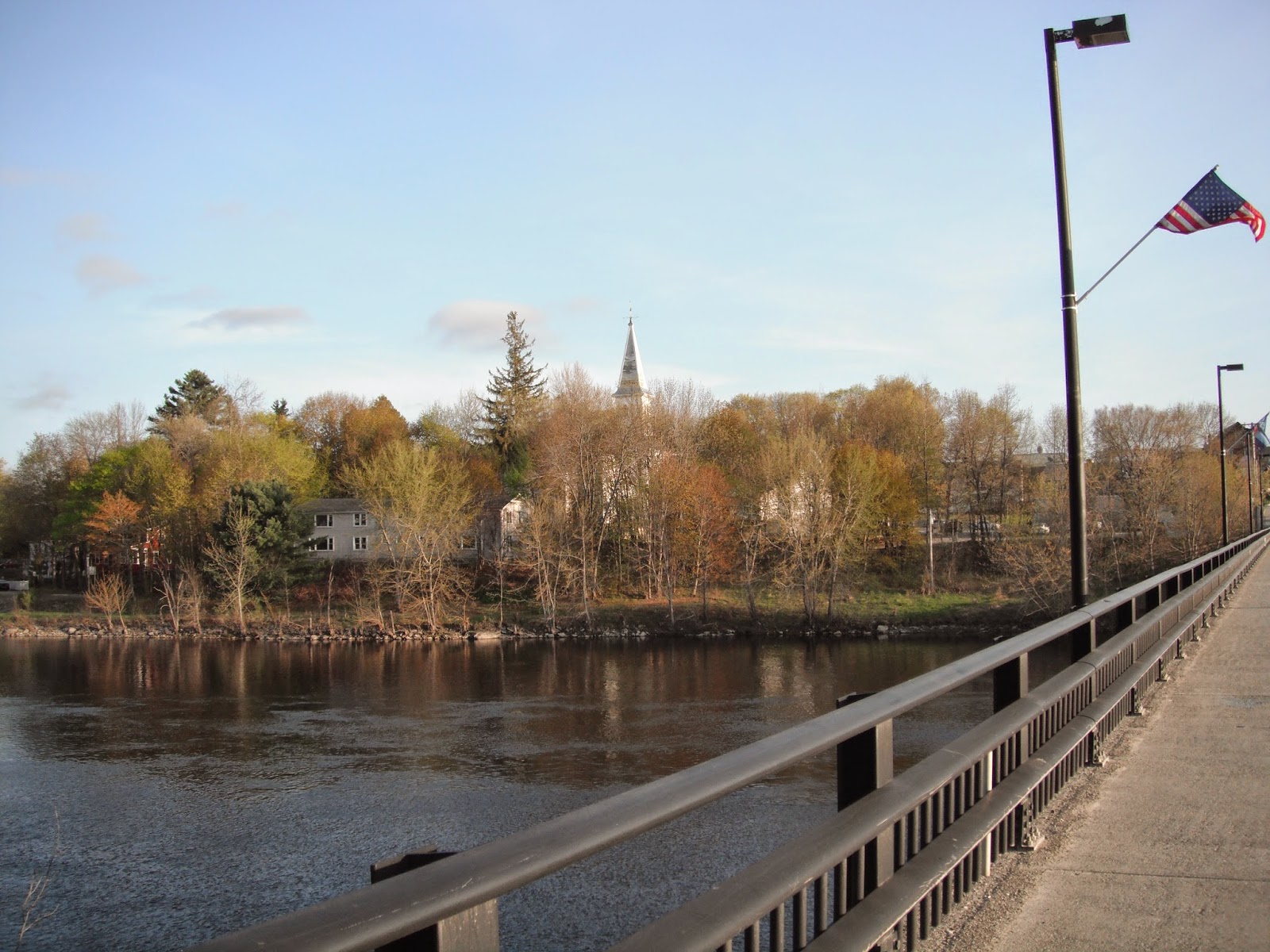
The Penobscot River, on the bridge to downtown Orono. The University of Maine is actually on a large island in the Penobscot. Well, if you are picky about what you call an island, maybe you wouldn't call it an island, but certainly there's a river on both sides of it.
The town of Orono. At last I have reached the region where the jigsaw puzzles with vague origins in "Small-town America" come from.
Sunset over the Penobscot.
Rhododendrons (right?) on campus after rain-showers. Truman purple! Looks like it's going to rain until Thursday of next week, including during our field sampling on Monday, so y'all have some rainy pictures of spring-fed vernal pools to look forward to. Have a good weekend!
Tuesday, May 13, 2014
Pictures: End of Spring & Beginning of Summer
While waiting at a bus station in Portland, Maine to go North to Orono, Maine, I thought I would post some pictures from recent adventures and arrival in Maine.
Spring was late this year, and 39 degrees F in late April was the warmest temperature for our ornithology class's bird surveys at Big Creek Conservation Area, an oak-savannah restoration habitat near Kirksville.
Spring in St. Louis during Easter weekend.
Up early for a bird survey.
Bear Creek on Truman's campus, where I'm doing surveys of the bird community to study the effects of plantings along suburban stream edges.
Spring flowers on Truman's campus!
On Saturday morning after we were all free from our exams, some friends and I got up to see the sunrise at 1000 Hills State Park and eat muffins.
Barn Swallows on the shore.
We had been meaning to rent canoes here for a long time and finally found a morning to do it!
We paddled to a cove of the opposite shore and landed on a small shrubby island, which we believe to be the home of several endemic species of ticks (monographs currently in press.)
The opposite shore.
Finally, Maine: haven't seen much of it yet, but what I've seen so far has been promising. The grassy area in the middle of this picture from the plane is a salt marsh!
In an hour I'm taking a bus north to Bangor, and then it's a short drive to U-Maine's campus. Thanks for reading!
Saturday, May 3, 2014
The Pony Express
In poetry workshop this semester, our professor told us that the only difference between us and published poets is the "pony express." In other words, the difference is that published writers send their stuff out. It's fitting, then, that the journal in which two poems I wrote for this workshop will appear is named after the saddlebags used by Pony Express mail-carriers: the Mochila Review. (Our teacher encouraged us to submit to this journal, published by Missouri Western, without being aware of the coincidence. Kismet!) Here's the link to the PDF. My poems are on pages 35 and 61. Shout-out to two of my classmates, Lydia Frank (pp. 52 and 78) and Paula Vaught (pp. 25 and 79) , who also are in print in this issue. Here's to the pony express!
We also published the 2014 issue of Windfall, TSU's undergraduate literary magazine, this past Thursday. Let me know if you want a copy (free but limited supply) and I'll try to put one aside for you.
Tuesday, April 22, 2014
Off to Orono
This summer I am headed off to the University of Maine-Orono to work as a Research Assistant on a project studying ephemeral wetlands. The small bodies of water we will be studying are called vernal pools. They fill with snowmelt in spring and dry up at the end of the summer. In the time in between, they are important habitat for frogs and salamanders. The project is supported by a National Science Foundation grant for research on small-scale landscape features with an out-sized impact on the surrounding ecosystem.
The graduate student I am working with is focusing on biogeochemistry and the cycles of nutrients in the pools, including dissolved oxygen, nitrogen and phosphorus. Keeping an eye on these chemical concentrations can give us a better idea of the quality of the habitat and how it is being affected by runoff from nearby human activity. That's my slapdash explanation before actually having seen any of these pools. I'll know much more soon.
As the ice is melting right about now, I will have to head off to Maine quickly after exams end. I'll be back in Saint Louis in mid-August.
This is my first experience on a biology project with national funding, so I'm very excited to start. In Orono, I will also be an hour from Acadia National Park. It will be a different kind of summer than I'm used to, but it should be very rewarding! I hope to keep some updates here throughout the summer.
The graduate student I am working with is focusing on biogeochemistry and the cycles of nutrients in the pools, including dissolved oxygen, nitrogen and phosphorus. Keeping an eye on these chemical concentrations can give us a better idea of the quality of the habitat and how it is being affected by runoff from nearby human activity. That's my slapdash explanation before actually having seen any of these pools. I'll know much more soon.
As the ice is melting right about now, I will have to head off to Maine quickly after exams end. I'll be back in Saint Louis in mid-August.
This is my first experience on a biology project with national funding, so I'm very excited to start. In Orono, I will also be an hour from Acadia National Park. It will be a different kind of summer than I'm used to, but it should be very rewarding! I hope to keep some updates here throughout the summer.
Saturday, March 29, 2014
The True Confessions of a Teacher's Pet
The most Notebookish of my Index columns so far considers the possible causes of lackluster class discussions and students' reluctance to answer certain questions. I also wrote but did not draw the notebook-scribble info-graphic below the column, which I feel like I should have made either more simple or more obnoxiously complicated. (It's a Catch 22!)
Subscribe to:
Posts (Atom)