Wednesday, May 8, 2013

In Just-spring

A brief history of northern Missouri weather this year, for those interested.


Not so long ago, this was where we lived. Note the heavily laden trees, the nearly unrecognizable campus (this is in front of the health center, believe it or not), and the snow leopard in the bottom right.

And then we went through that long period of a few days of warm weather and then back to winter; meanwhile, the trees cautiously kept their leaves back.


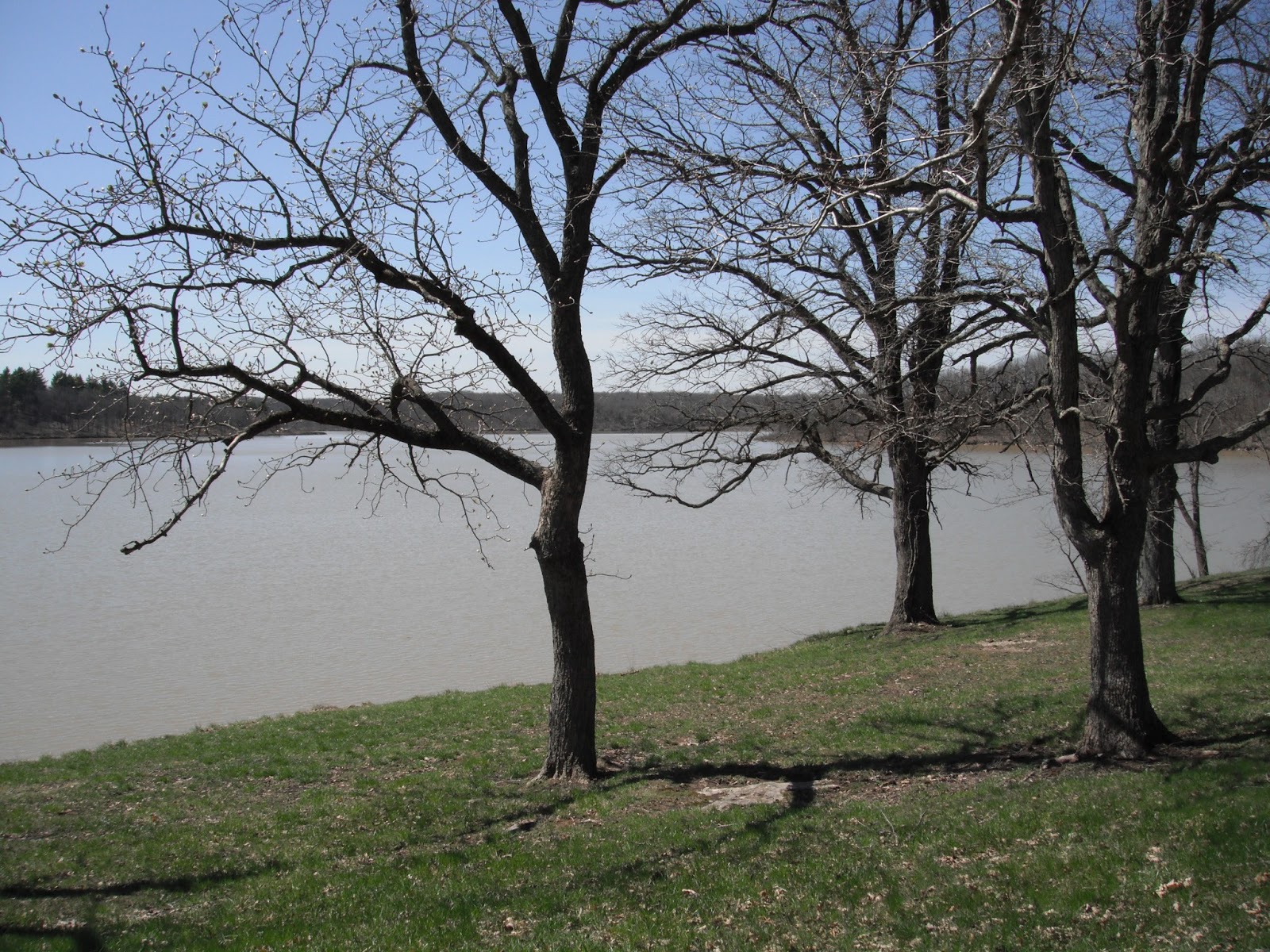
 But then, very suddenly, "the world is mud-luscious" and "puddle-wonderful" (ee cummings).


Welcome to the Shire. I'm a big fan of these blue flowers at left. Also the pink ones above. A kind of cherry tree, perhaps?

(In my best David Attenborough voice) With the long-awaited departure of the migratory polar bears, the rabbit population of the southern prairie and its bordering forests at last rebounds--and bounds, and bounds.


I tend to take pictures of the same thing over and over again--you might remember seeing a similar view of the shelter in the Sunken Garden before. However, I'm not particularly apologetic about this habit--no, what I really want is a picture from the same view at the same time of day from every day of at least one year, but preferably seven.

Lately I've wondered what we are to make of transformations of this kind. As astonished as we are every time, spring happens every year. The popular short-sighted mistake is to see the turning of seasons as linear progress, conquering the preceding season--which would be about as silly as spinning around in a four-walled room and thinking that each time your sight passes a corner, the wall you're looking at is new and unique in the world. Then again, maybe not such a mistake. Doesn't each spring have a character of its own among all springs that have ever been? Do we remember enough of what is the same to really know what is different? And perhaps climate change is making our weather even more frantic and capricious, and perhaps there are more sinister implications for these seemingly more abrupt changes between the seasons. But even if it turned out to be scientifically irrelevant, I suppose I'd rather stay one of the foolish humans spinning in our enormous room of light, forgetful and amazed at the intricate green details each time around.

Wednesday, May 1, 2013

Eating an Apple with No Noise at All

Good news! The nice folks over at the Foliate Oak Literary Magazine published my poem in their May issue. Read it here. Check out Foliate Oak's Facebook page here.

And cue celebratory fiddle tune:


Sunday, April 7, 2013

The Death of Justina (Cover)


Sometimes in a day that's going in too many directions at once, filled with a strong feeling that surges out of the shallow waters of intellect and can only find its depth in music, I want to hear a certain song. Lately it's been Jimi Hendrix's live cover of "Like a Rolling Stone." And sometimes it's enough to just imagine the music coming from me, me becoming Hendrix, calling the drummer Bob Dylan's grandmother, banging out the first chords. "Yeah hear what I say now—"

But other times that's not enough—sometimes you have to hold whatever instrument it is that you play and try to play what you want to hear. I've got a violin. Violins and guitars are different creatures, but it doesn't stop me from trying. It doesn’t matter what it might sound like to others—if I can get the barest scrape to how it’s supposed to sound, it’s usually enough.

And still other times, the music I want to hear is words. Sometimes just reading the words is enough, imagining myself reading them, the author reading them—myself as the author. 

But other times I've got to actually write the words, with my own hands hitting the chords and plucking out the riffs. Because so help me God it gets more and more preposterous, it corresponds less and less to what I remember and what I expect as if the force of life were centrifugal and threw one further and further away from one's purest memories and ambitions; and I can barely recall the old house where I was raised, where in midwinter Parma violets bloomed in a cold frame near the kitchen door, and down the long corridor, past the seven views of Rome—up two steps and down three—one entered the library, where all the books were in order and the lamps were bright. Fiction is art and art is the triumph over chaos (no less) and we can accomplish this only by the most vigilant exercise of choice, but in a world that changes more swiftly than we can perceive there is always the danger that our powers of selection will be mistaken and that the vision we serve will come to nothing.

I think that's why for so long schoolchildren were taught to get Bible verses and poems to heart, and why to John Cheever, in one story no words of his own would do, why the old durable words came through him with the irresistible force of a song we all know:

"Do, he wrote, or you'll be dead. I felt very tired. I put another piece of paper into the machine and wrote: The Lord is my shepherd, therefore can I lack nothing. He shall feed me in a green pasture and lead me forth beside the waters of comfort. He shall convert my soul and bring me forth in the paths of righteousness for his Name's sake. Yea, though I walk through the valley of the shadow of death I will fear no evil for thou art with me; thy rod and thy staff comfort me. Thou shalt prepare a table before me in the presence of them that trouble me; thou hast anointed my head with oil and my cup shall be full. Surely thy loving-kindness and mercy shall follow me all the days of my life and I will dwell in the house of the Lord for ever. I gave this to Ralphie and went home."

Thursday, April 4, 2013

A Word: Why Do We Call Dollars 'Dollars'?


Happy Spring! It still doesn't feel too much like spring in Kirksville, though we are seeing some early monocot flower buds push blade-like leaves through the topsoil. I've got a few essay-like ideas putting down roots right now. While these are developing secondary xylem and solidifying their grasp on the soil, here's a short linguistic-historical tale I wrote, once again for the Writing Center blog, on the creation of the word 'dollar.' It was the result of a journey through several entries in the Oxford English Dictionary, a voyage only possible with a sturdy magnifying glass.


A Word: Why Do We Call Dollars 'Dollars'?


Ah, the ubiquitous crumpled dollar—that small greenish rectangle of linen that purchases our chewing gum, under-tips the wait staff at restaurants, and refuses to be inserted into vending machines. But where does that word dollar actually come from?

Dollar, just like Dvorák, RENT, Pilsener, a lengthy pseudo-operatic rock song from the 1970s, and Ántonia Shimerda, comes to us from Bohemia, which is now part of the Czech Republic. In 1516, in the town of Jáchymov, situated near the German border and called by the nearby Germans Joachimsthal (literally “Joachim’s valley”), a new silver mine opened. Three years later, Count Hieronymus Schlick, a nobleman wishing to extend his coolness even beyond being a Bohemian count named Hieronymous Schlick, decided to start minting his own money from the silver mined in Joachimsthal, and called his large coins Joachimsthalers. (Note that in German, ‘th’ is pronounced as a hard ‘t,’ and that the ‘a’ in Joachimsthalers is pronounced like ‘a’ in English ‘what.’) As this coin gained use throughout Bohemia and Germany, burghers chose to shorten this unwieldy name to just thaler, which became the currency in many German states until German unification under Otto von Bismarck, when the Goldmark became the imperial currency. According to the Oxford English Dictionary, in the 16th century the thaler spread from High and Low German to Dutch, the language of the great sea-traders who spread their dalars all over the world, and from thence at last to England, where it was Anglicized into daler, daller, and finally dollar. Moral: next time you go to buy a bag of Cheetos from the vending machine in the laundry room, thank Count Schlick for not naming his coins Hieronyms or Schlicks.

Wednesday, March 13, 2013

The Pope and the Sow

At my Catholic, all-boys high school, our theology teachers advised us students to be ready for people that would challenge our beliefs once we were turned loose upon the world. Probably the most prevalent reaction to this warning among us, for better or worse, was a sort of confused indifference; some of us armed ourselves with Catholic apologist thought, in preparation for future theological sparring matches; my personal feelings lay somewhere in the muddle between those two. I have little tolerance for some of the ossified social opinions that the Catholic church chooses to cloak in heavy dogmatic robes and impenetrable pseudo-legal prose. On the other hand, I didn’t look forward to the prospect of hearing the church criticized. I felt protective of it in a certain way, like one would feel protective of a relative with some odd habits. The purest dogmatic form of Catholicism is certainly not my spiritual center, but at the same time many of my strongest beliefs do come from the Catholic tradition. More traditionalist Catholics would likely criticize me as a “cafeteria,” or carelessly eclectic, Catholic, picking out beliefs like green beans, pizza, and chocolate milk at the dining hall.

But as Truman State’s Newman Center pastor Father Bill says, it’s hard to be in the middle. My beliefs, which I would never claim as the best or even particularly coherent, are just where conscience and experience has led me. Many of my friends in college are amused to find that I’m Catholic. The church seems to be regarded not so much with suspicion but with cautious interest, perhaps like the kind felt at a zoo when looking at a rare species of iguana. The iguana has little interest in them, but they are interested in its unusual form. “Huh,” they say. “Catholic. Interesting.” I have a tendency to offer fun facts in conversation, and when one of these is related to Catholicism, my friends acknowledge the occurrences by calling, “Catholic Fact!”


The one thing that non-Catholics have actually questioned me about in college is the tradition of saints. Why pray to saints when Jesus is supposed to be our personal savior, our direct link to the divine? I’ve never had a perfect, direct answer for that question, mainly feeling that such spiritual navigation is best left to one’s own working out. The idea of saints as good examples is too simple. Catholics and non-Catholic Christians are not likely to come to an understanding on that issue.


However, I do understand saints as stories. Many of our early saints are, plainly stated, made up. They are some of the countless mythic creations that are a large part of our story-telling species’ lives. That does not have to make the truths they represent less valuable, or that I don’t have great respect for most of the saint stories I’ve heard. Like any of our stories, saint stories begin with a seed of real-world experience. In some cases, it was the verifiable life of the person in question. In other cases, it is a re-working of messy experience into terms that can be communicated through a memorable story. Whether we realize it or not, we own the stories of our saints. They are what we will make of them.


Our new pope, Francis, formerly Arcbishop Jorge Bergoglio of Buenos Aires, is the first pope from South America, as well as the first Jesuit pope. As my high school was Jesuit, this connects him to me. We share an important set of beliefs about living in the world. Many religious orders believe that a relationship with God is only possible through removing oneself from the world and living monastically. Jesuits believe that solitude is important, but that one must also find God in all things, particularly in the chaotic world of human society and of nature. The language of the Jesuits uses military metaphors because the founder, Ignatius, saw the new order as on the front lines of carrying out the Gospel, delving into the messiness of reality and doing their best there. Jesuits value connection with the world as it is. One of the first stories that CNN told about Francis is that, as Archbishop Bergoglio, he lived in an apartment and rode the buses of Buenos Aires to work. Anyone on the bus could chat with him if they wanted. That’s the mark of a true Jesuit.


Our new pope has chosen a name that no pope has ever chosen before. And he has taken partial ownership of a very important name and story, that of St. Francis. I’m thinking, as I would imagine the new pope was, mainly of St. Francis of Assisi than the other saints by the name of Francis (though, importantly, Francis Xavier was a co-founder of the Society of Jesus with Ignatius, and Francis Borgia was an early Jesuit.) The story of St. Francis of Assisi is to us very familiar—that animal saint. He is surrounded by happy, anthropomorphized smiling creatures when he is painted. It makes him a fun saint, and much approachable for non-Catholics than some of our bloodied martyrs or anti-Semitic crusader-saints (I’m looking at you, Louis IX, namesake of my hometown.)


You might be surprised to hear that St. Francis’s story was not always told this way—far from it. The original St. Francis had little patience for animals on their own, and much less for flawed humanity’s connections to the natural world that animals usually represent in our stories. One of the original, canonical tales of St. Francis was his interaction with a sow. The sow had killed a lamb with its muzzle, and Francis, linking the lamb to the metaphor of Jesus as the sacrificial lamb of God, vengefully cursed the sow and proclaimed that no man or beast would eat from its dead body. This curse led to its death just days later. This sow is our fallen nature, our inclination to destroy innocence. The historical St. Francis—and even the St. Francis of many legends—had no particular kindness for most animals. Though he believed in the communion of all creation in praise of the Creator, he did not believe that all creation was anything near equal, holding to the medieval Christian conception of nature, in which humans were the privileged stewards of creation. In the Victorian period, however, St. Francis began to be pictured as associating in a friendly way with animals, based on the “Canticle of the Creatures” attributed to him. In the 1960s and ’70s, during the environmental movement, ecologists, environmentalists, and theologians began re-popularizing these images of St. Francis emphasized caring for animals that were created long after his death. In 1967, historian Lynn White argued that St. Francis should become the patron saint of ecologists, for he saw St. Francis as a radical that brought about a new, more humble conception of the relationship between humans and nature. White viewed St. Francis as what is known as a deep ecologist, claiming that the “key to an understanding of Francis is his belief in the virtue of humility—not merely for the individual but for man as a species.” Though White’s goal was essentially to create a “new religion” of ecology, whose patron saint was St. Francis, the part of his paper that suggested a reconsideration of St. Francis as a medieval Christian ecological activist was accepted by the religious establishment. Pope John Paul II followed White’s suggestion and canonized St. Francis as patron of ecologists in 1979.


A year later, one of my favorite poets, Galway Kinnell, published a piece called “Saint Francis and the Sow.” (Yes, short and worth a read. I wrote a paper on it last year, which is why I’ve got all these fun facts about St. Francis ready to go. Catholic Fact!) In his poetry, Kinnell tries not to personify animals but to animalize humanity, and to seek out the natures of animals as valuable in their own right. In this poem, the reverse of the original story, St. Francis is depicted awakening the sow to its own powers of self-blessing, playing a surprisingly humble role for a saint. He “reteaches” the sow “its loveliness,” and the sow “flowers, from within, of self-blessing.” Kinnell’s St. Francis empowers animals. He does not presume to lift them above their animal-ness but rather affirms it, and in so doing affirms the cast-off, looked-down upon parts of ourselves.


Pope Francis the First reminded me of this humbler incarnation of St. Francis today when he asked the assembled crowds at St. Peters’s, as well as the millions tuned in around the world, to pray for him. The applause and hum on our TV gave way suddenly to a few moments of meditative silence as he and everyone else bowed their heads. It is a small sign, but it is a sign of a humble vision of the pope’s role, and a sign that perhaps this pope is participating in the continued creation of St. Francis’s story like Galway Kinnell and others. It gives me hope that I’ll be better able to explain why I am still a Catholic, and that the stories that we tell about this Francis just might have value for future generations. But we’ll have to see.

Friday, March 1, 2013

"Quips and sentences and these paper bullets of the brain"


It's been a while since I've put something up here. Don't think I haven't been working, though. I've been focusing on poetry lately, as well as looking into publishing in literary journals. It could be quite a while before the fruits of those efforts appear, though. For now, here's an essay I wrote for the Truman Writing Center's blog about choosing good verbs. I doubt that you folks need or want advice on the fundamentals of writing, but in this essay we get the chance to destroy a perfectly good poem, as well as explore the ways in which the original poem works.

On Verbs: Sink or Swim—Or Walk?


Trust your verbs. Always—and if you find that you can’t trust them, fire them and get new ones. You can’t have a sentence without a verb. Verbs are not always the showiest part of a sentence, not always the part of your writing that the reader walks away remembering, but they are the hub around which all the other parts of the sentence turn. To make a comparison to music, verbs are like the chords in a song, the essential foundation that gives just the right tension and shading to the ear-catching melody of nouns and adjectives.

The fundamental importance of verb choice is sometimes hard to see clearly unless you compare the disastrous effects of the wrong verb to the strong but flexible structure given by the right verbs. To see some verbs in action, let’s look at a poem by Billy Collins. He’s one of my favorite poets—the clarity and accessibility of his word choice often stands in sharp contrast to the surprising journeys his images take the reader on.

Walking Across the Atlantic
Billy Collins

I wait for the holiday crowd to clear the beach
before stepping onto the first wave.

Soon I am walking across the Atlantic
thinking about Spain,
checking for whales, waterspouts.

I feel the water holding up my shifting weight.
Tonight I will sleep on its rocking surface.

But for now I try to imagine what
this must look like to the fish below,
the bottoms of my feet appearing, disappearing.

(from Sailing Alone Around the Room)

Lovely little poem, don’t you think? So that we can contrast the firm, flexible structure made by good verbs with the chaos, or inflexible, impenetrable wordiness, caused by bad and unhelpful ones, let’s ruin this poem by just changing some of the verbs to similar, but much less effective, ones. With apologies to Collins:

Strolling Across the Atlantic

I stand waiting for the holiday crowd to vacate the beach
before hopping onto the first wave.

Soon I am strolling across the Atlantic
dreaming about Spain,
watching for whales, waterspouts.

I feel the water keeping up my shifting weight.
Tonight I will snooze on its rocking surface.

But for now I try to visualize what
this must look like to the fish below,
the bottoms of my feet showing up suddenly and vanishing.

Well, yuck, right? It’s not meaningless, but it’s not poetry any more. Everything’s either gone flat, or gone silly. See how “stand waiting” adds an unnecessary word and changes the simple, deft stroke of “wait” to a two-word phrase with a clunky –ing ending? See how “strolling,” which might appeal to us at first as a more interesting action than “walking,” just made things far too silly and egotistical, in contrast to the determined but everyday tone that the original poem had with “walking”? See how “watching” in the second stanza gave the narrator an over-anxious Captain Ahab attitude, in addition to adding a third word beginning with ‘w’ to that line, overwhelming the subtle, wispy alliteration Collins intended with “whales, waterspouts”? See how “to visualize” in the third stanza is so much more wordy and businesslike and less dreamy than “to imagine”?

I could have changed the verbs much more subtly and still spoiled the poem. On the other hand, it could have been worse: I didn’t throw in any nasty passive-voice constructions like “I felt my weight as it was held by the water” that invert the usual clearer order of doer of the action followed by receiver of the action: “I feel the water holding up my shifting weight.” Picking ineffective verbs—too wordy or too extreme—can keep your writing tied to the ground. Or, to stay in the world of this poem, the surface tension created by the verbs that keeps you on top of the water collapses, and you sink into the waves like the rest of humanity, splashing about in a sea of unhelpful language.

Our choices with verbs are more limited than other word choices in English. When choosing a noun or an adjective, we often have dozens of alluring options. But finding the right verb for a situation has a pleasure all its own. While they are sometimes less flashy than the adjectives or the nouns—I’m more likely to remember the “whales” and “waterspouts” than that the narrator was “checking” for them—they set the tone in a way that nouns and adjectives simply cannot. “Checking” is the same thing we do when crossing the street—it’s casual, almost thoughtless. In our mind’s eye, we see the narrator turning his head every now and then to look right and left for a whale’s back or a spout of water, as if for an oncoming car at a crosswalk—just in case. We get the sense that the narrator has done this before. He has walked across the Atlantic so many times that it’s as habitual as crossing a street with light traffic. He has dealt with the fantastic so many times that to him, it’s just an everyday occurrence. This is the essential tension of the poem—the contrast between the supernatural journey taken and the simple, confident word choice of the narrator. It allows this poem to retain its mystery and offer up new pleasures even after many explorations. Verbs can take you across the Atlantic—as long as they’re the right ones.

Tuesday, February 26, 2013

Tuesday


has a perfection that haunts me,
like the oracular whine in the cabin of an airliner
sailing over Ohio.
Something transient, the lack of judgment

gifted to time neither end
nor beginning, nor yet even middle:
some minor point in the development,

often missed by fast readers, where
the characters are quietly putting on
their humanity like early spring jackets:
a favorite word, a particular thoughtful expression
that comes over one’s face
when listening to music
or writing out French homework,
trouble falling asleep, trouble waking,
an inclination towards cloud architecture,
a mild hatred of cats, a violent affection
for a certain sitcom.

The events of Wednesday will swallow these things.
On that absurd and turbulent day,
someone new will hate us,
we’ll make Grandma angry for the first time
in twenty years,
we’ll be falling in love, we’ll get chased
by a nasty neighbor’s poodle,
we’ll save someone’s life,
we’ll run over a pregnant opossum
and feel evil for days.

But for now,
the sky as yet dim and bland,
the waking dog
raising its nose to the fading moon
and the Pop-Tarts hot in our hands,
let us drink up the perfection of Tuesday.