Saturday, May 17, 2014

First Days in Maine


I went into the field with the grad student I'm working with the morning after I arrived in Orono. This is Duck Pond, the first of the vernal pools we sampled from. This summer is about background research and preparing for future summers. We anchored light and temperature sensors to the pool floor and waded to put in depth sticks to track the depth of water over the season. We also attached Nalgene tubing such that we could take samples from different levels of the water column by drawing the water from shore. This is done to avoid disturbing the water and the sediment during sampling. Since the differences in nutrient concentrations are subtle, large primates wading in the pool would instantly change the chemistry of the water column. Eventually, we want to compare water samples taken at deep and shallow depths to see if there is stratification in the nutrient concentrations.


They may not look it, but these pools can get pretty deep. We use hip waders, which go up above the waist, and Duck Pond certainly reached to my hip. The next pool, Emerald Pond, was so deep it would have topped our waders, meaning that the grad student I'm working with had to quickly swim in clothes without waders to put in the depth sticks with the sampling tubing attached. (Waders become dangerous and awkward when full of water, as you might imagine.)

It is also relevant to mention that Duck Pond was 46 degrees F, and Emerald was 52 degrees. Not exactly ideal swimming conditions. For science!

Another view of Duck Pond. More about wading in hip waders: the water pressure flattens them against your legs, and the air in them gives them a buoyancy that makes your feet bounce upwards each time you step. The effect is a little like what I imagine moonwalking in a spacesuit would feel like.

The next field day is this coming Monday. Thursday and Friday were for paperwork, training, and preparing field equipment for Monday. I also had some time to wander around the University of Maine's campus after work. Here's the Library (foreground) and the Memorial Union.

Another view of the Memorial Union.

A house attached to the greenhouses. I've always liked the way universities sometimes re-purpose of old houses instead of tearing them down.
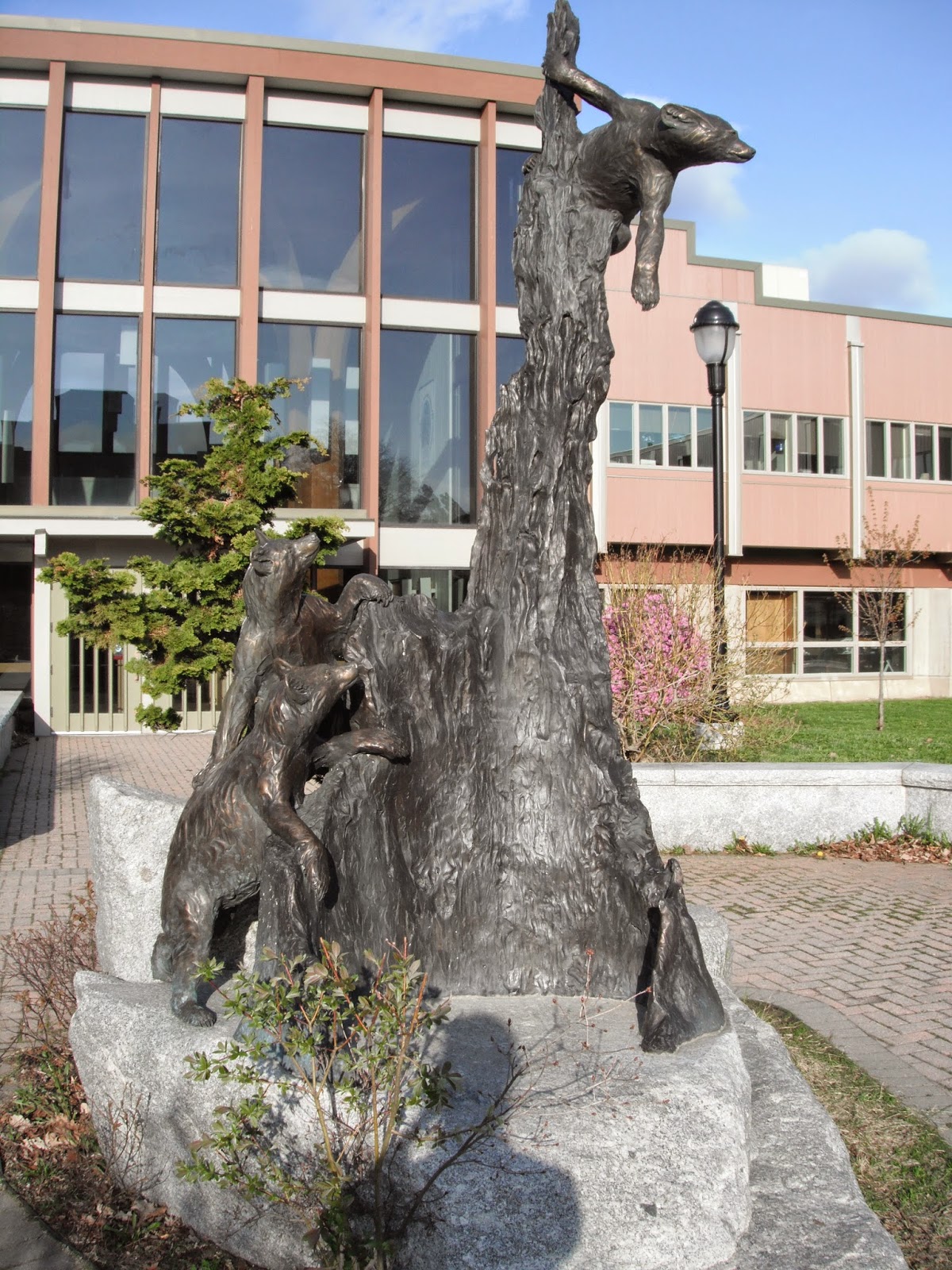
A statue in front of Nutting Hall, where our lab is, as well as the rest of the Department of Wildlife, Fisheries, and Conservation Biology. Note that the little juniper behind the bears is trimmed to look like a miniature pine.

The entry hall of Nutting Hall. Very rustic and all that. The thing on the left appears to be a sideways wooden tree that spins. Your guess as to its purpose is as good as mine.

I found a path to campus through a field and some woods managed by the university. Beehives!

Buoys monitoring the water currents of inland Maine. Currently reporting significant evaporation.

Translation-- "WARNING: KICK-ASS SCIENCE INSIDE"

 There's large areas of undeveloped and low-developed land in Maine, and the apartment complex where I live has some trails. I'm a big fan of the birch tree forests here. Reminds me of Mother Russia.

The Penobscot River, on the bridge to downtown Orono. The University of Maine is actually on a large island in the Penobscot. Well, if you are picky about what you call an island, maybe you wouldn't call it an island, but certainly there's a river on both sides of it.
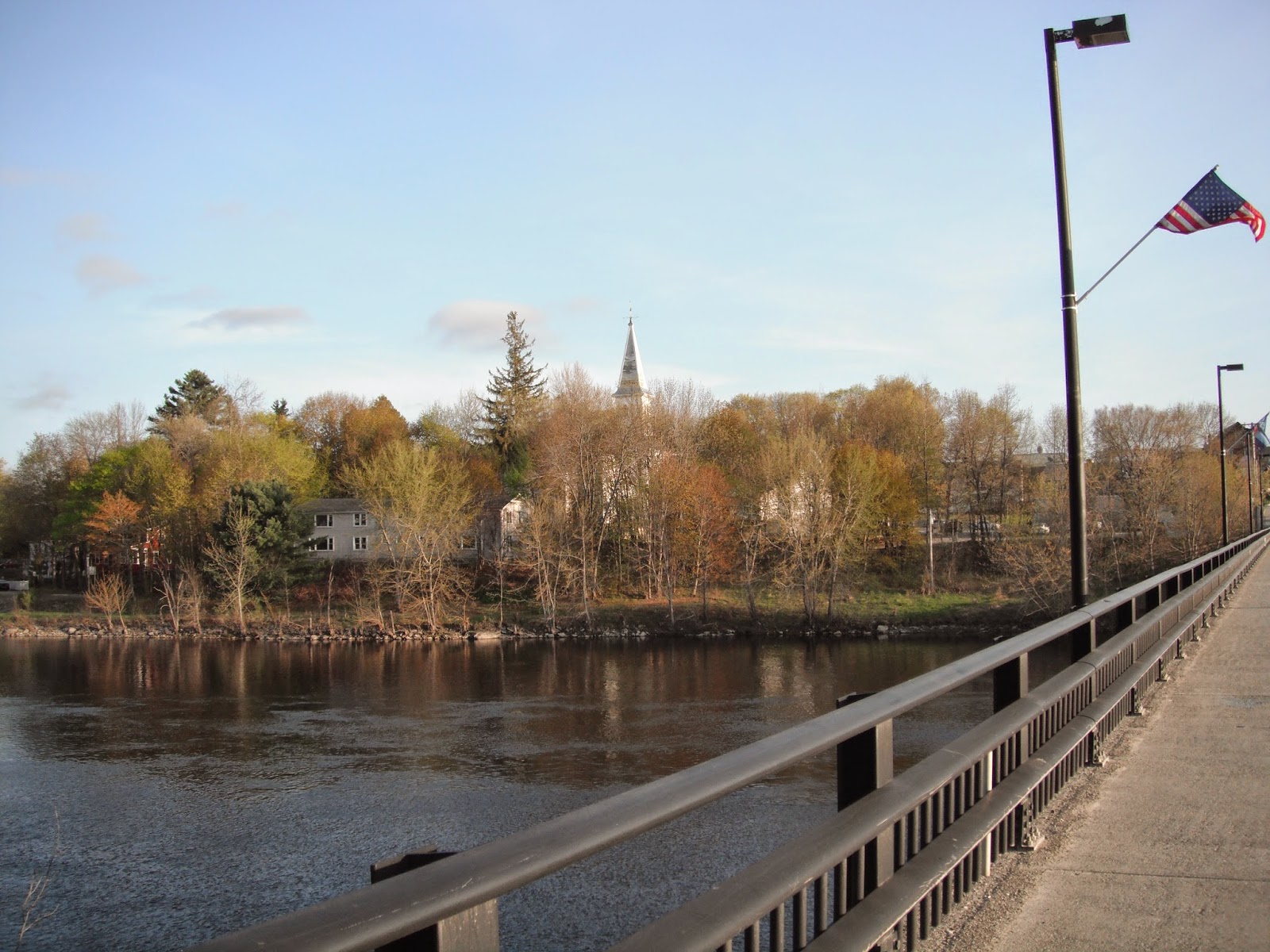
The town of Orono. At last I have reached the region where the jigsaw puzzles with vague origins in "Small-town America" come from. 

Sunset over the Penobscot.

Rhododendrons (right?) on campus after rain-showers. Truman purple! Looks like it's going to rain until Thursday of next week, including during our field sampling on Monday, so y'all have some rainy pictures of spring-fed vernal pools to look forward to. Have a good weekend!


Tuesday, May 13, 2014

Pictures: End of Spring & Beginning of Summer

While waiting at a bus station in Portland, Maine to go North to Orono, Maine, I thought I would post some pictures from recent adventures and arrival in Maine.


Spring was late this year, and 39 degrees F  in late April was the warmest temperature for our ornithology class's bird surveys at Big Creek Conservation Area, an oak-savannah restoration habitat near Kirksville.

Spring in St. Louis during Easter weekend.


Up early for a bird survey.


Bear Creek on Truman's campus, where I'm doing surveys of the bird community to study the effects of plantings along suburban stream edges.

Spring flowers on Truman's campus!

On Saturday morning after we were all free from our exams, some friends and I got up to see the sunrise at 1000 Hills State Park and eat muffins.

Barn Swallows on the shore.

We had been meaning to rent canoes here for a long time and finally found a morning to do it!

We paddled to a cove of the opposite shore and landed on a small shrubby island, which we believe to be the home of several endemic species of ticks (monographs currently in press.)

The opposite shore.

Finally, Maine: haven't seen much of it yet, but what I've seen so far has been promising. The grassy area in the middle of this picture from the plane is a salt marsh!

In an hour I'm taking a bus north to Bangor, and then it's a short drive to U-Maine's campus. Thanks for reading!

Saturday, May 3, 2014

The Pony Express

In poetry workshop this semester, our professor told us that the only difference between us and published poets is the "pony express." In other words, the difference is that published writers send their stuff out. It's fitting, then, that the journal in which two poems I wrote for this workshop will appear is named after the saddlebags used by Pony Express mail-carriers: the Mochila Review. (Our teacher encouraged us to submit to this journal, published by Missouri Western, without being aware of the coincidence. Kismet!) Here's the link to the PDF. My poems are on pages 35 and 61. Shout-out to two of my classmates, Lydia Frank (pp. 52 and 78) and Paula Vaught (pp. 25 and 79) , who also are in print in this issue. Here's to the pony express!

We also published the 2014 issue of Windfall, TSU's undergraduate literary magazine, this past Thursday. Let me know if you want a copy (free but limited supply) and I'll try to put one aside for you.

Tuesday, April 22, 2014

Off to Orono

This summer I am headed off to the University of Maine-Orono to work as a Research Assistant on a project studying ephemeral wetlands. The small bodies of water we will be studying are called vernal pools. They fill with snowmelt in spring and dry up at the end of the summer. In the time in between, they are important habitat for frogs and salamanders. The project is supported by a National Science Foundation grant for research on small-scale landscape features with an out-sized impact on the surrounding ecosystem.

The graduate student I am working with is focusing on biogeochemistry and the cycles of nutrients in the pools, including dissolved oxygen, nitrogen and phosphorus. Keeping an eye on these chemical concentrations can give us a better idea of the quality of the habitat and how it is being affected by runoff from nearby human activity. That's my slapdash explanation before actually having seen any of these pools. I'll know much more soon.

As the ice is melting right about now, I will have to head off to Maine quickly after exams end. I'll be back in Saint Louis in mid-August.

This is my first experience on a biology project with national funding, so I'm very excited to start. In Orono, I will also be an hour from Acadia National Park. It will be a different kind of summer than I'm used to, but it should be very rewarding! I hope to keep some updates here throughout the summer.

Saturday, March 29, 2014

The True Confessions of a Teacher's Pet

The most Notebookish of my Index columns so far considers the possible causes of lackluster class discussions and students' reluctance to answer certain questions. I also wrote but did not draw the notebook-scribble info-graphic below the column, which I feel like I should have made either more simple or more obnoxiously complicated. (It's a Catch 22!)

Thursday, March 20, 2014

What's So Funny 'bout Literary Theory?

The next time I try to explain, apologize for, defend, rationalize, criticize, or otherwise talk about literary theory (that often misunderstood boogie man of academia) with someone less familiar with its goals, I plan on repeating more or less word-for-word Louis Menand's introduction to his piece on Paul de Man. At any rate, it's better than mumbling something along the lines of:  "Derrida ... class struggle ... subaltern ... objet petit a! Anyway, it's something we should all care about."

"The idea that there is literature, and then there is something that professors do with literature called “theory,” is a little strange. To think about literature is to think theoretically. If you believe that literature is different from other kinds of writing (like philosophy and self-help books), if you have ideas about what’s relevant and what isn’t for understanding it (which class had ownership of the means of production, whether it gives you goose bumps, what color the author painted his toenails), and if you have standards for judging whether it’s great or not so great (a pleasing style or a displeasing politics), then you have a theory of literature. You can’t make much sense of it without one.

It’s the job of people in literature departments to think about these questions, to debate them, and to disseminate their views. This is not arid academicism. It affects the way students will respond to literature for the rest of their lives. But it’s also part of an inquiry into the role of art in human life, the effort to figure out why we make this stuff, what it means, and why we care so much about it. If this is not the most important thing in the world to understand, it is certainly not the least."

Wednesday, March 5, 2014

Active Nonviolence in Crimea

For those seeking a look at Crimea that considers the situation in relatable human terms, I highly recommend Patrick Reevell’s article, “No Bloodshed in a Standoff at an Airfield in Ukraine,” published in the New York Times this morning. It demonstrates Ukrainian soldiers using active nonviolence to protest the Russian soldiers’ occupation of their airfield Tuesday.

The Ukrainian soldiers' leader, Col. Yuli Mamchur, was acting against orders from the Ukrainian naval command, “who had ordered them to hand over their weapons to other Ukrainian units” that had defected to the pro-Russian government of Crimea. (The leader of the Ukrainian navy himself had defected.) Col. Mamchur chose to oppose the Russians’ occupation and the Crimean government’s cooperation by “order[ing] his men to meet the Russians unarmed, hoping to force a peaceful resolution.”

This is exactly the method of nonviolent protest: forcing a peaceful resolution by demonstrating dissent while refusing to use violence. By challenging the goodwill of the oppressor, the tactic denies the oppressors any excuse to use violence and gives them no option but to either become the wrongdoer through illegitimate violence or to give in to the protesters’ demands, which is what happened here. I will let you find the rest of the thrilling and bizarre details in the article (at one point during the standoff, a soccer game erupts). My point is that this action demonstrates the effectiveness of active nonviolence, a method of dissent that continues to have a low reputation and understanding. I’ve been met with giggles for using the phrase in the past, which is somewhat disturbing. However, this event shows how it is ultimately the most effective response to violent oppression. Furthermore, it shows how media attention can take an incident far from our view and whose participants may have never expected to gain recognition and bring it to the forefront of public discussion. International attention enforces the consequences of the use of violence by either side.


For more on active nonviolence, the technique pioneered by Gandhi and other 20th century protest leaders, you should check out at least the introduction of A Force More Powerful: A Century of Nonviolent Conflict by Peter Ackerman and Jack DuVall. The chapters contain more fascinating stories much like what happened at the Crimean airfield yesterday.