Thursday, November 15, 2012

Escaping the Cycle of Political Apathy

The next time I hear someone my age complain that our votes are meaningless and that we can't affect the course of politics, I'll have a convincing counterexample.

A junior and a senior from Truman (one of whom is the student association president) co-founded Missourians for Equality, an organization that aims to fight for gay civil rights, according to the Truman Index. The students have recently filed a petition for an amendment to the Missouri constitution to prohibit discrimination against sexual minorities on an equal plane with other protected classes. If Missourians for Equality gathers 150,000 signatures for its petition by May 2014, then the amendment will appear on the ballot that November.

Read the full story by the Index here.

I'm truly impressed by what these students are doing. People my age have the chance to influence Missouri civil rights policy in a potentially historic way. I'm convinced that our generation's political apathy is not nearly as justified as we imagine. Believing that we can't affect the course of events is a self-fulfilling prophecy; these Truman students decided to ignore such thoughts and go ahead and change things.

Monday, November 12, 2012

Photo Essay: Two Trips in the Rural Edges of Missouri

Recently I went on two trips that skirted the extreme edges of human habitation in Missouri: areas where people live just this side of wilderness, with strange, transitional features. (Click photos to enlarge.)


Pasture-Hills South of Columbia


First, I hiked through hilly country south of Columbia with my friend Andrew. We weren't actually sure where the heck we were. We were looking for a decent trail to hike while driving along a highway that skirted the edge of a section of Mark Twain National Forest. Our search was made more difficult because the only sign with a map that we found had been shot through several times with a firearm, parallel to the plane of the paper, obliterating most of the map. The trail we eventually found was apparently just outside of Boone County, for after crossing this bridge (and there was some doubt as to whether it would actually support the weight of the Highlander I was driving) we were informed that Boone County was no longer responsible for the maintenance of the roads. Not that the roads encountered previously seemed much maintained, at all.


A heroic old bridge, to be sure; yet a daunting prospect to cross in a medium-sized SUV.


The creek was of a nice size--would have been nice for a canoe trip, had it not been so brutally cold.


Just over the bridge was a trail-head into the woods, which we decided to take, having no particular plan for where we were going.


This helpful sign explained who has the right-of-way on narrow wooden footbridges. Apparently horses reign supreme on this trail.


We found a very old overturned car a little off the trail. Any guesses as to the make/model?


 Very suddenly, the trail opened up onto wide grassy fields on the ridges of hills. For some reason, the view made me think of Poland, or at least the things I associate with Poland, seeing as I've never been there.


There were faint trails, perhaps made by horses, through these fields. And they seemed to be used for pasture-land, as evidenced by the fresh and abundant cow pies.


Hollows packed tight with pine trees separated the grassy ridges from one another. The thick woods, as well as the ill-defined trails on the fields, caused us to get moderately lost a number of times. Eventually we found our way back to where we started.


On another trail earlier that day we found this pair of cartoonishly large holes in a living tree.


The Western Pale of Kirksville


A few days later, I took my bike out to the western outskirts of Kirksville, towards the University Farm. I would like to take this opportunity to correct the mistaken and shockingly prevalent belief held by people unfamiliar with Truman that there are cornfields on the main block of campus, which must be crossed by every Truman student on their way to class. There is indeed a farm operated by the university a mile from campus, entirely out of sight of the main campus, and agricultural science classes sometimes meet there. But there are no crops grown next to the library, forsooth and anon.

Let's start the trip on campus:

The Sunken Garden losing its leaves. Thoroughly non-agricultural green space, such as can be seen on many modern college campuses.

A brick path on campus.

 Alright, westward we ride, under cloudy, dispersed daylight. Passing by several blocks of a suburban landscape such as you might find in St. Louis county (and indeed more than a few expatriates of St. Louis live in the area) we come up rather suddenly to the beginning of the transition to rural land. 
 A new subdivision adjacent to active fields, and then more houses west of the field. This pattern repeats a couple times until we reach the Boundary Road. 


This house is one of the smallest free-standing dwellings that I've ever seen in this country. Not sure if it's currently occupied.


Houses and fields near the Boundary Road, to the west of town.

Finally we cross the Boundary Road and go up the long drive to the University Farm.
My dependable Schwinn mountain bike, which has served as my steed on many adventures and misadventures, on the gravel drive up to the University Farm. In the distance, the farm's vineyard and some of its fields.

There are several academic buildings and structures at the farm. One is the university observatory, which includes this large telescope. In the picture it's closed, but on Stargazer's Club open house nights it's crammed out the door with people and lit inside with red light (which is less harmful to night vision than white or yellow light.)


Some astronomic equipment whose function I do not know.

What looks to be a vegetable garden. In the background, the windmill.

A strange autumnal sight: dead sunflower stalks taller than me, and a cleared field.


 A harvested field, covered with windfall tomatoes that were left behind. The sight of this field recalled something we learned in high school theology--that poor people known as "gleaners" would pick up unwanted crops, and that their right to do so was stated in Hebrew law.

An Angus cow, a surprisingly large animal, gives me a wary look.

I had just watched Fiddler on the Roof, so this path struck me as looking like a road on which one might find Tevye tugging his cart of milk and rambling heavenwards: "On the other hand... on the other hand..."

Monday, September 24, 2012

Satanic Verses, Vampiric Ideas

A reminder in today’s New York Times about the challenges posed by freedom of speech:

I was surprised to read in Bill Keller’s column this morning that the author Salman Rushdie chose to live in America over other democratic countries because he “reveres … the freedom, not so protected in other Western democracies, to say hateful, racist, blasphemous things.”

He reveres the freedom to say hateful and racist things? “Blasphemous” makes sense, but at first the other two adjectives confused me. I understood the protection of bigoted speech to be an unfortunate but inevitable consequence of speech being free. But Rushdie’s well-worded explanation settled some questions about freedom of speech that I’ve had for a while:

“Terrible ideas, reprehensible ideas, do not disappear if you ban them. They acquire a kind of glamour of taboo. In the harsh light of day, they are out there and, like vampires, they die in the sunlight.”

The American experiment, often not engaged in wholeheartedly, includes a fair amount of Thoreau-style self-government: rather than policing speech, the U.S. system expects an active, conscientious public to decry bad ideas and words. The ideal is a meritocracy of words, of orators. If evil words persist in floating to the top of the public consciousness, seeming to work some mysterious power over people, the only failure is on the part of the citizenry.

Saturday, August 18, 2012

Why Do You Talk So Much, Robert Frost?


I wonder about the trees.
Why do we wish to bear
Forever the noise of these
More than another noise
Thousand Hills State Park, Kirksville, MO
So close to our dwelling place?...
They are that that talks of going
But never gets away;
And that talks no less for knowing,
As it grows wiser and older,
That now it means to stay…
I shall set forth for somewhere,
I shall make the reckless choice
Some day when they are in voice
And tossing so as to scare
The white clouds over them on.
I shall have less to say,
But I shall be gone.”
—Robert Frost, “The Sound of the Trees”

The above poem is the bookend to the collection originally published as Mountain Interval, now known by its more marketable, recognizable title The Road Not Taken. In it, Robert Frost ruminates on beginnings and endings (“there are no such things./ There are only middles”) the challenge to have both a past and a future, the mixed results of technological advances (telephone poles, forsooth!) and the mysteries of nature, of things that both grow and stay the same.

Another crop of young people are becoming freshmen at college now. As with last year’s crop, which I belonged to, there is not so much a wide spread to how these people respond to this event so much as enormous disparity between them. To those who speak of extreme excitement, of straining at the limits of patience, of the certain excellence of the coming months: I raise my glass in respect and appreciation, but I really don’t understand how you feel this way. Not that I see anything wrong about that reaction. But to those who react with more uncertain sentiments, with enormously long Facebook statuses lavish with thanks for what they have been given with perhaps a dubious word or two at the end about the promise of the future: to you, a heartfelt and hearty “cheers.”

I sympathize who can see with some clarity what they are leaving behind and who cannot see at all what they are going to are faced with feelings they may have never felt before. With their minds they understand what is necessary and good about going away to school; with their hearts they ask what the sense is in leaving something good for something else, and grapple with the stunning amount of unknowing that confronts them. If their feelings are anything like mine were, of course, this is only a single thread in the Gordian’s knot of things they think, feel, and wish right now. They are making the sounds of Frost’s trees, of Frost himself, the songs of staying and going that rise and fall and never resolve.

I merely hope that they do not split this knot artificially, like me and others—that they do not respond to a question by cutting it apart, but give themselves enough time to unwind each strand. In that time of uncertainty last year, I demanded a quiet hope to act as an immovable fact.

But seeing things like those long thankful Facebook statuses is undeniably a good sign. They know that they ultimately don’t know how to respond to the enormous questions that now beat at their doors. But this causes them to speak and to write, and for that I am thankful.

One thing I’ve found is that there is no truly helpful advice for college, and a lot that's just annoying ("Plastics!"); the only accurate thing you can say is that there are no answers to those questions, and won’t be for a while. But unknowing need not be fatal, nor any of the answers that may yet grow in its fertile soil. And this growing takes more time than we are normally willing to allow.

But those are only the words of another tree talking of staying and going. And words are always offered in abundance to people about to leave for college, from aunts and uncles, teachers, friends—so I do not pretend to be adding much of anything. We are always motivated to say things to what they perceive to be younger versions of ourselves, the things we think we needed to hear then, even if we are speaking the answers to questions that belong to us and not to them.

No matter who hears, though, we must keep talking. It's more for ourselves than for anyone else, but occasionally you hear something that, while not really an answer, clarifies the challenge you face. There have been a couple old, gnarled trees, like Frost, that have been helpful to me in this way. Another is the German poet Rainer Maria Rilke, who wrote to someone in which he recognized his younger self:

“You are so young, so before all beginning, and I want to beg you, as much as I can, dear sir, to be patient toward all that is unsolved in your heart and to try to love the questions themselves like locked rooms and like books that are written in a very foreign tongue. Do not now seek the answers, which cannot be given you because you would not be able to live them. And the point is, to live everything. Live the questions now. Perhaps you will then gradually, without noticing it, live along some distant day into the answer.”
—from Letters to a Young Poet

Anton Chekhov also deeply valued unanswered questions, above all answers we may try to throw at them:

“You are right to demand that an author take conscious stock of what he is doing, but you are confusing two concepts: answering the questions and formulating them correctly. Only the latter is required of an author.”
—from a letter to Alexei Suvorin

For people who deal with change like I do, no one can really tell you anything that will be what you are looking for. But you can, at least, keep talking, and listening to yourself talk, which is called writing.

“Why do you talk so much,
Robert Frost? One day
I drove up to Ripton to ask,

I stayed the whole day
And never got the chance
to put the question.”
—Galway Kinnell, “For Robert Frost”

Thursday, August 16, 2012

There Will Be Time


"There will be time, there will be time
To prepare a face to meet the faces that you meet;
There will be time to murder and create,
And time for all the works and days of hands
That lift and drop a question on your plate;
Time for you and time for me,
And time yet for a hundred indecisions,
And for a hundred visions and revisions,
Before the taking of a toast and tea."
--T.S. Eliot, "The Love Song of J. Alfred Prufrock"

A couple days ago, I thought it would be a great idea to write an essay about the composer Dmitri Shostakovich’s famous “Leningrad” symphony—the controversies surrounding its meaning, the thrilling story of its composition, my experiences of it, and my own take on its import. This led to a trip to the local library. I returned with a short biography of Shostakovich, a collection of essays about him, a recording of Symphony No. 7: Leningrad, as well as a CD of the string quartets of Debussy, Faure, and Ravel—for fun.

I got home, sat down at the table with my laptop, plopped the Leningrad Symphony into the CD player, and realized that there was nothing I less wanted to do than write an essay about Shostakovich at the moment. It was like hearing from a friend about a great hiking trail, and going there and finding a charred wasteland of cooled lava under a mountain that may or may not be emanating smoke. What made me think I would enjoy writing an essay on a summer day? Shostakovich stared up at me from the cover of the essay collection. Most photographs you see of the Soviet composer are from his early years, where he appears bespectacled, precocious, even adorably childlike. Here he glared at me through tight wire-rimmed glasses as a middle-aged man, his face flabbier than in his youth, his expression cross and demanding, the survivor of Stalin's purges. “So you’re going to write about me and my symphony, eh?” he seemed to say, as the ‘hero theme’ from the first movement swelled defiantly from the stereo system. “Like to see you try, sobaka.

For years, most of my unscheduled summer days have gone a little like this: I have a fabulous idea for a short story, essay, poem, invention, experiment, adventure—and then when I actually set out to do it, I end up napping, staring at clouds, or drinking tea and re-reading an old favorite book. A full-time internship interrupted this cycle, but now that it’s over I’m faced with the old dilemma. I make two simultaneous and diametrically opposed demands of my summer days. First, they are to serve as a reservoir of physical and spiritual relaxation, an oasis of calm, the memory of which I can tap into in scarcer, more difficult times during the school year. Second, they are to be the time in which I actually carry out the long list of projects I’ve accumulated over the school year.

I imagine that years from now, when I hopefully have a real job and a family to deal with, I’ll look back on these empty summer days as something from a fairy tale. “Whole days of absolutely nothing?" I will ask my former self incredulously. "Why didn’t you just enjoy that while it lasted?” To which my former self will shrug his shoulders and pour himself a plate of kettlecorn and try to make it a little further into a Robert Frost collection while watching Harry Potter and the Deathly Hallows: Part 1.

The obvious solution to this problem would be to alternate days of rest and work. But I always want to do both things on the same day, usually at the same time. And when I inevitably fail to either work or relax, I tell myself, like Prufrock, that there will be time for both the next day. Take today, for example. I planned to polish up a couple essays I had been working on that could serve as blog posts. Coffee-fueled optimism at 10 a.m. told me I could do this. Then it got to be 10:30 and I felt that if I did something low-energy, like listening to an episode of This American Life, I would be both rested and rejuvenated in my pursuit of finishing the essays. Then it was 11:30, I had listened to an episode of This American Life from 1997, been informed of the wider world, amused, and intellectually challenged, and I still didn’t want to work on those essays. But after the autobiographical short story by David Sedaris on the episode, I did have this idea for writing a short autobiographical essay that would emphasize ridiculous characterizations in the way he did: things like the photograph of a dead composer on a book cover trash-talking someone. And believe it or not, I actually wrote that essay. Did I feel accomplished at completing a small project, or did I feel mentally rested because I allowed myself to write about something that I found fun to write about? Well, I really felt neither of those things. What I felt like was eating Zebra Cakes and watching shows about shark attacks on the Discovery Channel while reading a Wallace Stegner novel.

Tuesday, August 14, 2012

Lots of Fun at Finnegan's Wake


At an impressionable age, perhaps seven or eight, I became acquainted with the idea of an Irish wake. The old Irish way, as my dad explained then, was that instead of having a sad ceremony, the wake was a big party. The aim was to emphasize celebration of the deceased’s life, not the difficulty of the passing for those left behind.
Obviously, this does not work for all deaths. And I have since heard from other sources of the “keening” and extremes of grief at traditional Irish wakes as well. Most likely, drawing from my own experience of non-Irish wakes, both extremes are usually present in some degree, along with a lot of confused, muted emotions from distantly related relatives and friends. But from this young age I was sure I wanted an old Irish wake of the loud, uproarious, laughing kind. “Hold your gob and quit your weepin,” my will would say to whoever would be around to read it. “’Tis to be an Irish wake, so. Let there be laughter and silliness. Just don’t let the old dog get too much whiskey in him, the crayture.” Or something like that. Enough to get the idea across.
I guess what I think this says about me, apart from that I was the odd sort of youngster who wanted to plan out his memorial services, is that for a long time I’ve been attracted to that element of Irish storytelling that emphasizes the comic, the life-affirming, and the bloody ridiculous aspects of life. This comes out in the myth of the Irish wake, in which a sad event becomes a cause for laughing, drinking, and gaiety. It also shows up in a big way in the ballad tradition. There are many sad, serious, grim ballads about Ireland’s rough history—“The Foggy Dew,” “The Rising of the Moon,” and “She Moved Through the Fair”—but there are also an extraordinary abundance of absurd, funny songs: “Seven Drunken Nights,” “Brennan on the Moor,” “The Irish Rover.” And perhaps most importantly, many ballads that take something nasty and put it to a tune and to words that make change it into this strange blend of silliness and awareness of the rotten side of life—but any tragedy that could have been made out of the experience is blown all to hell. Examples of this could include ballads such as “Paddy on the Railway,” “Building Up andTearing England Down,” “The Irish Navy.” Each of those takes an unpleasant thing and makes a song out of it that neither turns from the unpleasantness nor bows to it. The subject of the song is laughed at, but it is also not forgotten.
There are some songs which exemplify this dynamic more than others. “The Orange and the Green” is a small act of genius. It takes the tune of “The Rising of the Moon” (see above), an old rebel song, and applies it to the more modern story of the son of a Catholic woman from Cork and a Protestant man from Ulster. The telling of this story is not what you’d expect: no grim lamentation of the Troubles; instead, it’s a rollicking, comical story of growing up in a politically divided household: the son is baptized in two churches and called two different names (Willy by his father, Pat by his father). When by a bad coincidence the father’s and mother’s families finally meet during teatime, we find perhaps my favorite song lyric of all time:

"One day me Ma's relations came round to visit me:
By chance me father's kinfolk were just sitting down to tea.
Well I tried to smooth things over, but they all began to fight,
And being strictly neutral, I punched everyone in sight!"

Of course, there’s some commentary here about the awful, deeply-entrenched division of Ireland between Orange and Green, symbolized by the son’s helplessness to solve his parents’ problem. But that’s not what we feel when listening to the song—we cheer the son on in the ridiculous battle in the parlor room. The story is lifted from tragedy to a strangely potent celebration of life’s vibrant absurdities. There’s not even a hint of barbed humor or dark sarcasm—just the supreme glee of nonsense. The song’s most powerful political statement, if we really must analyze it that way, is in its comedy: the way in which a serious partisan song becomes a silly story, perhaps suggesting the mindlessness of the political divisions.
The song “Finnegan’s Wake,” the story of the ultimate Irish wake, is perhaps the best example of this tradition. The ballad later inspired James Joyce's work by the same name. There’s a tragedy buried in there somewhere, a man dying from drunkenness no less, but it’s buried under many layers of jokes and plucky tunes. The song is exuberant and the chorus calls for a dance. The one character that dares to cry at the wake is told to “hold [her] gob.” And similar to “The Orange and the Green” it ends in a drunken brawl.
(If you’ve listened to no other song, listen to this one. The commentary at the beginning is priceless, but if you must, skip to the song at 0:44.)

Tim Finnegan is resurrected by whiskey being splashed across his dead body—in a masterstroke of comedy, the thing that killed him becomes the thing that brings life to him again. It’s this sort of response to life’s calamities that I wish I could exhibit at all times. Especially since I have a natural tendency towards the dramatic. In many moods, if I can make a sad song out of daily trials—too much Novocaine at the dentist’s office, a struggle to finish an essay, my dog getting knocked around by other neighborhood dogs (even a wicked little Bichon Frise, unfortunately) become tragic stories all too quickly when I’m doing the telling.
The attitude I want is a blend of Kramer’s totally unconscious approach and the balladeer’s conscious reworking of nastiness into silliness. A couple days ago, I did have one small victory in this way: I was driving west on Highway 44 when I became aware that a medium-sized cooler was airborne and arcing towards my car at sixty-five miles per hour. I quickly shifted slightly out of the way, like a baseball batter jerking back from an inside curveball. The trajectory of the cooler was such that it probably was never going to hit me, but it came close, and if there was a car next to me its windshield would have been smashed in. I sped up to the tow truck from which the cooler had came, wanting to make sure the driver was aware of what had happened but not really sure what I would do.  (Was it the sort of situation for which the “finger” was called for?) When I was even with the driver, he smiled broadly in a sort of, “Well, that just happened, huh?” kind of way. I smiled back and waved in a sort of “Yep, you almost just nailed me with a hunk of plastic” kind of way. There’s a ballad in there somewhere.

Tuesday, August 7, 2012

The Curious Case of the St. Petersburg Symphony


Whenever I travel, my mind often takes a faint recollection of a place I’ve been and turns it into a vivid memory of a place or event only tenuously linked to reality. Various memories I have of the city of Boston, in particular, I now understand to be heavily fictionalized and built-upon subconsciously until a scene far grander than reality replaces the vague imprint of the initial memory.

The Shostakovich Grand Hall.
But this is not the case, I believe, with what I call the “St. Petersburg Symphony.” During the 3-week exchange program to St. Petersburg, Russia, that I took part in, my host family took me to the Shostakovich Grand Hall to see (what I believe to have been) the St. Petersburg Philharmonic perform. I’m forever indebted to my hosts' generosity. We nearly showed up late—I remember it definitely being my fault, but I forget how exactly. I did not find a program to that night’s performance for that reason. I had no idea what was being played, or by whom. These conditions created a very interesting experience.

I remember indistinctly enjoying the first two pieces played, not finding much particularly noteworthy about them. But that third (or um, fourth, maybe) piece—no music I have ever heard has stuck with me like that. I remember turning to my host student in awe afterwards, as if to say, “Did you just hear what I heard?” She seemed largely unmoved, though less bored than at the first two pieces. However, “stuck with me” is perhaps not the best phrase to use, because what’s stuck with me is sparsely detailed to say the least.

The dominant theme in this symphony or movement of a symphony (or maybe symphonic poem, I wouldn’t have known back then) was carried mainly by the brass, and said something to me that night very specific and affirmative about the trials of spirit that occur during times of extensive travel, and the spirit’s vital, brave response to the reluctance to begin a new journey. A theme to adventure, but not light and boastful (like, say, the "Raider’s March" from Indiana Jones) nor yet so wrought with struggle and home-yearning that it turns to melancholy (think of Vaughan William's "Fantasia on a Theme"). This theme (which sadly is now the faintest sort of memory to me) found the ever-shifting middle ground between struggle and hope, a portrait of a person, a country, or a band of friends that has found a way to dance on the line between the fear of loss and the potential of the unknown.

And there was an absolutely thrilling drumbeat that accompanied the theme—dogged, persistent, reminding one of the unrelenting beat of Ravel’s "Bolero", but with more energy. And unlike "Bolero," the drumbeat vanished and returned several times, though it was sustained for such incredible lengths of time that the percussionist responsible took his own very deserved bow and received eager applause at the end of the piece.

And the symphony was, you know, pretty long. Much longer than your typical "Maroon 5" song, I'd say. And that’s all I remember. There you have it: the "St. Petersburg Symphony." I have no idea who could have composed it, other than that now after a classical music history course at Truman I am fairly sure it’s post-Beethoven and probably even post-Romantic.

As we left the concert hall I looked to the posters on the walls for a name to attach to the night’s performance but couldn’t find anything. Hopping into my host family’s car, I had a sense that I should not bother trying to hunt down the symphony: rather that trap it forever in an iPod, better to let it be mysterious and free, better to allow it to return when I need it most, unexpected, calling me to adventure again.

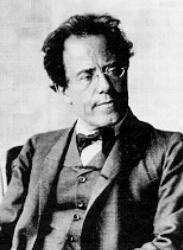
Could it be Mahler?
If it did return in this way, needless to say, I would welcome it as triumphantly as the heir of Elendil was welcomed to the empty throne of Gondor. But now I’m not just passively waiting for it to return: I’m hunting. There's a part of me that wishes to wait for an unasked-for return, but I also think that now is the time it is needed. I haven’t hired a PI yet, but I have been searching near and far. I’ve burned through many of Mahler’s symphonies, mainly because one of his more famous portraits is somehow concordant with the sense I have of the mysterious symphony. (His expression: somewhere between an ironic grimace and a quietly proud smile. Or is that just me capitalizing on the vagueness of early photography?) I’ve seized on the archives of the St. Petersburg Philharmonic’s programs and have been checking every item they performed for June 2010. Nothing like what I remember yet. Maybe it wasn’t the Philharmonic. Maybe I’m looking up works with similar names but vastly different content. (If someone thinks they have a lead on this, let me know!)

Maybe I’ll never find it. Maybe it’s not even as beautiful as I remember. Maybe it was a dream. One thing’s for certain, though: I’ll probably never let that memory rest, and eventually, it may become a nucleus for something very different from what actually happened. Does that make it less important?